By Tom Ozimek
Contributing Writer
Vice President JD Vance on Thursday said that the U.S. military has begun lifting its naval blockade of Iran, allowing more than a dozen ships to reach Iranian ports as part of a war-ending agreement signed between Washington and Tehran.
Speaking during a White House briefing, Vance said U.S. Central Command had allowed “north of a dozen ships” to pass and that more than 12.5 million barrels of oil moved through the Strait of Hormuz overnight, describing the developments as early evidence that both sides were implementing the agreement.
“So we’re also honoring our end of the early part of the agreement on the military side,” Vance said.
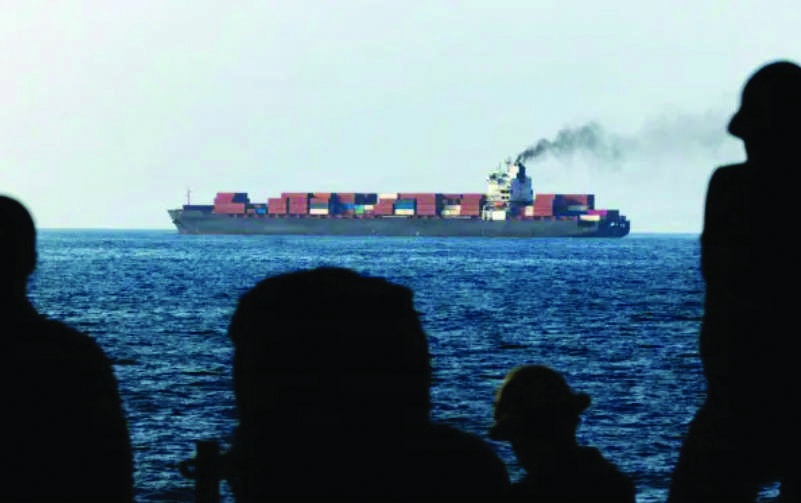
Maritime tracking data appeared to support Vance’s assessment, with shipping intelligence firms reporting a sharp increase in vessel movements through the Strait of Hormuz less than 24 hours after U.S. President Donald Trump and Iranian President Masoud Pezeshkian signed a memorandum of understanding aimed at ending the conflict.
Windward, a maritime intelligence company, said on Thursday that seven vessels stranded for 109 days since the war began were now underway, while Lloyd’s List Intelligence reported at least 14 transits through the strait on Thursday, up from just two on the same day last week.
Early Signs of Confidence
Speaking during a Windward-hosted livestream on Thursday, senior maritime intelligence analyst Michelle Wiese Bockmann said the first vessels departing the Gulf appeared to reflect growing confidence among shipowners that the agreement would hold.
Among the vessels she identified were a French-controlled LNG carrier bound for Pakistan, a Hong Kong-flagged tanker controlled by China’s state-owned COSCO group, an Italian-flagged vehicle carrier, a Hong Kong-flagged bulk carrier, and a Japanese-controlled very large crude carrier.
“We’re looking at what’s important now, which is what’s going out,” Bockmann said. “It’s going to start as a trickle, but certainly this is a very good sign, an early sign that there is confidence for outbound transits.”
Lloyd’s List Intelligence reported that at least 14 transits through the Strait of Hormuz had been recorded on Thursday, compared with just two on the same day a week earlier.
Lloyd’s said vessels controlled by some of the world’s largest shipping groups, including Italy’s Grimaldi Group, China’s COSCO and Japan’s NYK, had begun leaving the Gulf.
Reuters ship-tracking analysis showed three Saudi-flagged Bahri supertankers carrying about 6 million barrels of crude oil transited the strait hours after the agreement was signed.
The tankers had previously concealed portions of their voyages by switching off transponders during the conflict.
Lloyd’s List Editor-in-Chief Richard Meade said in a note that the key indicator would not be full tankers leaving the Gulf but empty vessels returning to load fresh cargos.
“Moving laden tankers out of the Middle East Gulf is cosmetic in terms of oil market accounting,” Meade wrote Thursday. “The real signal will be empty tankers heading in.”
Kpler said that a QatarEnergy LNG carrier had returned to Ras Laffan and loaded more than 209,000 cubic meters of LNG, becoming the first known QatarEnergy-chartered vessel to re-enter the Gulf for reloading since war-related shipping disruptions began.
Shipping through the strait “is being closely watched by traders and shipowners as an early indicator of improving confidence in the region’s most critical energy corridor,” Kpler analysts wrote in a Thursday post on X, while citing “growing expectations” that shipping flows through the Strait of Hormuz could normalize thanks to the diplomatic breakthrough.
Agreement Reopens Energy Corridor
The 14-point memorandum signed by Trump and Pezeshkian establishes a 60-day negotiating period during which military operations are suspended, and commercial vessels are guaranteed safe passage through the Strait of Hormuz.
The agreement also allows Iran to immediately resume oil exports and grants sanctions waivers covering banking, transportation, insurance and shipping services necessary to support those sales.
Iranian officials said implementation had already begun.
“Our monitoring shows that our ships have entered and exited ports without any problems,” Iranian Foreign Ministry spokesman Esmail Baghaei said on Thursday, according to state-affiliated news outlet Mehr.
The memorandum calls for traffic through the strait to return to full capacity within 30 days as the United States phases out its naval blockade of Iranian ports, while negotiators seek a broader agreement covering outstanding disputes such as broader sanctions relief and Iran’s nuclear program.
The initial moves toward reopening the Strait of Hormuz have already had a significant impact on energy markets.
Brent crude fell below $78 a barrel on Thursday for the first time since the opening days of the war as traders priced in the return of Iranian oil exports and the release of millions of barrels stranded in the region.
Despite the increase in vessel movements, industry officials have cautioned that a full normalization of shipping and energy flows could take months.
“There are some 550 merchant ships of above 10,000 [deadweight tons] that will need to be prepared to exit the Middle East Gulf,” Lloyd’s said in a note, including roughly 160 tankers, 200 bulk carriers, 60 container ships and 10 vehicle carriers.
INTERTANKO, which represents independent tanker owners, said shipowners still needed assurances regarding mine clearance operations and freedom of navigation before large-scale transits resumed.
“Some ships will, of course, start to move. That will be natural,” INTERTANKO Managing Director Tim Wilkins said.
Besides assurances regarding mine threat removal, more clarity is also needed “around sanctions, terrorism legislation and toll payments,” Lloyd’s Market Association CEO Sheila Cameron said on Thursday.
“The road to recovery in the Gulf will be a long and complicated one,” said Cameron, whose association represents the interests of all underwriting businesses in the Lloyd’s of London insurance market.
“It will take months for some sort of normality to return to international shipping with vessels in the wrong place and supply chains distorted.”
Reuters contributed to this report.