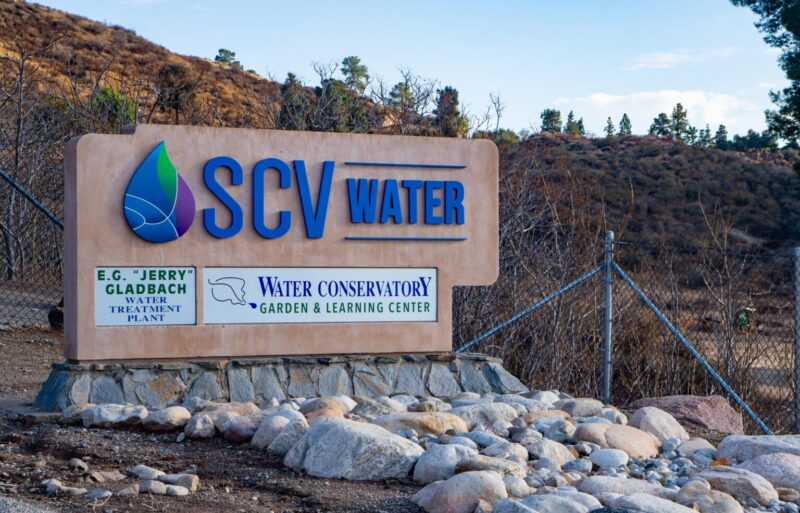
The Santa Clarita Valley Water Agency hosted a webinar, “Water Matters,” to give community members the opportunity to hear information on the 2026 Consumer Confidence Report and ask questions on Wednesday evening.
The presentation discussed water quality monitoring, water analysis, tackling groundwater contamination from PFAS (per- and polyfluoroalkyl substances, commonly known as forever chemicals), and more.
Jenny Anderson, senior water quality specialist for SCV Water, said that where SCV’s water comes from is important for the community.
“Also required (in the Consumer Confidence Report) is where our water comes from. So, this goes over our groundwater … (and) our import water, which is the Castaic Lake, recycled water, and any stored water, or banked water that we may have in the Bakersfield area,” Anderson said.
Anderson added that some calls SCV Water receives include resident questions about hard versus soft water and whether that is a problem for consumption.
“‘So, is my water hard? Does it mean it’s unsafe?’ The answer is no, absolutely not. All it means is that you have a higher quantity of calcium and magnesium. And think about it this way: A lot of times, people want some minerals, and they use dietary supplements,” Anderson said. “It is in our drinking water. It is not a health concern. More or less, it becomes more of an aesthetic issue.”
She used examples like spots on dishes or deposits on faucets.
Anderson also discussed the PFAS chemicals and how the agency tackles them.
She said between the years 2013 and 2015, the U.S. Environmental Protection Agency required water agencies to sample for certain PFAS constituents as part of an unregulated containment monitoring rule for PFAS sampling.
“Fortunately, SCV Water has been taking a very proactive approach. We were the first ion exchange treatment for PFAS in the state of California,” Anderson said. “As of right now, we currently have four PFAS treatment facilities online, and we have numerous PFAS treatment projects in planning, design and in construction. And then, just again, we do in-house testing for PFAS, and we are accepted through the California (Environmental) Lab.”
After the presentation, attendees on the Zoom meeting were able to participate in a Q&A session with Anderson.
In response to a resident’s question, Anderson said that local groundwater wells are being consistently treated for PFAS chemicals.
She added that consumers do not need extra filtration systems at home because the water supply meets federal and state regulations.
“For the ion exchange treatment facility, our goal, our operational goal, is to have it below a non-detect. So, what is detectable within the laboratory instrument? Which is, I believe, two parts per trillion,” Anderson said when asked what quantity of PFAS chemicals have been eliminated. “Thanks to our scale presentations earlier, you know that that is quite a small amount. So, we can never quantifiably just say that there’s zero, but we can only know as confidently as what a laboratory instrument can test for. And so that would be below two parts per day.”