By Matthew Vadum
Contributing Writer
The U.S. Supreme Court issued an order Monday allowing construction of President Donald Trump’s White House ballroom project to continue while the administration contests a lower court order that would block much of the development.
The justices voted 5-4 to grant the federal government’s request to stay a lower court’s order halting above-ground construction of the ballroom while a lawsuit against the project by a historic preservation group plays out.
The majority said the plaintiff in the underlying lawsuit, the National Trust for Historic Preservation in the United States, appeared to lack standing, or the right to bring a lawsuit. The majority said the government also established it would probably “succeed on the merits of a significant legal question, that it would likely suffer irreparable harm without a stay.”
The majority also said this new ruling was not a final adjudication on “the legality of the government’s East Wing project,” and that the lawsuit continues in the lower courts.
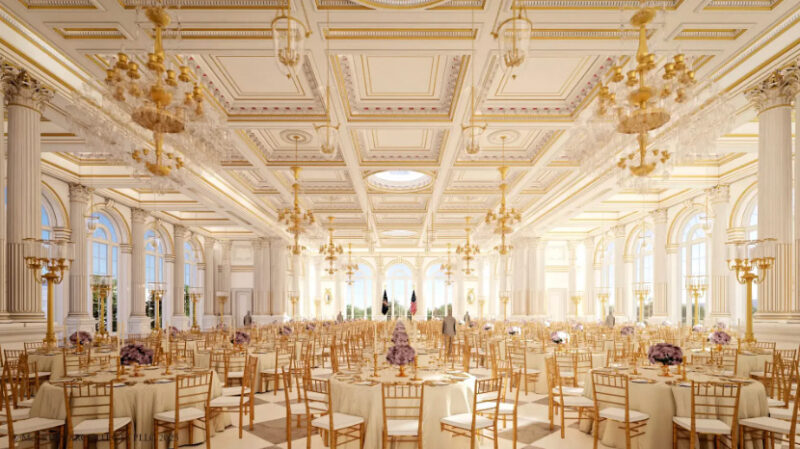
Construction on the project, which calls for building a 90,000-square-foot ballroom, began in September 2025. Building it required demolishing the East Wing, which Trump said was too small and in poor shape. The project is expected to cost about $400 million, all of which will be funded by private donors, according to the president.
A federal district court had blocked construction, and on Aug. 7, the U.S. Court of Appeals for the District of Columbia Circuit affirmed that ruling. The appeals court paused its ruling for 14 days to give the federal government an opportunity to appeal.
U.S. Solicitor General D. John Sauer said in a filing with the Supreme Court on Aug. 14 that the matter was of urgent importance because the federal district court’s preliminary injunction that would halt most above-ground work on the project was scheduled to take effect on Aug. 21.
The above-ground work includes the actual ballroom structure and a new East Wing building. The below-ground work, which was not blocked by the lower courts, includes a national security complex with bunkers, bomb shelters, and subterranean infrastructure related to continuity of government and presidential security.
Sauer said the D.C. Circuit erred in upholding the injunction, which “threatens the security and safety of the president of the United States” and “creates a needless interbranch collision.”
The overall project is 65% complete and has already passed the point at which major changes to the current design would be feasible, he said.
On Aug. 21, Chief Justice John Roberts had issued an administrative stay to give the justices more time to consider the government’s emergency application to allow construction to continue.
But Roberts, along with Justices Sonia Sotomayor, Elena Kagan and Ketanji Brown Jackson, dissented from the new, unsigned order, saying the construction of the project “is likely unlawful.”
“Congress has explicitly prohibited the construction of any ‘building or structure … on any reservation, park, or public grounds of the Federal Government in the District of Columbia without express authority of Congress.’”
“Congress has not passed any law resembling ‘express authority’ for the executive’s construction of it,” Roberts said.
The National Trust and the Department of Justice did not respond to requests for comment by publication time.