Customer journey optimization helps you understand, refine, and improve every interaction a customer has with your brand. It combines analytics, automation, and real-time personalization to increase satisfaction and loyalty.
Moreover, studies show that 73% of consumers consider experience a primary factor in purchase decisions, second only to price and quality.
In this guide, we’ll show you how to apply 7 proven strategies to create seamless and rewarding journeys for your customers.
What Is Customer Journey Optimization?
Customer journey optimization is the process of analyzing, improving, and managing every stage of the customer journey to create a seamless and satisfying experience. It connects marketing, sales, and customer service data to understand how customers interact across multiple touchpoints. Many businesses rely on the best customer journey mapping tools, such as FullStory, to visualize behavior patterns and uncover friction points that affect satisfaction. Using customer journey analytics and feedback, you can identify where improvements deliver the most impact.
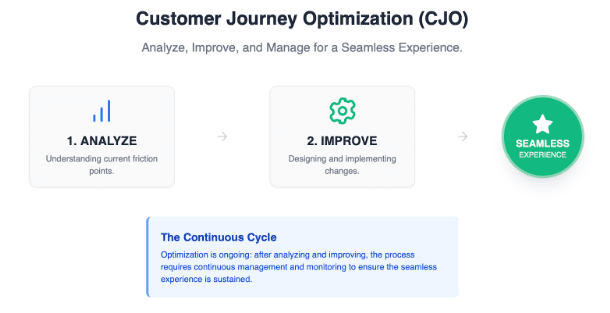
Speaking overall, optimizing the entire customer journey helps increase loyalty, raise conversion rates, and drive better business outcomes through consistent messaging and personalized experiences across all channels.
Why Optimize the Customer Journey?
Optimizing the customer journey helps your business understand how customers interact with your brand and identify areas that impact satisfaction or loyalty.
It’s simple: a strong customer journey optimization strategy will support better retention, higher conversion rates, and improved brand reputation. You’ll also gain valuable insights from customer data that reveal what drives engagement / frustration.
You should optimize the customer journey to:
- Improve customer satisfaction and build long-term loyalty.
- Identify and resolve customer pain points that reduce conversions.
- Increase customer retention through consistent and personalized experiences.
- Align sales, marketing, and customer support around shared performance metrics.
- Strengthen decision-making using customer journey analytics and measurable outcomes.
💡Key insight: A focused journey optimization process helps your business meet customer expectations, deliver seamless interactions, and gain a competitive advantage in the market.
5 Core Stages You’ll Want to Optimize
Customer journey optimization covers every phase of how customers interact with your brand, from first contact to repeat purchases.
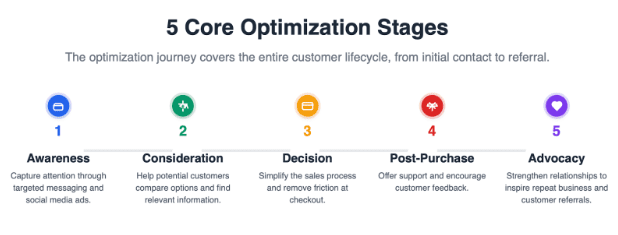
Each stage influences customer satisfaction, loyalty, and long-term retention. When you analyze and improve these stages, you gain valuable insights into customer behavior and can adapt your strategy to meet expectations more effectively.
You should focus your optimization efforts on 5 main stages:
- Awareness. Capture attention through targeted messaging and social media ads.
- Consideration. Help potential customers compare options and find relevant information.
- Decision. Simplify the sales process and remove friction at checkout.
- Post-Purchase. Offer post purchase support and encourage customer feedback.
- Advocacy. Strengthen relationships to inspire repeat business and customer referrals.
7 Strategies for Customer Journey Optimization
So, what are the most effective ways to optimize your customer journey?
Let’s go through the top 7 strategies that can help you refine how customers interact with your brand, improve satisfaction, and build lasting loyalty.
1. Personalize every customer touchpoint
Personalization lets you tailor every interaction to match customer needs and preferences.
Use customer data from your CRM, website analytics, and purchase history to deliver relevant offers and messages. Instead of showing the same content to everyone, adapt your communication for each stage of the customer lifecycle.
You can:
- Recommend products based on browsing or purchase behavior.
- Send personalized emails that adjust to customer interests.
- Display different website banners for returning visitors.
When you personalize your customer journey, you create relevant experiences that increase conversion rates and strengthen customer loyalty.
2. Connect channels for a unified experience
Omnichannel integration connects all customer touchpoints (digital and physical) into one continuous experience.
Customers often switch between your website, mobile app, social media, and physical store before deciding to buy. Use customer journey analytics and data synchronization to maintain consistency across those channels.
For this strategy, you should:
- Integrate live chat, instant messaging, and email into one support platform.
- Use analytics tools to monitor performance and identify gaps.
- Keep your tone, visuals, and promotions consistent across all platforms.
A unified customer journey will help reduce friction, improve customer satisfaction, and support repeat business.

3. Segment audiences and map their journeys
Segmentation and journey mapping help you understand how different customer segments move through your sales process.
Start by grouping customers based on demographics, intent, or purchase behavior. Then, use a customer journey map to visualize steps customers take from initial awareness to post purchase support.
You can:
- Detect customer pain points that lead to drop-offs.
- Identify opportunities to engage with customers before frustration builds.
- Adjust campaigns and experiences for each segment.
When you manage segmentation and mapping together, you gain valuable insights that improve decision-making and lead to a seamless and satisfying experience across the entire customer journey.
4. Engage customers (proactively!)
The next strategy focuses on proactive engagement – anticipating customer needs instead of reacting after problems occur.
Use customer journey analytics and behavioral triggers to predict when customers need help or information.
For instance, send automated reminders to users who abandon their carts or follow up with customers after a support interaction to confirm satisfaction.
You can:
- Set up predictive alerts that identify when customers might churn.
- Offer instant assistance through chatbots or live chat before frustration builds.
- Trigger personalized messages when customers hesitate during checkout.
Proactive engagement will help your business strengthen customer success, reduce churn, and increase customer loyalty. When you act before issues arise, you show customers that their time and satisfaction matter.
5. Collect and act on continuous feedback
Continuous feedback keeps your customer journey optimization efforts relevant. Collect insights from surveys, customer feedback forms, social media mentions, and review platforms.
Analyze these inputs to understand where customer expectations are not met. Use that information to adjust your messaging, products, and support in real time.
You should:
- Combine quantitative data, such as Net Promoter Score, with qualitative feedback.
- Integrate feedback tools into email or post purchase support flows.
- Run small experiments to validate new ideas before scaling them.
A consistent feedback loop will allow you to identify customer pain points early and refine your strategy continuously. This ongoing process helps you stay aligned with evolving customer needs and maintain high customer satisfaction levels.
6. Measure and analyze journey performance
The next strategy involves measuring how well your customer journey performs.
Tracking performance metrics helps you identify what drives conversions and what causes drop-offs. Use customer journey analytics platforms to monitor every step – from awareness to repeat business.
You can:
- Measure conversion rates, customer effort scores, and retention levels.
- Evaluate which customer touchpoints perform best and need optimization.
- Compare performance across different customer segments or campaigns.
When you track the entire customer journey, you gain valuable insights into how customers behave and where improvements deliver the biggest impact. This data-driven process helps you focus resources on changes that lead to measurable business outcomes.
7. Adopt technology and innovation
The final strategy focuses on using technology to scale and refine your customer journey optimization efforts.
Modern platforms combine automation, analytics, and machine learning to help your business deliver faster, more personalized experiences.
Also, tools like CRM systems, CDPs, and AI chatbots can help you manage multiple touchpoints efficiently and improve customer interactions in real time.
You can:
- Use automation to send follow-up messages, confirmations, or post purchase support instantly.
- Apply machine learning models to predict customer behavior and personalize recommendations.
- Integrate analytics tools that track the performance of each stage in the journey.
Technology will give you the ability to connect data across channels, identify customer pain points, and act quickly.
So, when you adopt innovative systems, you create a consistent, seamless, and satisfying experience that improves customer satisfaction, retention, and long-term loyalty.
Wrapping Up
Customer journey optimization helps your business deliver consistent, personalized, and measurable experiences that improve satisfaction and loyalty.
Each strategy – from personalization to technology adoption – supports better performance across all customer touchpoints and strengthens your competitive position.
Key takeaways:
- Use customer journey analytics to identify and remove customer pain points.
- Collect customer feedback regularly to adapt to changing expectations.
- Integrate multiple channels for a seamless and satisfying experience.
- Apply automation and machine learning to personalize interactions and increase customer retention.
FAQs
1. What is customer journey optimization?
Customer journey optimization is the process of improving how customers interact with a brand across every touchpoint. It uses analytics, automation, and personalization to identify customer pain points and enhance satisfaction. Businesses apply customer journey analytics to map behavior, measure performance metrics, and refine marketing and sales processes. The goal is to create a seamless and satisfying experience that increases customer retention, conversion rates, and long-term loyalty.
2. Why is customer journey optimization important?
Customer journey optimization helps businesses meet customer expectations and improve overall performance. It reduces friction in the sales process, supports consistent messaging, and strengthens customer engagement. Research shows that companies focusing on customer experience achieve higher customer satisfaction and repeat business. Optimizing the entire customer journey also provides valuable insights that guide better business decisions and improve marketing ROI.
3. How can you measure the success of customer journey optimization?
You can measure success using performance metrics such as Net Promoter Score (NPS), Customer Effort Score (CES), conversion rates, and customer retention levels. Customer journey analytics tools help track how customers move through different touchpoints and where interactions occur. Businesses often monitor engagement duration, repeat purchases, and satisfaction scores to evaluate improvement. Continuous tracking allows you to identify areas that require further optimization and assess the impact of new strategies.
4. How does customer feedback influence journey optimization?
Customer feedback provides direct insight into satisfaction levels and pain points. Feedback collected through surveys, reviews, or social media helps identify where customers face friction. Businesses use this data to modify touchpoints, adjust messaging, and enhance post purchase support. Integrating feedback into journey optimization ensures that strategies stay aligned with evolving customer needs and deliver measurable improvements in experience quality.
5. How does customer journey mapping fit into optimization?
Customer journey mapping visualizes how customers interact with your brand through each stage of the lifecycle – from initial awareness to repeat purchases. It identifies decision points, emotional responses, and pain points across channels. When used in customer journey optimization, these maps guide businesses in prioritizing improvements and aligning internal teams around a single view of the customer.
6. What are the main benefits of customer journey optimization for your business?
Customer journey optimization increases customer satisfaction, strengthens loyalty, and drives higher revenue. It helps you deliver personalized experiences, maintain consistent messaging, and identify opportunities for repeat business. The process also enhances employee engagement, improves brand reputation, and supports sustainable growth through better customer success management.