By Jack Phillips
Contributing Writer
A judge ruled on Monday that the man accused of assassinating conservative commentator Charlie Kirk last month can appear in civilian clothing during all pre-trial hearings.
Attorneys for Tyler Robinson, 22, argued that the extensive media coverage of his case could cause prejudice among the jury due to courtroom footage of him appearing in jail garb and in restraints. But prosecutors said that jail clothing assists with safety and identification.
In a hearing on Monday, Utah State Court Judge Tony Graf sided with Robinson’s attorneys and allowed him to wear civilian clothing, but denied Robinson’s request to not wear restraints due to the extraordinary nature of the charges against him. Media outlets are prohibited from photographing or recording Robinson while in restraints, the judge also ruled.
Robinson is facing capital murder charges in the Kirk shooting, which occurred on Sept. 10 at Utah Valley University, where Kirk had been speaking at a student event.
In their petition earlier this month, Robinson’s attorneys asked the judge for permission for their client to appear in person in court without restraints and in civilian clothes in order to protect his right to a fair trial. His attorneys had noted that a similar motion was granted in the trial of Bryan Kohberger, who was sentenced to life in prison in July for the murders of four University of Idaho college students in 2022.
“With each development in the case generating thousands of articles and comments online, the likelihood of potential jurors seeing and drawing conclusions regarding Mr. Robinson’s guilt and/or deserved punishment from obvious signs of pretrial incarceration will only increase,” his attorneys, who are led by public defender Kathryn Nester, wrote in a court motion filed on Oct. 9.
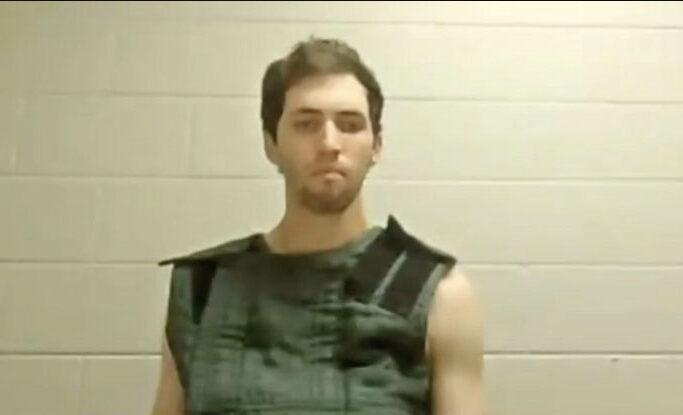
Because of the “pervasive media coverage in this case,” displaying images of Robinson in shackles, jail garb, and a suicide vest could “undoubtedly be viewed by prospective jurors and will inevitably lead to prospective juror perception that he is guilty and deserving of death.”
During his first court appearance in mid-September, Robinson was seen wearing the vest and a jail uniform as he appeared remotely before the judge.
“In the modern age of ubiquitous internet access and unrelenting media attention to high-profile criminal cases,” Robinson’s attorneys told the judge, “the prejudicial effect of a criminal defendant appearing in shackles, jail attire, and bulletproof or suicide vests at any hearing threatens fundamental fairness.”
The Utah County Sheriff’s Office and prosecutors, in trying to counter the defense’s claims, had argued that the issue could be resolved by having Robinson appear remotely for noncritical hearings, according to Graf in Monday’s hearing.
Prosecutors and Utah Gov. Spencer Cox have said that Robinson likely acted alone, while saying that family members told officials that he had become more leftist in recent years.
Bullets that were recovered in the case allegedly contained “anti-fascist” messages, state officials said after Robinson’s arrest last month.