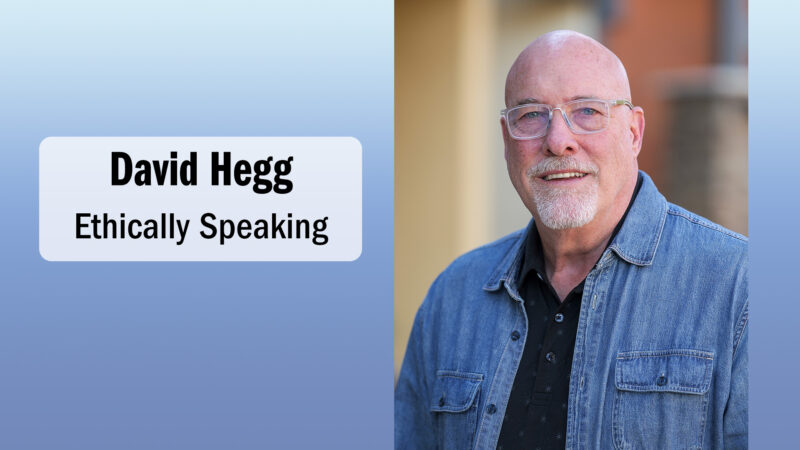
By David Hegg
Have you ever noticed no one has to teach a child to lie? Lies seem to be part of the natural expression of the human heart, and as we age, we become more adept at lying. “Are you almost done with that project?”
“Uh, yes, uh, I’m just putting the finishing touches on it.” But the truth is you’ve forgotten all about it, and now need to hustle to align your reality with your lie. We all do it, and we all do it for reasons whose ugliness is only surpassed by the ethical necessity of looking at them and learning how to push them out of our lives.
Lying is a common practice. We’re told 95% of all Americans lie at least twice a day, and the other 5% — you guessed it — lie about it! We lie about inconsequential things, but they are still lies. When asked if we’ve read that new book or heard the latest business news, we want to be considered “in the know,” so we respond with a slightly nuanced “yes.” But the nuance is just the coat our lie wears to go undetected. We lie by exaggerating, we lie when we fabricate statistics (like the spurious one at the top of this paragraph), and we lie by selling half-truths as whole truths. If you doubt it, try keeping track of all the times you are tempted to lie tomorrow, and all the times you actually give in to temptation.
However, my intention is not to discuss whether we lie or what constitutes a lie. I want to explore the “why” behind the lie. I can’t speak for everyone, so I’ll speak for myself. When I find I have intentionally shaved the edges off the truth, it is mainly because I don’t want to look bad. In fact, I want to look good and escape whatever embarrassment I would feel if the truth were known.
There are lots of other reasons we lie. However, all lies are ultimately rooted in the human characteristic of self-interest. Lies in all their forms are the fruit of pride. Pride lies at the root of so many hurtful attitudes and actions. However, pride is not an inherent source. Instead, pride requires constant nourishment, and the nutrients that fuel and sustain it are readily available.
Our society is pride-enhancing. We have become dependent on adulation, recognition and the compliments we believe we deserve. They become ingredients in the care and feeding of our pride. Labeled self-esteem, or confidence, or whatever you want, pride continues to permeate our lives, often to our detriment. Pride keeps us from acknowledging our weaknesses, shortcomings, failures and fears. It keeps us from asking for help, seeking the best of others, and championing another’s success. But most of all, pride is constantly singing in our souls a siren song that addicts us to our own significance, to a relentless pursuit of reputation, even at the expense of character. More to the point, pride is deceit’s public relations agent, telling us that lying is in our best interest and a valuable tool in the battle for success and personal well-being.
A good friend, Alistair Begg, once told me after a public speaking engagement, “Compliments are like perfume; a little is nice, but you don’t want to drink it.” I’ve never forgotten that, and have taken it to heart many times.
What it comes down to is this: If you want to fight pride, you have to speak the truth about yourself, to yourself, consistently. Pride will tell you you’re something that you’re not, and then pride will move you to believe it. But honest self-talk can short-circuit the process. We must speak the truth to ourselves to be the authentic people our world so desperately needs.
An ancient document speaks powerfully to this issue. David, the King of Israel, posed an eternally relevant question in Psalm 15: Who gets to live in the presence of God? He gave several answers, but chief among them was this: He who walks with integrity, and works righteousness, and speaks truth in his heart. Notice it doesn’t say “speaks truth from his heart” but “to his heart.”
Ethical living is dependent on real virtue, taking control of life from within. When we speak truth to ourselves, we prefer authenticity over hypocrisy, life’s reality over pride’s facade. And speaking truth to our hearts will make it easier to do so everywhere else.
Local resident David Hegg is senior pastor of Grace Baptist Church. “Ethically Speaking” appears Sundays.