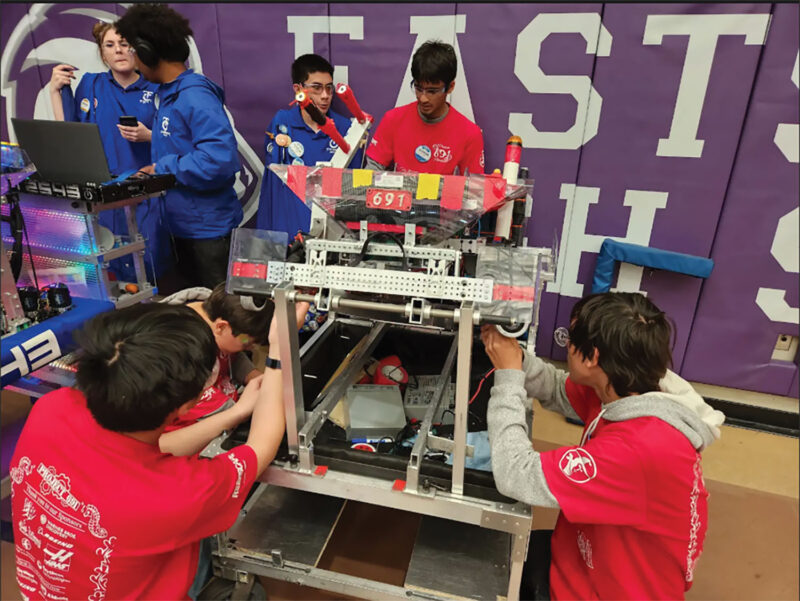
Building youth confidence in the fundamentals of robotics is exactly what Academy of the Canyons students Shreyas Hingarh, Gautham Korrapati, along with West Ranch student Matthew Poberezhskiy, sought to do.
Being a part of West Ranch High School’s Project 691 Robotics team, the 16-year-old students decided to start Learn & Launch Robotics, a free initiative designed to teach younger kids the essentials of robotics.
Collaborating with Old Town Newhall Library, the high school juniors launched the project in fall of 2025, from Sept. 29 to Nov. 10, with the next six-week session starting on Feb. 2.
“We participate in the FIRST Robotics Competition, which is a really big competition worldwide, and it brings together a lot of different people, students and mentors to assemble these robots. We rely on a lot of donations from our community, and one way we try to give back is through engaging with the community,” Hingarh said. “This year we started through two programs: one at the Newhall Library, the other at the Boys & Girls Club.”
The incentive of Learn & Launch was to familiarize students who fall in the middle school range and gear them for future opportunities in STEM subjects: science, technology, engineering and math.
“We wanted to work with kids who are interested in STEM, like robotics and programming, and could grow to also join our team in the future. The program is designed for sixth to eighth graders, but we do have leniency and we let in fifth graders, too,” Poberezhskiy said. “We try to give them the tools to learn how to program in different languages and how to work with robots and simple electrical circuits.”
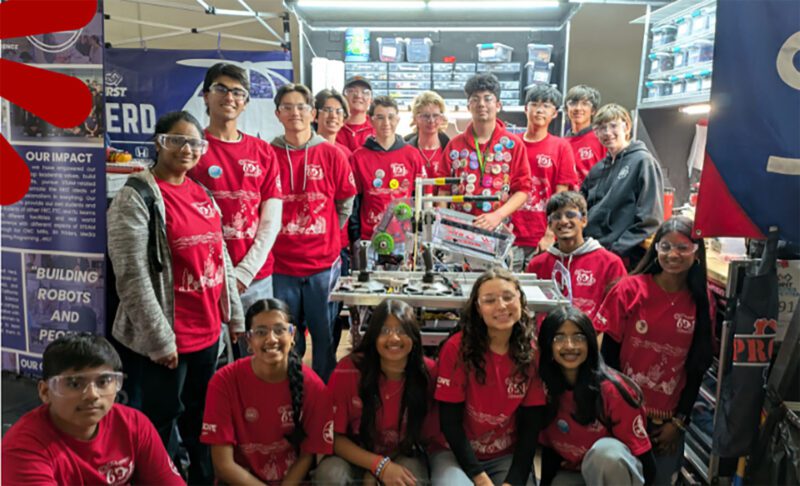
The students began planning for the project in the summer, seeing a need to bridge a gap between the knowledge younger students had and the standard of high school robotics.
“The biggest thing is that for elementary and middle schools, there’s another first competition called FIRST Lego League, which deals a lot more with Legos and being able to construct them. But the problem is that it doesn’t help you prepare much for high school robotics. It’s block programming, and a lot of what we deal with is more at the hardware level, which is what we try to [incorporate at Learn & Launch],” Korrapati said.
Hingarh, Korrapati and Poberezhskiy took the time to make sure a curriculum was properly designed, making slideshows and ensuring that it was interactive and fun for the students for the hour-long meeting every Monday of the program.
“We’ve made a lot of analogies to the real world, especially in the age of AI, and how prevalent it is in the job market and what a useful skill programming is. Then we moved onto working with Dash and Dot robots, which are pre-made robots. We taught them how to program and what different sensors are,” Poberezhskiy said. “There’d be a new obstacle course to try and get the robot through. Every day, we would teach them some new skills to try and expand their knowledge.”
Competitions were held, before ending the course with complex modules and programming languages.
“Moving forward, we’re planning to try and go down the electronic route. We’ll have them assemble the robot from scratch, so that way they’re able to see how each component goes together, and how all the electronics go together. Most importantly, what we’re trying to do is teach them how to problem solve and think about problems as a whole. We may see them struggle, but they’ll also succeed,” Korrapati said.
Encouraging their younger peers to prosper, the trio discussed what they individually think makes a great programmer:
“For me, it’s being able to learn from your mistakes and continue learning more things as you progress, and then being able to communicate what you’re doing and being able to work in a team. Being able to communicate where you’re having troubles is a huge part of being able to also ask for help when you need it,” Hingarh said.
“I think there are two main things that make a great programmer,” Korrapati said. “One of them is being able to learn quickly, which comes down to whether you’re able to break down specific ideas and concepts and be able to apply them to different situations. I think the other thing is being able to learn from your failures. Being able to take it not emotionally, but rather logically.”
“I think what makes a great programmer is somebody who learns from their mistakes,” Poberezhskiy said. “That was a theme we tried to impart on the kids. For example, in those obstacle courses that we did, everybody failed in the beginning. You just have to accept the loss. If you have the willingness to learn, you’re going to be OK with failing, and you’re going to learn from those mistakes.”
To register for the six-week Learn & Launch Robotics session, visit tinyurl.com/4pjjamdf.