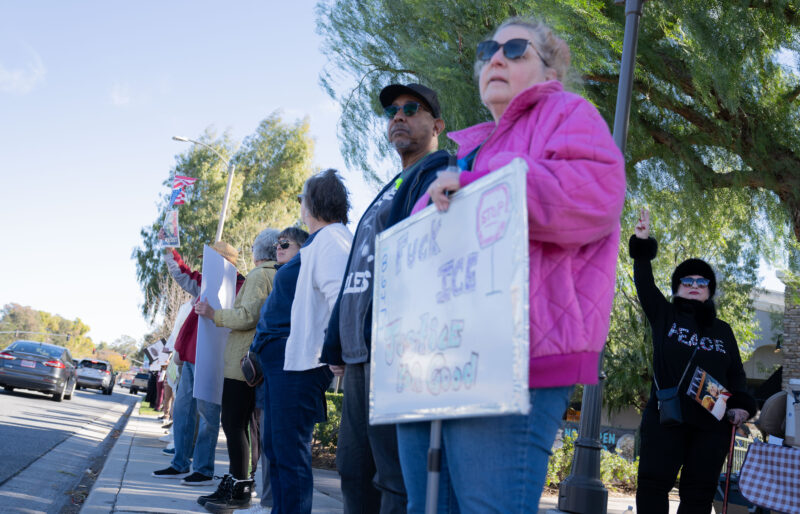
Protesters lined the intersection of McBean Parkway and Valencia Boulevard Saturday in a showing that’s become semi-regular since President Donald Trump’s reelection.
The incident that motivated many protesters to join the crowd that morning was just three days old: Minneapolis resident Renee Good’s death at the hands of Immigration, Customs and Enforcement agent Jonathan Ross.
About 200 protesters carried signs and flags referencing a suite of grievances against the Trump administration, many referencing Good’s death. May Day Strong had put out a press release Thursday calling for protests objection to “illegal occupation of Venezuela and the deadly ICE occupation of our cities” and the Santa Clarita location was listed as one of 15 in California.
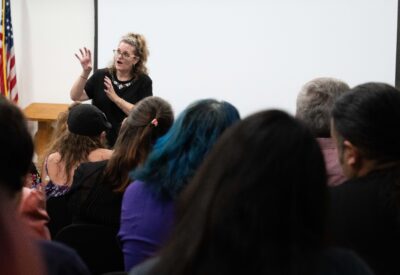
It was a smaller turnout than anti-Trump administration protests in Santa Clarita in the past, particularly June’s “No Kings” protest, said history professor Chief Elliott Sidnam.
“I think it’s smaller because it’s such short notice, and I fear that a lot of us are becoming – we’re still in a state of shock and numbness,” Sidnam said.
Sidnam was holding a sign displaying a V, a symbol Sidnam said had historical anti-fascist significance.
“V for Victory goes back to World War II and the allies against Nazis and fascism, right? And we feel that here we are again,” Sidnam said. “My grandfather fought fascists in World War II in Italy. I never thought in a million years – neither did he – that we’d get back here again.”
Other protesters, including families and couples, expressed similar sentiments when asked why they’d come to the Saturday demonstration. Santa Clarita Valley resident Miriam Lipner-Brineik, attending with her husband Salvatore Brineik, was critical of what she described as blatant federal overreach.
“I’m here because I don’t like the direction this country is heading. And it scares me to see correlations between what this country is doing now and in the 1930s Germany. I do know it’s not the same thing, but I do know it’s a similar playbook,” Lipner-Brineik said.
Brineik said that he believed it was important for people to participate in the process of political reform – and that doesn’t necessarily mean personally overhauling the system.
“You don’t need to change everything, but be a part of that change,” Brineik said.