Local and state officials this week labeled the first snowpack measurement as “welcome news,” with several late-December storms resulting in statewide snow levels that reached 71% of the average for this time of year.
Santa Clarita Valley Water Agency officials said the numbers will be watched throughout the spring, which is when the state determines the amount available for the local agency.
“Recent Sierra Nevada snowpack measurements show improvement from early-season storms, supporting a more stable outlook for State Water Project supplies that SCV Water relies on,” wrote Ali Elhassan, director of water resources for SCV Water, in an email via agency spokesman Kevin Strauss on Wednesday. “While snowpack remains below the long-term average, and final allocations will depend on conditions through the spring, SCV Water’s diverse water supply portfolio positions the agency to meet anticipated water supply needs for the coming year.”
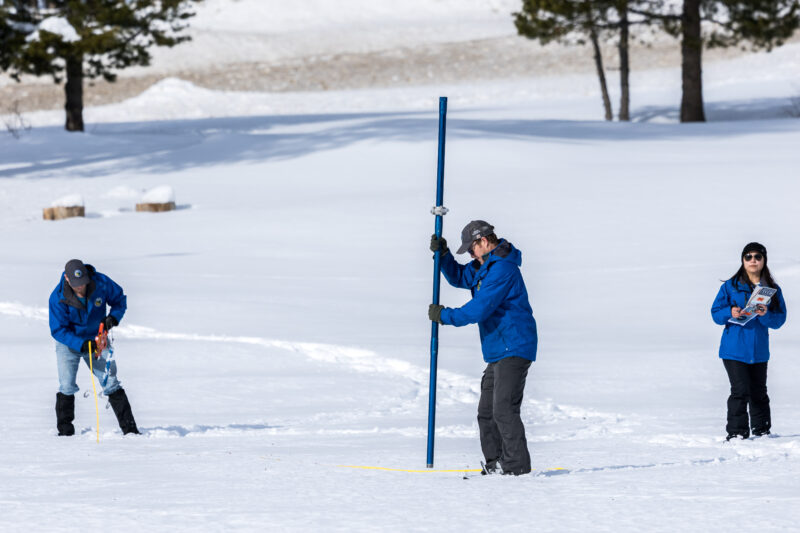
The manual survey recorded 24 inches of snow depth and a snow-water equivalent of 5 inches, which is 50% of average for the Sierra Nevada location where measurements are taken. The snow-water equivalent measures the amount of water contained in the snowpack and is a key component of DWR’s water supply forecast.
“Today’s results are welcome news for water managers who rely on the statewide snow surveys to make water supply decisions for the year ahead,” according to an emailed statement Monday from Jason Ince, a public affairs officer with the Department of Water Resources. ”California’s statewide snowpack had been lacking in early December with above-average temperatures and very little storm activity.”
Strauss has said previously that the snowpack has a direct correlation to the state’s allocation, which in turn can impact the SCV Water’s available supplies.
SCV Water officials have said about half of the SCV’s water supply is local, while the other half comes from imported sources like the State Water Project, via Castaic Lake, which is a southern terminus of the SWP.
The state’s Department of Water Resources announced an initial State Water Project allocation of 10% of requested supplies for the new water year after a Dec. 1 evaluation of the available sources. The water year starts Oct. 1.
Every year, the State Water Project uses factors like the snowpack measurement and other indicators to determine its annual available forecast of water available to local agencies.
The Dec. 1 figure represented twice the amount agencies were given at the start of the previous year, Strauss said in a statement last month, which also grew to 50% by the end of the year.
Strauss said the water planners took that as a good early sign.
“So as we prepare for future drier years, we’re not drawing down as many reserves, or we’re not taxing our local system,” he said in a previous statement, adding that means the agency can bank the water it is contractually obligated to purchase for future years.
These numbers from the state are part of the water-supply forecast for roughly 27 million Californians and 750,000 acres of farmland served by the State Water Project.