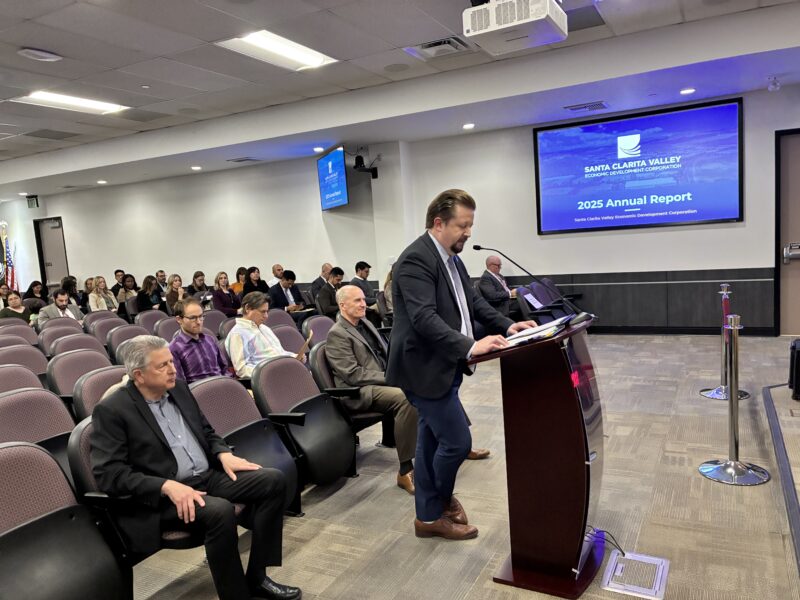
During a recent Santa Clarita City Council presentation, the CEO of the Santa Clarita Valley Economic Development Corp. said his organization’s role was a relatively simple one: “helping companies evaluate Santa Clarita as a place to start, grow and relocate their operations, while supporting the businesses that are already here.”
While Ondré Seltzer was summarizing a myriad of roles for the EDC, he also mentioned what he called challenges and opportunities in the evolving workplace, and discussed how the agency is attracting “target industries” through the EDC’s public-private partnership.
In a year-over-year comparison for the second quarters in 2024 and 2025, the city’s number of jobs grew by just under 1% in the final numbers, revising the early estimates given by the state.
The EDC works to make sure that, as much as possible, those jobs come in one of six clusters for the region, which local leaders have determined as desirable for the area: digital and media entertainment, including the filming and post-production at Santa Clarita Studios; aerospace and defense, e.g. Woodward; bioscience and medical devices, such as Boston Scientific; advanced manufacturing, a la DrinkPAK; company headquarters, like Logix, Sunkist and Vallarta; and information technology, like Troll Systems, which makes radio tracking data links.
Seltzer shared some of the strategies his organization uses, such as “sector engagement,” workforce resources and a task force of local businesses. He credited these examples from the EDC partnership with helping to raise the area’s median household income from $90,000 in 2010 to $139,000 in 2025, while growing the workforce by about 16,000 employees over that same time, based on EDC data.
The latest official numbers from the state indicate Santa Clarita ended the calendar year 2025 with just under 100,000 jobs, at 99,558, an increase of 964 over the same time the previous year.
Tyler Pledger, the city’s economic development manager, also shared data during the council meeting indicating a significant number of those were small businesses, as the city’s total number of businesses grew to 11,004 — an increase of more than 500 over the previous year’s figure (10,445).
Some of the effort has involved attracting neighbors from Palmdale (Crissair) or the Sylmar/San Fernando area, like Vallarta. Other strategies are newer or more nuanced, including the attraction of foreign direct investment and media strategies, like the new “Made in SCV” marketing campaign.
While the EDC’s job is to support these businesses, the March 10 discussion with council members focused on how and why that job is growing and evolving with prospective businesses’ needs.
Council members each had their own questions and curiosities about how the jobs marketplace was changing.
Mayor Pro Tem Patsy Ayala asked what strategies worked best in 2026 for workforce attraction, and Seltzer responded first by mentioning the organizations work with commercial real estate brokers looking for tenants, as well as networking at trade shows and networking at national site-selection conferences.
Team California serves a similar function as the EDC with a broader focus, he said, and those officials “have a lot of different businesses that they work with and help them make identifiable decisions on business locations nationally and internationally,” Seltzer said.
“When we are working with companies, we’ve got to address time to market, cost to market and workforce as the primary considerations,” he said. And for that reason, a majority of the EDC’s leads come from development partners and commercial brokers.
Councilman Jason Gibbs asked about the “headwinds” that Seltzer is seeing in the business world with respect to how employers are changing the workplace due to the growth of artificial intelligence. A recent Fortune article featured an in-depth analysis by an AI service, Anthropic, which contemplated a “Great Recession for white-collar workers,” due to AI. The AI-generated report also allows people to look up their position and see how likely it is the technology can replace them in the workforce.
“Over the 2023-33 employment projections period, AI is expected to primarily affect occupations whose core tasks can be most easily replicated by generative AI in its current form,” according to a U.S. Bureau of Labor Statistics report looking at jobs impacts from 2020 to 2033.
Insurance appraisers, claims adjusters and credit analysts were projected to be the most negatively impacted, while software developers, personal financial advisers and computer occupations are expected to see the biggest gains in that period.
“I would say a majority of our businesses currently are looking (at) automation solutions,” Seltzer said. That could mean layoffs, he said, which would impact how the organization looks at workforce development.
“In regard to AI, it is touching every single sector, every single industry and every single job at this point,” he said, but while there’s a concern about layoffs, “We recognize that that gives opportunities for businesses to be more competitive.”
Seltzer said when it comes to attracting businesses from out of state, one of the challenges he has is that the organization first has to win “the California argument,” which is the talk about the high cost of doing business in California, due to regulation and taxation. One of the main reasons the EDC hears “no,” he said, is that a CEO is ready to leave California altogether, which makes attraction or retention much harder.
A banner that welcomes visitors upon their first click to the Team California website — “Doing Business in California is Easier Than You Think” — seems to recognize the significance of that obstacle facing the EDC in terms of perception.
As far as in-state or regional competition, he said that areas just north of the SCV might have more developable land to market, but the SCV does have 2.7 million square feet of usable commercial/industrial space, and over the next five years, that figure is expected to grow to 8 million. He also said some cities are now offering grants and tax subsidies that can be in the six-figure range, which can add to the competition.
Seltzer said one of the goals of the EDC was developing “outside-the-box” solutions for how the organization and city can help drive down costs for businesses without spending that kind of money.
Councilman Bill Miranda thanked the EDC’s longtime leadership, including Calvin Hedman of Hedman Partners and Don Kimball of FivePoint.
Councilwoman Marsha McLean raised a basic existential concern about the push for automation.
“Don’t we need to keep humans in order to make sure AI is actually correct and is not leading down a path that can hurt rather than help?” she said.
Seltzer said everyone is grappling with these long-term impacts, as “they seem to be evolving daily.” He said it’s not just about making sure people have a job, but also a purpose and opportunity to “up-skill,” as he called it, or improve their career opportunities.
Mayor Laurene Weste asked about how these changing needs were being communicated with city leadership, especially when course correction is needed.
Seltzer said he works very closely on communicating business owners’ needs with Jason Crawford, the city’s director of community development, and City Manager Ken Striplin.
Refundable tax credits at the state level have been another big challenge in looking at the SCV from an external lens, but he said he was always available to work with the city.
Weste suggested more roundtable discussions with local businesses as a way to help.