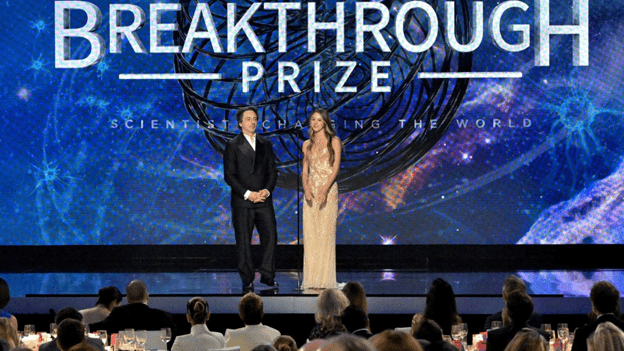
At the twelfth Breakthrough Prize ceremony last weekend, Yuri Milner’s prepared statement described this year’s laureates as people “building a cathedral of knowledge on foundations laid down by the giants who came before them. We owe our civilization — and its future — to them.”
The cathedral metaphor is not decorative. Cathedrals take centuries. No single architect sees one completed. The people who lay the foundations do so knowing they will never see the spires. That logic runs entirely counter to how most institutions, investors, and funding bodies operate — and it is a precise description of how fundamental science actually works. It is also the philosophy that has driven the Breakthrough Prize since Milner co-founded it fifteen years ago.
Fifteen Years, $340 Million
The twelfth ceremony brought the total past $340 million. Six prizes of $3 million each went to researchers in Life Sciences, Fundamental Physics, and Mathematics this year, for a combined $18.75 million. That total includes the Special Breakthrough Prize in Fundamental Physics awarded to David J. Gross — recognized for a lifetime of contributions spanning the strong nuclear force and string theory — and the inaugural Vera Rubin New Frontiers Prize, a $50,000 award expanding to three annual prizes from 2027.
Across fifteen years, Life Sciences awards have covered gene therapy for blindness and blood disorders, the genetic basis of ALS and frontotemporal dementia, the biology of how cells organize themselves, and immunotherapy approaches to cancer. Fundamental Physics prizes have gone to gravitational wave detection, the mathematics of string theory, the first image of a black hole, and now to the precision measurement of the muon’s anomalous magnetic moment. Mathematics prizes have recognized work spanning number theory, algebraic geometry, differential equations, and the mathematical behavior of wave systems.
The common thread: none of it was funded because it was immediately useful. Most of it became critically useful — medically, technologically, economically — years or decades after the foundational work was done.
The pattern repeats across the history of science often enough that it’s almost a rule. The mathematics of elliptic curves, developed by pure mathematicians with no application in mind, became the foundation of modern public-key cryptography. Research into the immune system’s response to foreign genetic material — the same mechanism CRISPR exploits — began as basic microbiology decades before anyone imagined using it to edit human DNA. The physicists who developed quantum mechanics in the early twentieth century were not trying to invent semiconductors. The semiconductors came anyway. What the Breakthrough Prize is betting on, consistently, is that the same pattern will hold — that the basic questions being answered today will underwrite technologies and medicines that don’t exist yet.
What the New Prize Tiers Argue
The Breakthrough Prize has added award categories over its history, and each addition makes an argument about something the original structure was missing. The New Horizons Prizes, $100,000 each, go to early-career researchers in Physics and Mathematics. The Maryam Mirzakhani New Frontiers Prize, $50,000 annually, goes to early-career women mathematicians within two years of their PhDs. The Vera Rubin New Frontiers Prize, announced at this year’s ceremony by Milner and NVIDIA CEO Jensen Huang, extends the same model to physics.
Mirzakhani died of cancer in 2017 at 40, a Breakthrough Prize laureate whose mathematical contributions transformed her field. Vera Rubin documented evidence for dark matter over decades of careful observation and died in 2016 without the Nobel Prize her work warranted. The prizes in their names are not honorifics. They are structural corrections — designed to reach researchers before institutional recognition does.
The Breakthrough Junior Challenge, another of Milner’s initiatives, pushes the pipeline logic further still, reaching teenagers before they’ve made any professional choices at all. The competition draws tens of thousands of entries from over 200 countries annually. The Eureka Manifesto, Milner’s book on humanity’s scientific mission, ties all of it together — the prizes, the pipeline, the ceremony itself — into a single argument about what a civilization that takes science seriously actually looks like.
What a Cathedral Actually Is
Notre-Dame de Paris took roughly 200 years to complete. Construction began around 1163. The main structure was largely finished by the mid-thirteenth century, but work continued for centuries after. Nobody who placed the foundation stones was alive to see the rose windows go in.
The hemoglobin genetics research that ultimately produced an approved gene-editing therapy for sickle cell disease began decades before CRISPR existed as a tool. Stuart Orkin, who shared this year’s Life Sciences prize, has been working on the underlying biology for fifty years. The therapy that reached patients did so because of foundations laid long before anyone could say what they would be used for.
That’s what $340 million across fifteen years of prizes is acknowledging. Not individual discoveries in isolation, but a process — knowledge accreting on knowledge, each generation working on foundations it didn’t lay and leaving foundations it won’t see used. The Breakthrough Initiatives run on the same logic. Breakthrough Listen, the largest program ever mounted to search for signals of extraterrestrial intelligence, has been scanning millions of stars for years. It is part of the same cathedral. Whether the spire gets finished in anyone’s current lifetime is, at this point, beside the point.
A cathedral isn’t useful until it’s finished. It’s never really finished. You build it anyway.