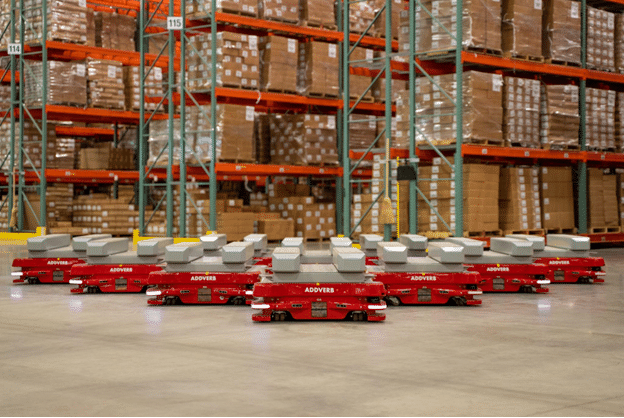
U.S. fulfillment centers are deploying more warehouse robotics to manage rising order volumes, shorter delivery windows, and increasingly complex fulfillment operations. But adding more robots does not automatically make a warehouse work better. The real advantage comes when these technologies can communicate with the systems already running the operation.
A warehouse management system connects robotics through a single control layer, allowing inventory decisions, warehouse execution, and material movement to work together in real time rather than as disconnected processes. According to a 2026 Modern Materials Handling software survey, 31% of respondents identified compatibility with existing systems as a challenge, while 29% cited integration with existing software applications as a challenge, highlighting the need for connected warehouse technologies rather than isolated automation systems.
70% of warehouses report technology gaps that prevent them from fully benefiting from captured operational data, demonstrating why stronger integration between WMS and warehouse robotics is becoming a business priority.
Why Is Connecting WMS with Robotics More Effective Than Optimizing Warehouse Technologies Individually?
A robot can be fast. A conveyor can move goods quickly. A storage system can work efficiently. But if each one is working toward a different priority, the warehouse can still fall behind. The warehouse management system connects inventory decisions with robotic execution, helping tasks follow what the fulfillment operation needs next.
A Deloitte Insights study found that over 55% of warehouses struggle to balance local efficiency with global coordination, creating operational disconnects that reduce overall warehouse performance.
Research from Supply Chain Digital indicates that implementing a data-driven, AI-powered warehouse system can reduce order fulfillment time by as much as 40%. This reduction is achieved by optimizing material flows throughout the facility, ensuring that resources are utilized in the most effective way possible.
For deeper insights, download Addverb’s whitepaper – Metrics that Matter for Automation Software.
The point is simple: improving one machine does not always improve the U.S. warehouse. When systems work together, an improvement in one area can support the next step instead of creating a new bottleneck.
How Does Connecting WMS with Robotics Improve Fulfillment Performance?
The biggest difference can be seen when a warehouse decision does not stop at a software screen. When the WMS communicates with robotics in real time, an inventory decision can trigger a task, a robot can execute the movement, and the system can update the operation without separate manual instructions. An automated warehouse control system can support this connection by coordinating robotic activity with the priorities and workflows defined by the WMS.
A leading eyewear brand achieved over 98% next-day delivery after implementing Addverb’s Warehouse Execution System (WES), demonstrating how connected warehouse software and automation improve fulfillment visibility and execution.
| Area | Robotics Operating Independently | Robotics Connected to WMS |
| Inventory | Updates can remain separate | Inventory information guides execution |
| Task allocation | Separate instructions | Current priorities guide tasks |
| Material movement | Robot-focused | Coordinated with workflows |
| Visibility | Limited across processes | Connected execution view |
| Fulfillment | Automation works in individual areas | Automation supports the wider operation |
Instead of asking whether a robot is performing well on its own, the better question is whether the entire fulfillment operation is moving toward the same goal.
How Does WMS-to-Robotics Connectivity Reduce Warehouse Bottlenecks?
A warehouse bottleneck rarely stays in one place. A receiving delay can affect storage. Storage delays can affect picking. Picking delays can eventually affect shipping. The warehouse management system can connect receiving information with robotic movement, so inventory is identified, prioritized, and moved according to operational needs.
A study conducted with a leading apparel retailer identified receiving as the largest warehouse bottleneck, with a 96-hour dock-to-stock time compared with the industry benchmark of 24 hours, while 8 hours is considered above average and a few hours represents world-class performance.
Connecting WMS with warehouse robotics in the USA reduces the manual coordination between these steps. It can support:
- Faster movement from receiving to storage: Inventory can be routed based on operational priorities.
- Better downstream availability: Products can reach the processes that need them sooner.
- Earlier bottleneck response: Delays can be addressed before they spread across fulfillment.
What Should Fulfillment Centers Evaluate Before Connecting WMS with Robotics?
Integration should start with the warehouse, not the robot. Before connecting systems, fulfillment centers in the USA need to understand how their layout, storage utilization, inventory accuracy, and existing technology will support the connection. The warehouse management system should fit the way work actually happens while leaving enough room for future automation.
According to World Class Warehousing and Material Handling, Honda’s warehouse operated at more than 98% storage utilization before implementing a new WMS, leaving insufficient room to relocate inventory and reconfigure storage, demonstrating why operational readiness is essential for successful WMS integration.
Before integration, fulfillment centers should evaluate:
- Warehouse layout and storage utilization
- Existing robot and software workflows
- Inventory accuracy and data quality
- Compatibility with current systems
The goal is not simply to connect more technology. It is to create an operation that can keep working smoothly as volumes, workflows, and automation needs change.
Addverb: Seamlessly Connecting WMS with Warehouse Robotics
Addverb enables WMS integration with warehouse robotics to synchronize inventory management, robotic task execution, and material movement through a connected warehouse automation environment. Its warehouse management system, Optimus, coordinates inbound and outbound logistics while providing real-time visibility into inventory levels, locations, and movements.
It also helps manage resources, balance workloads, identify bottlenecks through operational data, and adapt to changing site requirements. When paired with robotics, WMS helps turn warehouse decisions in the U.S. into coordinated actions on the floor.
Conclusion
Connecting WMS with warehouse robotics turns isolated automation technologies into a coordinated warehouse operation driven by real-time inventory and execution data. A unified control layer improves visibility, reduces bottlenecks, and supports faster, more accurate fulfillment while preparing facilities for future automation growth.
This changes the question from how many robots are deployed to how well the entire fulfillment operation works together. Addverb helps U.S. fulfillment centers connect WMS with warehouse robotics through an integrated software approach that enables synchronized, data-driven warehouse operations.