For most of Earth’s history, the continents were almost entirely dead. Not quiet, not sparse. Dead, apart from thin crusts of microbes. Wind scoured bare rock, ultraviolet light sterilized every exposed surface, and when rain fell it ran straight off into the sea because nothing was there to hold it. Life had been thriving in the oceans for billions of years by then. On land, there was nothing to eat, nothing to hide under, and no soil to stand in.
Then a plant a few centimeters tall stood upright, and the world began to change.
That moment opens “Onto Land,” Episode 6 of The Story of Life on Earth, an independent video series made as an homage to the British children’s author Martin Jenkins and his illustrated history of life, Life: The First Four Billion Years. The episode runs barely three minutes. In that time it moves from microbial crusts on Silurian rock to a fish with a wrist, and it ends by asking viewers to look at their own hands. What follows is a longer walk through the same ground.
Soil Before Plants, Plants Before Animals
The episode puts the first real landmark at around 433 million years ago. By then, microbial mats and simple mosses had spent a very long time doing slow, unglamorous work: breaking rock down, trapping dust, dying and decaying in place. The result was the planet’s first soil. Without it, nothing larger could root.
Cooksonia is the plant the episode chooses to stand up first, and it’s a good pick. Britannica describes it as one of the earliest known vascular land plants, a leafless, forking stem only about 6 centimeters tall, with a small spore capsule at the tip of each branch. It had no leaves and no roots. It photosynthesized through its stems. What it did have was plumbing, tissue that moved water up through the plant’s own body. Earlier land plants had to sit in damp places and soak water in from outside. Cooksonia carried its water inside itself.
The episode calls that “one trick,” and it frames everything after it as a consequence. Once a plant could hold water internally, it could grow taller without drying out. Taller plants competed for light, which rewarded leaves. Leaves demanded more water, which rewarded roots. Height demanded support, which rewarded wood. Within tens of millions of years, bare rock had become forest.
Animals came ashore behind the plants, because that’s where the food and the shade now were.
A Fish in the Weeds
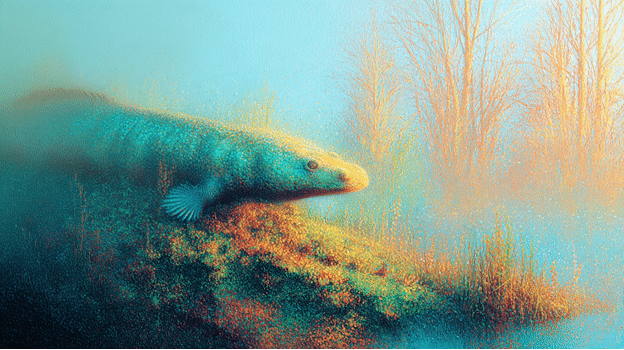
While forests spread across the land, something was changing in the shallow water at their edges. The Devonian shallows the episode describes were choked with plants and mud, a difficult place to swim. Some fish living there evolved unusually sturdy fins, built for shoving through vegetation and propping themselves up on the bottom. They weren’t built for walking. But inside those fins, the bones had begun to settle into a familiar pattern: one bone, then two, then a cluster of small ones. Shoulder, elbow, wrist.
In 2004, on Ellesmere Island in Canada’s high Arctic, a team found one of those fish. Tiktaalik roseae was dug out of the Fram Formation by a group led by Ted Daeschler of the Academy of Natural Sciences in Philadelphia, Neil Shubin of the University of Chicago, and Farish Jenkins of Harvard. The discovery is famous partly for how it was made. According to The Canadian Encyclopedia’s entry on Tiktaalik, the team chose the site by looking for rocks of the right age, formed in the right freshwater environment, in a region nobody had yet searched. They predicted where a fish on its way to becoming a land animal should be, and then they went there and found it.
Tiktaalik had scales and gills like a fish. It also had something no fish before it had: a neck. The bony connection that locks most fish heads to their shoulders was gone, so Tiktaalik could turn its head independently of its body. Its front fins held the same bones found in the arms and wrists of four-limbed animals, with joints that could flex.
The episode is careful here, and so are the scientists. Tiktaalik never truly walked. It was a fish that could prop itself up, probably an ambush predator waiting in the shallows. The first real walkers came later and were, in the episode’s words, slower and clumsier.
The First Walker Was a Millipede
The earliest confirmed land animal didn’t have a backbone at all.
Pneumodesmus newmani is a small, segmented, millipede-like creature found in 2004 by Mike Newman, an amateur fossil hunter, on the foreshore at Cowie near Stonehaven in Scotland. What makes it remarkable is a row of tiny holes down the side of its body. Those holes are spiracles, the openings insects and millipedes still use to breathe. As The Scottish Beacon reported, spiracles belong to a gas exchange system that only works in air. Whatever else Pneumodesmus did, it breathed the atmosphere.
Its age has been argued over. The fossil was originally dated to around 428 million years ago, in the late Silurian. A University of Texas team proposed in 2017 that the rocks were younger, closer to 414 million years old. Researchers from the universities of Aberdeen and Sheffield later reexamined the site and came down firmly on the side of the older date. They confirmed the Cowie rocks as one of the oldest known land ecosystems. For now, the tiny Scottish millipede holds the title.
Eight Fingers in Greenland
Back in the water, the four-limbed animals were experimenting.
In the Late Devonian rocks of East Greenland, the episode introduces two animals that sit near the root of every amphibian, reptile, bird and mammal alive today. Acanthostega paddled through the shallows on webbed limbs and still breathed with gills. Ichthyostega, sturdier and heavier, could haul itself across the mud.
Most of us grow up assuming that five fingers is the original, natural number. In 1990, Michael Coates and Jennifer Clack published a paper in Nature titled “Polydactyly in the earliest known tetrapod limbs” showing that it wasn’t. Acanthostega’s forelimb carried eight digits. Ichthyostega’s hind limb had seven. The authors went further and suggested that limbs with digits may first have been adaptations for life in water, not on land. Hands, in other words, may have evolved for paddling and gripping underwater plants long before anything used them to walk.
Ichthyostega’s own gait turned out to be stranger than the old museum reconstructions. A 3D study of its joints by Stephanie Pierce, John Hutchinson and Jennifer Clack, described by Cambridge’s Department of Zoology, found that its shoulders and hips had a narrow range of motion and its limbs couldn’t rotate the way a salamander’s do. The front legs did most of the work, used like crutches to heave the body forward while the back legs trailed. The episode’s phrase for this is “a slow, awkward, seal-like shuffle,” and it fits.
None of this looks like a single fish crawling up a beach. The episode puts it plainly: less one decisive step onto land, more years of aquatic animals testing different hands.
Giants in the Coal Forests
The forests that plants built in the Devonian kept growing into the Carboniferous, and the animals living in them got very large. The episode mentions a millipede relative two and a half meters long and dragonflies the size of hawks.
The millipede is Arthropleura, and it’s real. In 2021, the Natural History Museum in London covered a fossil found in a fallen cliff block at Howick Bay in Northumberland that suggested the animal reached about 2.6 meters and up to 50 kilograms, roughly the length of a small car and the weight of a large dog.
The episode links these giants to oxygen-rich coal forests, which is the classic explanation: Carboniferous air may have held 26 to 30 percent oxygen compared with 21 percent today, and more oxygen would let animals that breathe through spiracles grow larger. That idea is now under pressure. The same Natural History Museum report notes that the Howick specimen came from rocks laid down when oxygen levels were only slightly higher than today’s. The museum’s report points to other possibilities, including a lack of flying predators and a rich food supply of nuts and seeds in the leaf litter.
Where the Book Picks Up the Thread
Every beat in “Onto Land” has a counterpart in the book the series was made to honor. Life: The First Four Billion Years, published by Walker Studio in 2019, runs the full distance from the formation of the universe to the first mammals and beyond, with the move from sea to land as one of its central turns. It’s an 80 page oversized hardback, illustrated by Kate Greenaway Medal winner Grahame Baker-Smith, and Walker pitches it at readers aged 11 and up.
Jenkins came to it with an unusual background for a children’s author. He spent years as a conservation biologist before writing more than fifty nonfiction books for young readers, and that training shows in the way the book handles evidence. School librarian Laura Gardner, reviewing it on her blog, gave it four out of five and singled out how it treats predation as a force that shaped body plans and may have helped push life out of the ocean. She also liked that it presents science as knowledge that keeps being revised, which is exactly the lesson of Acanthostega’s eight fingers. Her caveats are fair ones: the text is demanding, and the book is so large it’s hard to shelve.
Readers on Goodreads, where the US edition holds a rating above four stars, keep coming back to Baker-Smith’s artwork, the kind of full-spread illustration that makes a 2.6 meter millipede feel properly enormous. In the United States it’s published by Candlewick as Life: The First Four Billion Years: The Story of Life from the Big Bang to the Evolution of Humans, and it’s available on Amazon. Readers in Ireland can find it at the independent bookshop Vibes & Scribes.
For anyone who finishes the episode wanting more about the plants that started all this, Jenkins has a whole book on them. A World of Plants, illustrated by James Brown and also from Walker Studio, covers photosynthesis, seed dispersal, how trees are built and which plant species are now endangered. The Strawberry Post’s review came away saying the book taught the reviewer more about plants than years of school had. It makes a natural companion to a story that begins with moss.
Look at Your Hand
The episode’s closing images are all about what survived. The one bone, two bones, wrist and digits pattern that first appeared in a Devonian fin now sits inside whale flippers, bird wings, horse legs and human arms. Millipedes still breathe through spiracles, much as Pneumodesmus did. Many modern amphibians still return to water to lay their eggs, a habit that dates to the first uncertain generations of four-limbed animals.
And the next episode is already waiting. “Onto Land” ends by pointing to The Great Dying, the extinction that would wipe out most of what these pioneers built. That’s the next chapter in the series, and the next story here.
Before then, wiggle your wrist. One bone, two bones, then digits. That arrangement is Devonian, and you’re carrying it around.