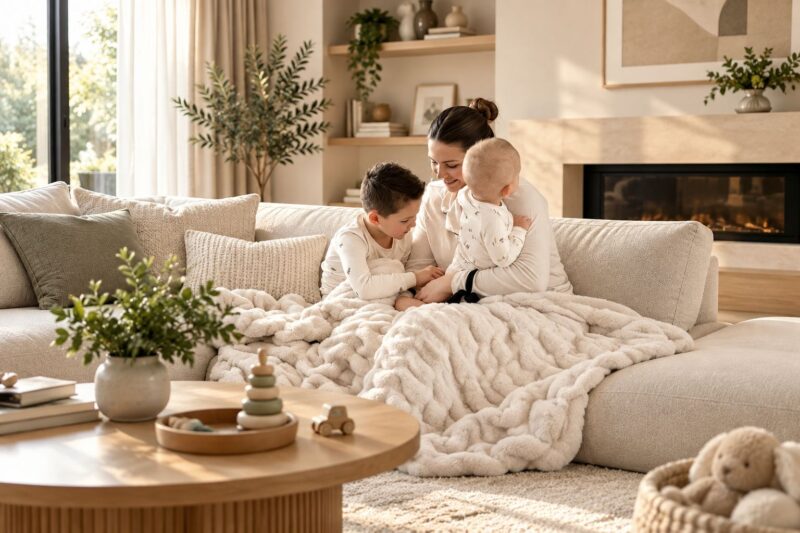
Minimalism and family life look like opposites. One demands clean surfaces and visual quiet. The other involves crayon marks, random shoes near the door, and a stuffed animal population that keeps growing. Most parents who love the idea of a calm, uncluttered home have made peace with the assumption that it’s not available to them — at least not until the kids are older.
That assumption is worth questioning. Minimalist design for families isn’t about achieving the impossible stillness of a childless apartment — it’s about applying the core principles of minimalism in ways that hold up to actual daily use. A waterproof bed protector under clean, simple bedding is a good example of that thinking: it’s invisible, it serves a real function, and it means you’re not anxious every time a child climbs into your bed with a juice cup.
That’s minimalism working practically — protection built in, not layered on top. Here’s how to make the approach work room by room, without pretending that children don’t exist.
Minimalism by Room: Bridging the Gap
Each room presents its own tension between the minimalist ideal and family reality. Here’s how to resolve it practically:
| Room | Minimalist principle | Family reality | What bridges the gap |
| Living room | Clear surfaces, neutral palette | Toys, pet hair, spills | Closed storage, performance slipcovers |
| Bedroom | Clean lines, nothing on the bed | Kids climbing in, nighttime accidents | Waterproof protector, simple washable bedding |
| Dining area | Uncluttered table, minimal chairs | Food spills, crayon marks | Performance fabric seats, wipe-clean surfaces |
| Kids’ room | Calm, low stimulation | Toys everywhere, creative chaos | Deep baskets, low open shelving |
| Entryway | One hook, one surface | Bags, shoes, coats for four people | Built-in bench with hidden compartments |
Storage Is the Foundation
In a family home, minimalism lives or dies on storage. The rooms that consistently look calm are the ones where everything has a designated place to disappear into — not because the objects don’t exist, but because they’re contained when not in use.
The most effective storage in a minimalist family home tends to be built-in rather than freestanding, closed-front rather than open, and placed near the point of use. A built-in bench at the entry handles shoes and bags without visual clutter. Deep drawers under a bed contain extra bedding without using floor space. A large closed cabinet in the living room swallows toys at the end of the day and makes the room usable for adults in the evening.
Materials That Support the Approach
Minimalist interiors look effortless partly because the materials carry more weight. In a family home, that means choosing surfaces and textiles that stay presentable without constant attention.
Performance upholstery on seating means spills don’t become permanent marks. Washable slipcovers in neutral tones keep sofas looking intentional even with heavy daily use. Hard flooring like stone, sealed wood, or quality vinyl plank holds up to foot traffic and cleans in a single pass in a way carpet never quite does. In bedrooms, simple washable bedding in one or two colors maintains the visual calm that defines the space, and a waterproof layer underneath means the mattress itself stays protected without anything showing.
Practical Rules That Actually Hold
Abstract minimalist principles tend to break down in family life unless they’re translated into specific, repeatable habits. These are the ones that consistently make a difference:
- One surface rule: each room has one surface that stays completely clear — a kitchen counter section, a coffee table, a nightstand. That single clear surface does more for the feeling of the room than decluttering everything else combined.
- Contain before you display: anything that doesn’t actively contribute to the look of the room lives behind a closed door. Display is reserved for things you’ve chosen deliberately — not things that ended up somewhere.
- Neutral base, limited accent: a neutral palette with one or two accent colors keeps the room visually coherent even when the inevitable objects appear — a red toy on a light gray sofa reads differently than the same toy on a busy patterned one.
- Buy less, buy better: fewer, higher-quality pieces that are designed for durability and easy maintenance reduce both visual noise and long-term replacement frequency.
- End-of-day reset: a ten-minute routine of returning things to their designated places makes the difference between a home that occasionally looks calm and one that consistently does.
Minimalism with children isn’t a permanent state you achieve and then maintain effortlessly. It’s a set of decisions — about storage, materials, habits, and what you choose to keep visible — that you make consistently enough that the home returns to calm on its own. The goal isn’t a showroom. It’s a space that feels settled even when life in it is anything but.