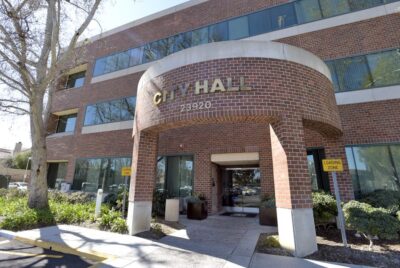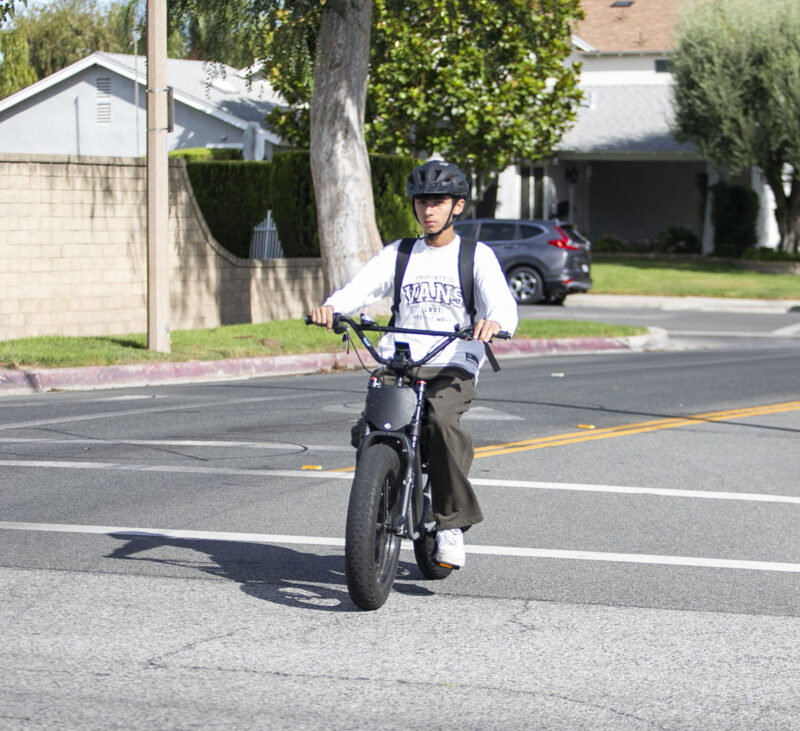
The Santa Clarita City Council is expected to discuss new rules for e-vehicles Tuesday, with proposed fines and suggestions for future advocacy, but also an acknowledgement that, in some respects, their options are limited by county and state laws.
E-bikes and e-motorcycles have been on the city’s radar for more than a year, with residents asking for more rules, as the number of e-vehicles taking to the city’s roads as anecdotal accounts and complaints have increased significantly in recent years, according to the city.
The city has hosted multiple outreach events and enforcement operations since last year, but residents have called for more action, particularly for those riders who are ignoring the city’s posted speed limits or weaving dangerously in and out of pedestrian traffic on city streets and paseos.
The city has met with the public and school districts, as well as held a couple of discussions during council meetings.
However, in terms of changing the city’s rules, City Manager Ken Striplin talked about the process for that in August, saying city staff had to first conduct research and meet with a number of impacted entities, including the Santa Clarita Valley Sheriff’s Station and the L.A. County District Attorney’s Office.
Now that the city has done its due diligence, it has a few suggestions for the City Council to consider Tuesday.
“Community feedback emphasized the importance of promoting safe riding behaviors and holding individuals accountable for violations rather than broadly restricting e-bike use,” according to the “summary of findings” in the city’s agenda for Tuesday’s meeting.
The staff recommendations for the council’s discussion focus on three main areas, which staff says were formulated from community feedback and the city’s legal options.
The first item is administrative citations, which are the strongest correction currently available under state and county law, based on the agenda report from the city.
Masis Hagobian, who led the city’s review of e-bike and e-motorcycle policy, was not immediately available for comment Friday.
Stronger options, such as asset forfeiture or impoundment, aren’t legal under state law, according to the city.
“Discussions with the L.A. County District Attorney’s Office and the SCV Sheriff’s Station highlighted the challenges of holding minors and their parents or guardians accountable for repeated unsafe riding behavior under existing state law,” according to the city staff agenda, which recommends advocacy for changing state law if that’s what the council wants.
“While state law provides certain vehicle seizure and impoundment authorities for qualifying street racing offenses, permanent forfeiture is subject to additional legal requirements and is not available for routine e-bike or e-motorcycle violations,” the agenda states. “Expanding forfeiture authority to address these violations would require changes to state law.”
At the city level, Santa Clarita could legally charge escalating fines for repeated violations of the city’s laws.
“Violations would be subject to administrative fines of $200 for a first violation, $300 for a second violation, and $500 for a third and subsequent violation,” per Tuesday’s agenda. “These fines would provide an additional local enforcement option to supplement existing enforcement under state law and hold individuals accountable for violations.”
While parent and rider accountability were mentioned as challenges, the city is also looking at a village approach to identify its repeated scofflaws, by establishing a city-maintained “community reporting program,” that would allow residents to identify a location, time, date and description for when violations occur.
That system could have proactive and reactive benefits. Tracking behavior and contact with law enforcement could allow city staff to look at where repeat offenses occur and share information with law enforcement. It could also be used to establish any history of violations, should an injury accident or subsequent incident occur due to illegal riding, according to the city.
Info box
While the state is calling for more advocacy on the laws, there have been several recent changes to the laws, which are mentioned in the city’s agenda. This year, Gov. Gavin Newsom signed the following bills into law, which are aimed at addressing e-bike safety, education, and operating requirements.
Assembly Bill 1569: Establishes a statewide e-bike safety and training program for students in grades 7 through 12. The program will be developed by the California Department of Education in coordination with the California Highway Patrol to promote safe riding practices.
Assembly Bill 2346: Establishes additional e-bike equipment and safety requirements, including speedometers and lighting. The legislation also authorizes local agencies to establish speed limits on bicycle paths and multiuse trails.
Senate Bill 1167: Strengthens requirements for the labeling, marketing, and sale of e-bikes. The legislation is intended to help consumers distinguish lawful e-bikes from higher-powered electric devices that do not meet state e-bike classifications.