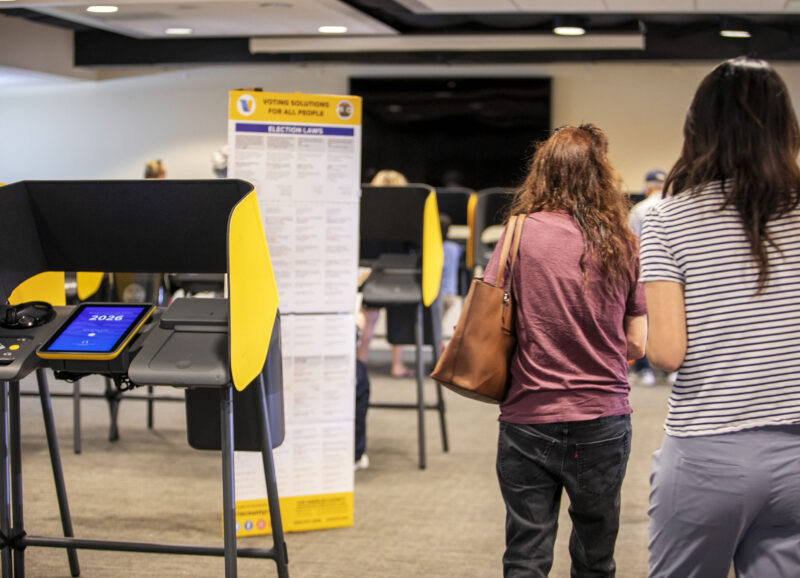
Santa Clarita Valley voters will see city, state and federal races on their ballots next month, and in addition to a slew of state propositions, there are also two county measures that address labor negotiations and the county’s Ethics Commission.
Starting this week, county election officials statewide are expected to start mailing ballots, with the vote-by-mail period officially starting today, according to the Secretary of State’s website.
The two measures that all voters in L.A. County will be able to decide on are Measure A and Measure E, and either can pass with a simple majority of 50% of the vote plus one.
Measure A addresses labor disputes in Los Angeles County and how they can be resolved. Measure E creates protections for the recently created Ethics Commission, which was authorized by L.A. County voters in 2024 through Measure G.
Here’s a breakdown of what both would do:
Measure A
This measure initiated by union representatives began early this year as an effort to change L.A. County’s triennial contract negotiations with major labor associations, including firefighters, deputies, investigators for the District Attorney’s Office, medical examiners, lifeguards and their supervisors and non-administrative employees working in the fire, sheriff and medical examiner’s offices.
The significant difference for these county employees would be who decides when talks have stalled, as well as what steps will be taken then, based on the draft ordinance written by county counsel. (The text is available here: bit.ly/4yQjJXn.)
“The proposed ballot measure would establish a binding arbitration framework for specified labor disputes,” according to a February memo from the county CEO’s office.
For the unions mentioned above, the measure would remove the existing mediation and fact-finding process under the Employee Relations Ordinance for negotiation impasses and “instead require binding arbitration for unresolved disputes or controversies pertaining to wages, hours, and other terms and conditions of employment,” according to the memo.
Under the proposed changes, any of the above bargaining teams could declare an impasse, which would trigger the involvement of a panel of appointed arbitrators — one partisan union representative, one partisan management representative and one neutral representative — to decide the appropriate COLAs, wages and other employment conditions, according to an interpretation from L.A. County Counsel’s Office, which drafted the ordinance.
The panel’s decision is binding to the board, which prompted a caution from county counsel, due to the potential cost impact: “because the arbitrators ‘pick a winner’ as between the parties’ final offers, the decision will no longer be a compromise. One side will win,” according to the February memo.
L.A. County’s adopted budget for the 2026-27 fiscal year was about $54.2 billion, with about $20.8 billion of that going to salaries.
L.A. County 5th District Supervisor Kathryn Barger, who represents the SCV, did not respond to a request for comment on the measure.
The measure also carries the support of Association for Los Angeles Deputy Sheriffs, or ALADS, and several professional unions that represent the affected employee groups. A spokesman for ALADS did not respond to a request for comment Monday.
There is no registered opposition.
Measure E
Measure E has two major impacts to how things run in L.A. County. The first would be establishing independence of the county’s Ethics Commission, which voters approved in 2024; and the second is restoring Measure J funding, which puts 10% of unrestricted county general funds toward both direct community investment and incarceration alternatives. That was something voters had approved in 2020, but it sunset in 2024.
The measure is supported by Supervisors Holly Mitchell and Lindsay Horvath, who were also backed by several “good-government groups,” such as League of Women Voters in L.A. County, CA Clean Monday and CA Common Sense, according to the argument filed in favor.
There was no argument submitted against, according to the L.A. County Registrar-Recorder’s Office.
The first part of Measure E has its roots in Measure G, which created the Ethics Commission, but left some questions about its operations that a new proposal looks to address.
Under Measure E, the commission would serve as an independent department written into the county’s charter.
For Measure E on the Ethics Commission portion of it, a “yes” vote would support greater independence and structure for the county’s Ethics Commission and Office of Ethics Compliance; codify its duties and enforcement power; and establish an inflation-adjusted funding mechanism, according to an analysis from Dwayne Harrison, county counsel.
The measure also codifies the commission’s membership: one member who has a background in public information and public meetings, community outreach and engagement, or using technology as relates to open government (the Governance Reform Task Force would select the first, with the county CEO selecting the person after 2029); chair of the Board of Supervisors has one appointee who has a background in law or public policy; assessor shall nominate a member who has a background in campaign finance, accounting, auditing, compliance with ethics laws; and the commission names the remaining four, who must be approved by the Board of Supervisors.
The funding portion of Measure E has drawn the most controversy for the measure. The opposition has largely stemmed from the blanket 10% that the county would be required to set aside. A four-fifths vote by the Board of Supervisors may reduce the set-aside in the event of a fiscal emergency, if there are threats to the county’s ability to fund mandated programs.
Election timeline
DATES TO REMEMBER
Oct. 5
County elections officials will begin mailing ballots on or before this date. Return your ballot as soon as you receive it.
Oct. 5-Nov. 3
Vote-by-mail early voting period. Oct. 6 Secure ballot drop boxes open. Oct. 19 Last day to register to vote. Same day voter registration is available at your county elections office or voting location after the voter registration deadline, up to and including Election Day.
Oct. 24
First day vote centers open in Voter’s Choice Act counties for early in-person voting.
Oct. 31
In person early voting locations throughout California will be open on Saturday, October 31. Visit caearlyvoting.sos.ca.gov to find locations and voting hours.
Tuesday, Nov. 3
Last day to vote in-person or return a ballot by 8:00 p.m. Polls are open from 7:00 a.m. to 8:00 p.m.
To be counted, your ballot must be postmarked no later than Election Day. We recommend mailing it at least 7 days before Election Day. If you mail it closer to Election Day, take it to a United States Post Office and ask a postal employee for a manual postmark.