Takeout is no longer a side business for Santa Clarita Valley restaurants. For many local burger spots, cafés and food trucks, orders that leave the building now make up a large share of sales, whether they go out through a delivery app, a pickup window or a lunch rush at a business park. That shift has made packaging one of the more important decisions a small food business makes, and owners are rethinking what they buy.
This article looks at the three packaging items that come up most often in those conversations, burger boxes, paper cups and the cardboard boxes used for larger orders and catering.
Burger Boxes Are Doing More Than Holding Food
A burger box used to be a plain clamshell grabbed from a stack. Now it is part of the meal experience. It has to keep the food warm, hold up against grease, fit in a delivery bag and still look good when the customer opens it at home or posts a photo.
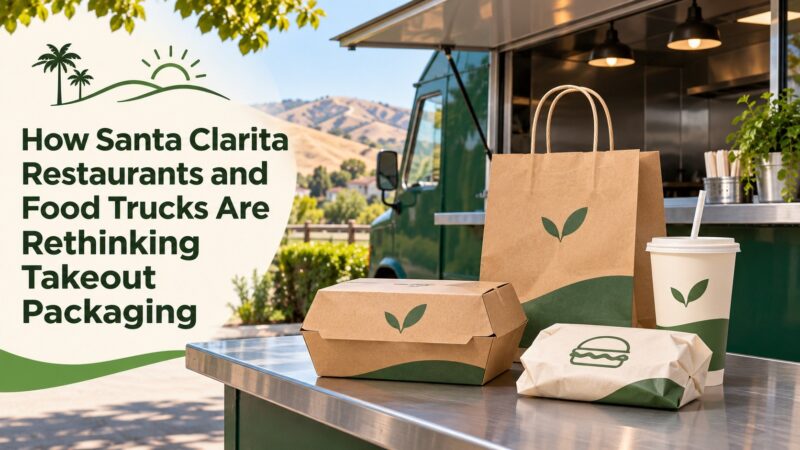
Packaging makers who produce custom hamburger boxes offer a wide range for that reason. Their published options include black burger boxes for a premium look, brown kraft boxes for a natural feel, burger and chip boxes sized for combo meals and deliveries, and compostable bagasse boxes made from sugarcane. All materials and inks are food-grade and safe for direct contact, with grease-resistant coatings to keep burgers fresh and hands clean. Boxes are made to the restaurant’s size, board and print, with a 100-unit minimum, free design and free shipping, and production takes seven to ten business days after proof approval.
For a small operator, the low minimum is the key detail. It lets a new restaurant or food truck test a branded box without committing to thousands of units, then reorder once the design has proved itself.
Paper Cups Are a Moving Billboard
Every drink that leaves a counter is a small advertisement. A branded cup carried through a shopping center or an office building puts the restaurant’s name in front of people who have never visited. For coffee carts and cafés especially, cups are one of the most visible pieces of the brand.
The first decision is size. Suppliers of wholesale paper cups publish a helpful size guide. A 2 oz cup suits free samples, espresso tasters and sauces, 4 oz covers single shots and tasting portions, 8 oz fits a short coffee, tea or hot chocolate, 12 oz handles regular coffee, lattes and a side of soup, 16 oz covers large coffees and iced drinks, and 20 oz suits extra-large coffee, iced tea and smoothies. They note that coffee shops usually stock three sizes, 8, 12 and 16 oz, and that one lid size often fits both the 12 and 16 oz cups, so matching lids are worth requesting with the quote.
Keeping the range to three or four sizes simplifies storage, ordering and the menu board, which matters in a small kitchen with limited shelf space.
Catering and Bulk Orders Need Sturdier Boxes
The fastest-growing part of many restaurants’ takeout business is catering. Office lunches, school events and family gatherings in the valley all generate larger orders that need to travel safely. Stacking individual meals into a bag does not work for twenty lunches.
Plain and printed cardboard boxes fill that gap, both for carrying catering orders and for shipping supplies or retail products. Owners who buy cardboard boxes from specialist suppliers can choose from shipping, mailer, moving and storage boxes, pick a size that fits the product and packing style, and add printing for branded packaging. Recyclable cardboard and corrugated options are available, double and triple wall boards add strength for heavier loads, and boxes ship free inside the US in seven to ten business days after the proof is approved.
For catering, a box sized to hold several meal containers snugly, with handles or a lid that closes firmly, makes delivery faster and reduces spills.
Heat, Distance and Delivery Apps
Santa Clarita’s summer heat and the distances involved in deliveries across the valley put extra stress on packaging. Food that sits in a car for twenty minutes on a hot afternoon needs packaging that keeps grease in, keeps steam from turning fries soggy and holds its shape.
Owners who handle a lot of delivery orders often test packaging the simple way, by ordering from their own restaurant and seeing how the food arrives. That test usually reveals whether vents are needed, whether a box is too large for its contents, or whether a different board would hold up better.
Keeping Packaging Costs Under Control
Packaging can quietly eat into margins if it is not managed. A few habits help. Stick to a small number of standard sizes, order in quantities that unlock better pricing without filling the storeroom, and review packaging when the menu changes so that boxes still match the food.
Asking suppliers for samples before committing to a large run is another easy win. A box or cup that looks perfect online may be slightly wrong in person, and a sample costs far less than a storeroom full of the wrong size.
Sustainability Questions Customers Are Asking
More customers now ask whether takeout packaging can be recycled or composted, and some choose restaurants partly on that basis. Kraft boards, recyclable cardboard and compostable options such as bagasse give owners choices that suit their menu and budget. Being clear on the menu or the box about what can go in the recycling bin helps customers do the right thing and shows that the business has thought about it.
Packaging as Part of the Menu
For Santa Clarita restaurants and food trucks competing for takeout orders, packaging has become part of the product. A sturdy, branded burger box, a cup in the right size and a catering box that arrives intact all tell customers that the business cares about the whole experience, from the kitchen to their table. Getting those details right is one of the most affordable ways a small food business can stand out.