By Chris Summers
Contributing Writer
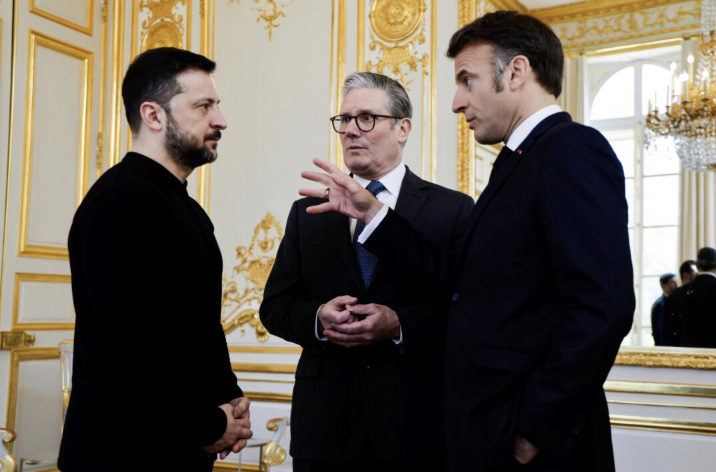
European leaders held talks on Thursday with Ukrainian President Volodymyr Zelenskyy over the shape of security guarantees to Kyiv if a cease-fire can be agreed with Russia.
The summit in Paris, attended by up to 30 leaders either in person or virtually, was planned to discuss what sort of military contributions they could make to Ukraine to deter Russia from attacking again, in the event of a final peace agreement.
The meeting of members of the so-called “coalition of the willing” featured the leaders of France, Britain, Germany, and several NATO member countries in Europe, as well as Turkey, Australia and Canada.
French President Emmanuel Macron, standing alongside Zelenskyy in Paris on Wednesday, said the coalition leaders would endorse plans for security guarantees drawn up by senior military officers.
‘Robust Peace’
Macron said, “We are ready, us Europeans, to provide security guarantees to Ukraine. It enables us to say solidly that we are ready for a robust peace for Ukraine and Europeans, but the question now is to see the sincerity of Russia.”
NATO Secretary-General Mark Rutte told a press conference on Wednesday he expected clarity soon. “That means that we can engage even more intensely, also with the American side, to see what they want to deliver in terms of their participation in security guarantees.”
The coalition of the willing has indicated it would want a security guarantee from the United States.
During a meeting at the White House on Aug. 18, U.S. President Donald Trump said the United States would help provide security guarantees to Ukraine after the war to prevent future aggression.
During that meeting, Trump told seven European leaders, including Rutte and European Commission President Ursula von der Leyen, that a breakthrough occurred at the Alaska summit when Russian President Vladimir Putin agreed to accept security guarantees for Ukraine.
He expressed hope that Europe would shoulder a large portion of the responsibility, with the United States playing a supportive role.
On Aug. 20, Russian Foreign Minister Sergei Lavrov said attempts to resolve security issues relating to Ukraine without including Moscow were a “road to nowhere.”
Referring to the meetings to discuss security guarantees, Lavrov said, “We cannot agree with the fact that now it is proposed to resolve questions of security, collective security, without the Russian Federation. This will not work.”
Merz Warns of ‘Capitulation’
On Sunday, German Chancellor Friedrich Merz said peace could not be negotiated, “at the price of Ukraine’s capitulation.”
In an interview with German public broadcaster ZDF, Merz said, “You could end the war tomorrow if Ukraine surrendered and lost its independence.”
“Then the next country would be at risk the day after tomorrow. And the day after that, it would be us. That is not an option,” Merz said.
Trump and Putin met in Alaska on Aug. 15, and he later took to his Truth Social platform to call for Putin and Zelenskyy to hold a bilateral meeting, after which all three of them would hold a trilateral meeting to resolve the ongoing Russia-Ukraine conflict.
But during an interview on Aug. 29, Trump said, “A [trilateral meeting] would happen. A [bilateral], I don’t know about, but a [trilateral] will happen. But, you know, sometimes people aren’t ready for it.”
Trump likened the warring countries to a pair of children fighting on a playground, and assessed that children sometimes need time to fight each other before they are broken up.
Fighting continues to rage along the 620-mile front line, and Zelenskyy said Russia fired 500 drones into Ukraine on Wednesday, mainly targeting civilian infrastructure.
Putin, speaking in Beijing at the end of a four-day visit to China, said on Wednesday, “If common sense prevails, it is possible to agree on an acceptable option for ending the conflict.”
The Russian president said Trump had “a sincere desire” to find a settlement.
“It seems to me that there is a certain light at the end of the tunnel,” Putin said. “Let’s see how the situation develops. If not, then we will have to achieve our goal by military means.”
The Associated Press and Reuters contributed to this report.