By Jeff Louderback
Contributing Writer
Upon unveiling the new food pyramid and dietary guidelines for Americans last week, Health and Human Services Secretary Robert F. Kennedy Jr. admonished the health policy practices of previous administrations.
“For decades, Americans have grown sicker while health care costs have soared,” he said at a White House press briefing on Wednesday. “The reason is clear. Our government has been lying to us to protect corporate profit-taking, telling us that these food-like substances were beneficial to our health.”
“Federal policy promoted and subsidized highly processed foods and refined carbohydrates and turned … a blind eye to the cataclysmic consequences,” he said. “Today, the lies stop.”
The guidelines, which are used by federal nutrition programs, schools and everyday Americans, represent a major leg in Kennedy’s wide-ranging Make America Healthy Again agenda, which is aimed at addressing the national chronic disease epidemic.
By law, dietary guidelines must be updated every five years, and they are intended to provide a template for a healthy diet. More than half of adults in the United States have a chronic disease, many of which are related to diet, according to the U.S. Department of Agriculture.
Flipping the food pyramid extends far beyond symbolic change, according to Kendall Mackintosh, a certified integrative nutrition health coach.
“It fundamentally reshapes how future professionals are taught, how policies are written, and ultimately how Americans eat, feel and thrive,” said Mackintosh, a mother of three and a licensed dietitian nutritionist.
Because the USDA Dietary Guidelines serve as the backbone of federal nutrition policy, the guidelines will influence “far more than individual food choices,” she said.
“These guidelines directly inform school lunch and breakfast programs, military and VA food systems, hospital and long-term care nutrition standards, SNAP and WIC food allowances, and national public health messaging. When the foundation changes, the policies built on top of it must change as well,” she said, using the acronyms for Supplemental Nutrition Assistance Program, which is commonly known as food stamps, and Women, Infants, and Children, another food welfare program.
During his presidential campaign, and in his tenure as HHS secretary in the Trump administration, Kennedy has lamented what he calls the “corporate capture” of government health agencies and has focused on removing chemicals from the U.S. food supply and addressing the country’s chronic disease epidemic.
Dating back to 1992, the old food pyramid was criticized by experts for placing too much emphasis on carbohydrates and not enough on protein and healthy fats.
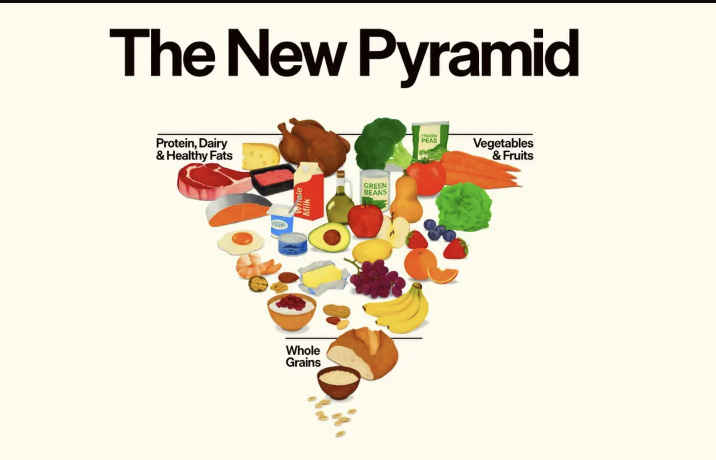
At the Jan. 7 briefing, officials unveiled a new graphic depicting an inverted version of the food pyramid. Protein, dairy, healthy fats, and fruits and vegetables sit at the top, the widest part, and whole grains were shifted to the bottom.
The guidelines also embrace a new stance on highly processed foods and refined carbohydrates, urging consumers to avoid “packaged, prepared, ready-to-eat, or other foods that are salty or sweet, such as chips, cookies and candy.”
Those products, also known as ultra-processed foods, compose more than half of the calories in the U.S. diet, according to the Centers for Disease Control and Prevention, and have been linked to obesity and multiple diseases.
The new guidance also encourages Americans to select whole-food sources of saturated fat — including meat, whole-fat dairy and avocados — while limiting saturated fat consumption to no more than 10% of daily calories.
Other suggested options are butter and beef tallow, a shift away from previous recommendations.
“These guidelines replace corporate-driven assumptions with common-sense goals and gold-standard scientific integrity,” Kennedy said, predicting that they will revolutionize the nation’s food culture.
Joel Salatin, who owns and operates Polyface Farm in Virginia, is regarded as a pioneer of sustainable or regenerative farming practices that enrich the land rather than depleting it.
A self-described “Christian Libertarian environmentalist capitalist lunatic farmer,” Salatin said of the news: “What a breath of fresh air from a government agency, to recognize the difference between whole grains and Froot Loops, between real food and Lunchables. Just because something is in a package with FDA-approved ingredients doesn’t make it nutritious or safe for health.”
He said that the announcement “represents a seismic shift in government bias toward healthier food.”
For three generations, the Harris family farmed White Oak Pastures the conventional way, relying heavily on chemicals, pesticides and antibiotics. In the mid-1990s, fourth-generation farmer Will Harris started the transition to regenerative methods, which prioritize building and preserving healthy soils, avoiding synthetic fertilizers and pesticides, and minimal or no tilling.
Harris still operates White Oak Pastures with his family, and he is also the founder of the Center for Agricultural Resilience, an organization centered on education about the benefits of regenerative farming.
On Thursday, Harris said he is cautiously optimistic that the new dietary guidelines represent a step away from “Big Food” and “Big Ag” dictating the country’s food supply.
“If you look at photos of Americans in the 1950s, they look healthy and fit. That was before there was a shift away from food that was grown and raised the healthy way, and that was before so many Americans ate diets heavy with processed foods,” Harris said.
“Since World War II, our country has focused on making food cheaper and taste good. There has not been an emphasis on quality and health. The first step to having a healthier society is educating people about what is healthy to eat and what to avoid or minimize.”
Sayer Ji is chairman of the Global Wellness Forum and founder of GreenMedInfo.com. He said the new dietary guidelines can keep advancing a gradual shift from conventional farming to regenerative agriculture.
“When policy shifts toward whole, biologically intact foods, it creates downstream pressure for farming systems capable of producing them,” Ji said. “Regenerative agriculture is not optional in this context — it is the only viable way to produce high-quality food at scale without further degenerating the land. In that sense, these guidelines could serve as a powerful accelerant for restoring soil health, biodiversity, and agricultural resilience.”
“Chronic disease is a predictable outcome of a food system built on ultra-processed inputs and chemical dependency,” he said. “By reframing dietary guidance around real food, this shift moves us closer to addressing root causes rather than managing symptoms.”
Venessa Wood, founder and CEO of Ag Women Connect, an organization that empowers women in agriculture, praised the new dietary guidelines, saying the announcement is another instance in which Kennedy and Agriculture Secretary Brooke Rollins are “putting farmers and ranchers back on the forefront of respect and promoting animal-based food.”
“These are common-sense recommendations. There was a time when Americans ate what they grew and raised, and they knew where their food came from if they got it from another source,” Wood said.
“As consumers, we’ve been fed so much misinformation over the decades of previous food pyramids. Now, we’re getting back to the basics, and these new dietary guidelines will lead to more appreciation for farmers and ranchers, because when people eat fresh, whole foods, they feel better, and they will want more.”
In August 2025, HHS and the Department of Education announced an initiative urging the United States’ leading medical education organizations to immediately implement comprehensive nutrition education and training.
Diana Starr, executive director of United Doctors of America, said she is hopeful that physicians learn more about nutrition and encourage their patients to follow the new dietary guidelines.
“Physicians have a responsibility to know about proper nutrition and advise their patients how to eat healthy, and parents have that responsibility, too,” she said. “Ultimately, it is up to each one of us to take control of our own health, and education is important. This is why the new dietary guidelines are a monumental leap forward because they emphasize whole foods.”
Known as the “Glyphosate Girl” because of her advocacy to alert the public about the dangers of the herbicide glyphosate, Kelly Ryerson is the founder of the Glyphosate Facts website and co-executive director of regenerative farming initiative American Regeneration.
Ryerson called the guidelines “revolutionary, and a brave pivot from the guidelines that have perpetually served corporate interests instead of American health.”
She said she believes that there will be decreases in diet-related deaths and chronic diseases, but she said that there is still a long path ahead to enhancing the health of the U.S. food supply.
“The new pyramid talks about real food and chemical additives but does not address the toxicity of the food that will emerge,” Ryerson said. “Real food does not mean that it has no harmful pesticide residues. In fact, some fruits and vegetables can contain more pesticides than the ultra-processed options.”
Rollins said the government is working on making unprocessed healthy food more accessible to all Americans, including those living in “food deserts.”
“Eating healthy, for the most part — we’ve got 100 simulations — is actually less expensive,” she said. “The challenge … is the access to those healthy foods, especially in parts of America where they have food deserts.”
She said that one way the administration will try to solve that problem is by introducing stocking standards to SNAP that will require retailers to double their stocking of healthier foods.
“That will allow us to immediately get these better foods into all communities, but especially the most vulnerable,” Rollins said.
Salatin said he is cautiously optimistic and noted that the guidelines do not address other pressing needs.
“While this is a great step forward, these guidelines fail to recognize the difference between plants and animals grown in healthy soil and habitats versus those grown in chemicals and concentrated animal feeding operations. That recognition is a natural next step once the breakfast junk cereal aisle becomes a thing of the past,” Salatin said. “I’ll take incrementalism toward truth any day and wait for the next step.”