The silent rejection happening before recruiters read your resume
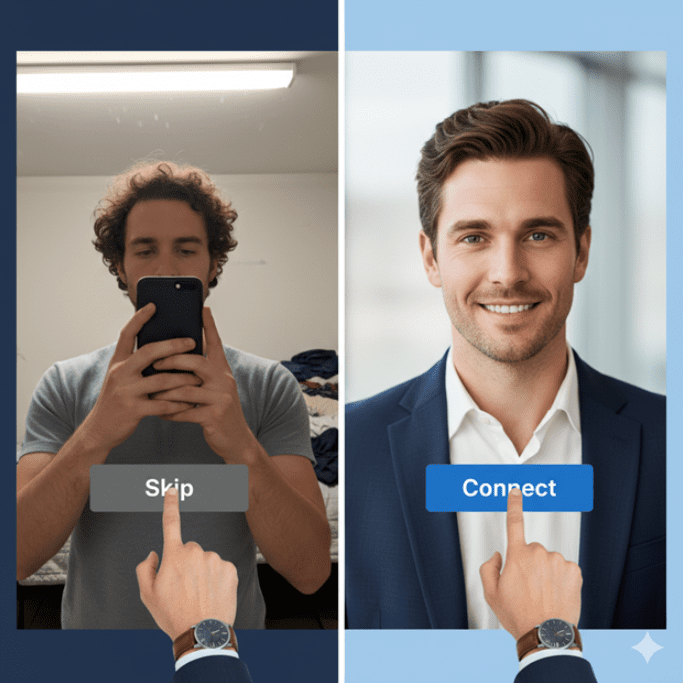
I watched a recruiter scroll through LinkedIn for seven minutes.
Not as a creepy observer. As research. I was sitting in her office, asking about hiring patterns for a piece I was writing. She agreed to let me watch her process – anonymized, of course.
What I saw changed how I think about job searching forever.
She spent less than two seconds on each profile. Two seconds.
Scroll. Pause. Skip. Scroll. Pause. Skip.
“Wait,” I said. “You’re not even reading the headlines.”
She didn’t look up. “I don’t need to. Not yet.”
Here’s the part that made my stomach drop.
She was filtering almost entirely by photos.
The two-second tribunal
I used to think recruiters were methodical. That they read your summary, scanned your experience, weighed your skills against the job description.
Some do. Eventually.
But the first gate? The one that determines whether you even get considered? That’s visual. That’s primal. That’s your LinkedIn profile photo doing heavy lifting before your credentials get a chance to speak.
Research backs this up. A study published in Psychological Science found that people form first impressions from faces in as little as 33 milliseconds. Not seconds. Milliseconds.
And those snap judgments? They’re remarkably sticky. Once someone decides you look untrustworthy, incompetent, or unprofessional, it takes significant contradictory evidence to reverse that impression.
Your resume is contradictory evidence. But it comes after the verdict.
What your photo is actually saying
Here’s where it gets uncomfortable.
Your LinkedIn photo isn’t just a picture. It’s a signal. A story. A shorthand for everything you can’t say in a two-second scroll.
The wrong signals:
That cropped wedding photo where you’re clearly standing next to someone you cut out? It signals you don’t take your professional presence seriously.
The selfie with harsh overhead lighting that casts shadows under your eyes? It whispers tired, unprepared, maybe even unwell.
The outdated headshot from 2015 when you had different hair and fewer years on your face? It suggests you’re hiding something. Or stuck in the past.
The photo where you’re not smiling and your arms are crossed? It screams unapproachable, the exact opposite of what collaborative workplaces want.
I’m not being dramatic. I’m being honest.
These micro-signals compound. A recruiter doesn’t consciously think, “This person has poor lighting in their photo, therefore I shall not hire them.” It’s subtler. They feel a vague sense of not quite right and move on.
You never know why. You just don’t get the call.
The professionals know something you don’t
Here’s a pattern I’ve noticed.
Look at the LinkedIn profiles of executives at Fortune 500 companies. Look at successful consultants, top salespeople, partners at law firms.
Their photos share something in common: they look intentional.
Clean backgrounds. Professional lighting. Appropriate attire. A genuine expression that conveys both warmth and competence.
These people understand that professional LinkedIn photos aren’t vanity, they’re strategy. They’re not spending money on headshots because they’re vain. They’re investing because they know the ROI is real.
Meanwhile, most job seekers treat their profile photo as an afterthought. Something to check off the list. Upload whatever’s on my phone and move on.
That asymmetry creates opportunity for those who pay attention. And disadvantage for those who don’t.
The myth of “authenticity”
I hear this pushback constantly: “I want to look authentic. Not fake. Not overly polished.”
I get it. I do.
But here’s the thing nobody tells you: authenticity and professionalism aren’t opposites.
A great professional headshot doesn’t erase your personality. It amplifies the best version of it. It captures you on a good day, in good light, presenting the version of yourself you’d want to bring to an important meeting.
Think about it this way. When you go to a job interview, do you roll out of bed and show up in whatever you slept in? Of course not. You prepare. You dress appropriately. You put your best foot forward.
Your LinkedIn photo is the same principle, applied digitally.
The goal isn’t to look like someone you’re not. It’s to look like you – at your most confident, competent, and approachable.
The cost of inaction (let’s do the math)
Let’s get concrete.
Say you’re job hunting. You apply to 50 positions over three months. You’re qualified for most of them. Your resume is solid.
But your LinkedIn photo is a grainy selfie from 2019.
If even 20% of recruiters unconsciously skip your profile because of that photo, that’s 10 opportunities you’ll never know you lost. Ten doors that closed before you could knock.
Now let’s say one of those 10 would have led to an interview. And let’s say that interview could have led to a job offer.
What’s that worth? $50,000? $80,000? $120,000 in salary?
You’re leaving money on the table for the price of a photograph.
The math gets even worse when you factor in time. Every month of extended job searching has costs – financial, emotional, and psychological. The stress compounds. Confidence erodes. You start questioning your qualifications when the real issue might be something far simpler.
But professional headshots are expensive… right?
This used to be true.
Five years ago, getting a quality professional headshot meant booking a photographer, renting studio time, doing hair and makeup, and spending $200-$500 for a handful of images.
For many job seekers, especially those between roles – that’s a real barrier.
But here’s where things have shifted.
AI headshot generators have fundamentally changed the equation. You upload a few casual photos, and the technology creates professional-quality headshots with proper lighting, backgrounds, and composition.
The results aren’t perfect for everyone. And traditional photography still has its place for executives and public-facing roles where maximum polish matters.
But for most professionals? The gap has closed significantly. You can get a headshot that communicates competence and approachability for a fraction of what it cost five years ago.
The “it’s too expensive” excuse has a much shorter shelf life than it used to.
What actually makes a LinkedIn photo work
Let me get practical. After talking to recruiters, photographers, and hiring managers, here’s what consistently separates photos that work from photos that don’t:
1. Your face takes up 60-70% of the frame
LinkedIn is a small thumbnail in most contexts. If you’re a tiny figure in a wide landscape shot, nobody can see your face. Get close. Cropping exists for a reason.
2. The background is simple and non-distracting
Plain walls, soft bokeh, muted office environments. Anything that keeps attention on your face rather than the clutter behind you.
3. Lighting comes from the front or side, not above
Overhead lighting creates shadows under your eyes and nose. It makes everyone look tired. Natural light from a window, or professional lighting setups, solve this instantly.
4. Your expression matches your industry
A warm, genuine smile works for most fields – sales, marketing, HR, consulting. A more serious, composed expression might suit law, finance, or academia. Know your audience.
5. Your attire signals the role you want
Dress for the job you’re pursuing, not the job you have. If you’re targeting director-level positions, your photo shouldn’t look like you’re heading to a casual Friday.
6. The photo is current
If people meet you and you look noticeably different than your photo, that’s a problem. Update every 2-3 years, or sooner if your appearance changes significantly.
The uncomfortable truth about bias
I’ve been dancing around something important.
We like to believe hiring is meritocratic. That qualifications matter most. That a well-crafted resume will overcome any superficial impressions.
It doesn’t always work that way.
Unconscious bias is real. Studies show that people make assumptions about competence, intelligence, and even honesty based on faces. These biases often correlate with attractiveness, but they go deeper than that. They’re about perceived professionalism – a fuzzy, subjective quality that varies by industry and role.
A good professional photo won’t eliminate bias. But it can reduce the friction it creates. It can ensure that the first signal you send is one of I belong here. I take this seriously. I’m worth your time.
That’s not about gaming the system. It’s about not letting a preventable variable count against you.
The mindset shift
Here’s what I want you to take away.
Your LinkedIn photo isn’t a decoration. It’s not a checkbox. It’s not something you set once and forget.
It’s the opening line of your professional story. The first sentence. The hook that either invites people in or sends them scrolling past.
And unlike your experience or your skills – things that take years to build, your photo is fixable in a day.
That’s the absurd part. The thing that might be costing you interviews is one of the easiest things to change.
So change it.
Not because some recruiter might judge you unfairly. But because you deserve to put your best foot forward. Because the version of you that shows up to important meetings – prepared, confident, professional – deserves to show up on your profile, too.
That version of you is just as authentic as the one in the grainy selfie.
Maybe more so.
The next time you scroll past a job posting without applying or apply without hearing back, ask yourself: when did I last look at my profile through a recruiter’s eyes?
Two seconds. That’s what you get.
Make them count.