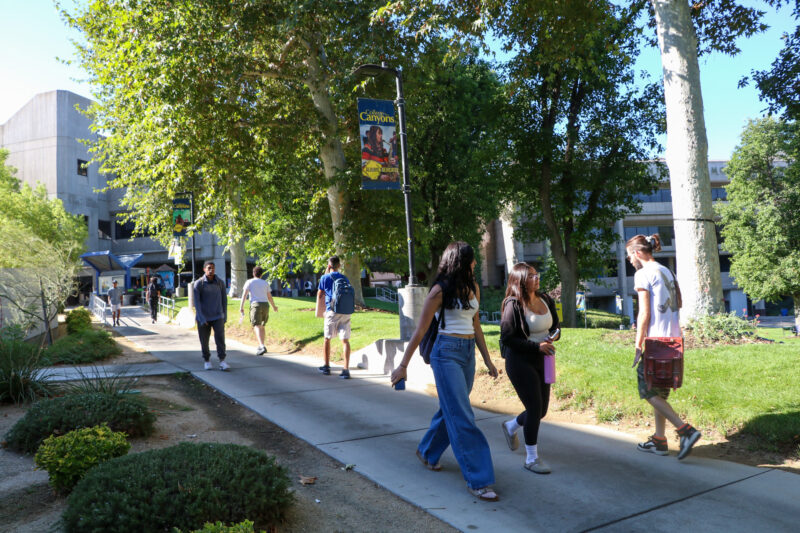
Amid conversations about the impact of artificial intelligence on the future of higher education, some College of the Canyons employee representatives are saying they’re foreseeing a “fire hose” of impacts for students and employees.
COC’s Classified Senate President Michael Monsour told the college’s governing board during its monthly business meeting Wednesday he wasn’t confident in the chancellor’s office’s ability to prepare the college community for a future impacted by AI.
“With the chancellor’s office, I have faith that they want to do it,” Monsour said. “I don’t have as much faith that they are prepared to do it, because I haven’t seen even my co-workers being prepared for what I’ve been seeing.”
Monsour said that he’s not only concerned about how the college is preparing academically for the capabilities of AI, but also how AI’s ability to automate certain jobs is impacting the classified workforce, such as the college’s programmers – adding that people who do certain jobs “may be obsolete in the next couple of years.”
“It can be a helpful thing, but I’m worried about too many people in positions where they just get used to the job that they’ve been doing for decades and doing it fantastically, that then we say, ‘Well, that doesn’t really work anymore,’” Monsour said. “How do they adjust to something that profound in their lives and in their careers?”
Some board members maintained that AI could be a powerful tool for college employees, not a means of replacing them – if they’re trained to use it.
“What’s interesting about that topic is my assistant will be replaced, I won’t need her to do what she was doing,” said Fred Arnold, the board’s vice president. “So it (was) negligent of me not to teach her one-on-one those skills, so she can level up and she can get better.”
After college Acting Superintendent Jasmine Ruys asked about the existing professional development programs related to AI for classified employees, Miranda Zamudio, interim vice president of human resources, confirmed no such program existed for them.
“I don’t think that conversation has really started, in terms of providing professional development for that,” Zamudio said. “I know that there are a lot of classified (employees) who are interested in that. We do have AI, as you mentioned, for faculty, but we really need to focus it on all other employees as well.”
Monsour, along with Faculty Senate President Lisa Hooper, also shared concerns about AI’s impact on student learning at the college.
Monsour said that students are already “seeing the blood in the water” when it comes to AI’s ability to automate skills higher education has traditionally taught.
“Unless we can create something in the community college system and here locally that inspires a younger generation to see a real value in what we’re providing, in tandem to the AI tools that they’re using, we will suffer long term for that,” Monsour said.
He suggested that, on one hand, the college should invest in trades and crafts that are more hands-on – like plumbing and pottery – in the spirit that people “still want to create things.” On the other hand, Monsour argued the school’s academic programs also need to be updated.
“We have to innovate our programs and curriculums, and we can’t be stuck in traditions that have said, you know, ‘Here’s the same math class that we’ve been teaching for 30 years,’” Monsour said.
In her address to the board, Hooper commended some of the college’s newest committees, the academic freedom and academic integrity committees, in dealing with a post-COVID and AI-adjacent educational landscape. When asked by Arnold how the board could support the Faculty Senate while AI rapidly changes the workforce, Hooper said that, if done well, curriculum programming is generally insulated from those changes.
“We try to write curriculum that has some breath so it can evolve as disciplines evolve, so that it’s not super prescriptive, but it’s more descriptive, and that gives our faculty the ability to pivot and to infuse new technology,” Hooper said. “I do think that there are some forces at play just that are sort of out of our control and quite frankly, unexpected.”
In response to board trustee Carlos Guerrero, who’s historically been vocally pro-AI, posing the possibility of future discussions about agentic AI – designed to accomplish a specific goal with minimal supervision – Hooper said she was tentatively open to them.
“I look forward, I think, to those conversations,” Hooper said. “I like to know what’s possible, but then I end up thinking about how it’s going to impact teaching and learning. So it’s a lot. It’s kind of a fire hose right now.”