Security teams are rarely short of technology. What they lack is capacity. Time to investigate properly. Headroom to think clearly when an alert lands at 02:00. Enough experienced analysts to separate a genuine incident from background noise.
This is where CrowdStrike’s managed detection and response service becomes relevant. Not as another dashboard, but as operational reinforcement.
When organisations explore CrowdStrike MDR use cases, they often expect a tidy catalogue. In practice, use cases surface under pressure. After an incident. During an audit. When alert fatigue begins to show in missed signals.
The scenarios below reflect how managed detection and response is actually used inside live environments.
When the Internal SOC Cannot Keep Pace
Many organisations run lean security teams. Two or three analysts covering business hours. Limited out of hours monitoring. A senior engineer who splits time between security and infrastructure.
Meanwhile, endpoint telemetry never slows down.
Alerts accumulate. False positives blend with genuine threats. Investigations stretch into hours when they should take minutes.
One of the most common CrowdStrike MDR use cases is simple operational stability. The external MDR team assumes responsibility for alert triage and validation. Escalations arrive with context, not raw data. Noise drops.
That shift changes behaviour internally. Analysts spend more time improving controls and less time chasing benign activity. Policies are refined. Gaps are identified properly. Security work becomes deliberate rather than reactive.
Recruitment pressures add another layer. Experienced analysts remain difficult to hire and retain. MDR becomes a pragmatic response to a market that does not offer quick fixes.
Early-stage Ransomware Detection and Containment
Ransomware remains disruptive because it moves fast once it gains momentum. The early signals are rarely dramatic. Suspicious PowerShell execution. Lateral movement using legitimate credentials. A domain controller accessed at an unusual hour.
Internal teams often detect fragments of this activity but lack full visibility across endpoints.
Among the most critical CrowdStrike MDR use cases is identifying that early pattern and acting before encryption begins. Managed responders correlate behaviour across hosts, assess intent and isolate systems where necessary.
Containment at this stage changes the trajectory of an incident. Instead of full-scale recovery and prolonged downtime, the organisation deals with a contained breach attempt.
The difference lies in speed and confidence. Decisions are made quickly because someone is watching continuously.
Visual Overview: How MDR Fits into Daily Operations
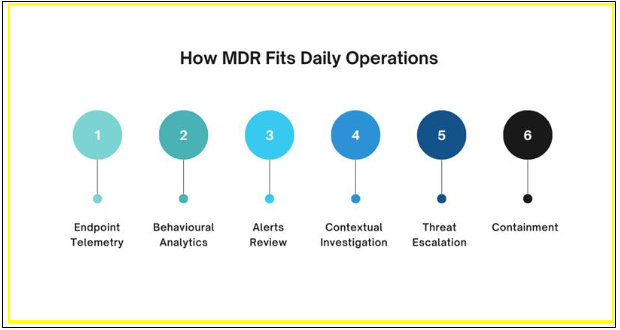
The following model illustrates where managed detection and response typically sits within an organisation’s security flow.
- Endpoint telemetry collected by CrowdStrike agents
- Behavioural analytics and threat intelligence applied
- MDR analysts review high-fidelity alerts
- Contextual investigation across affected hosts
- Confirmed threats escalated with recommended action
- Containment steps executed in coordination with internal IT
This sequence looks straightforward on paper. In reality, each stage demands judgement. Alert validation alone requires experience. Escalation must balance urgency with accuracy.
The value is not the flow itself. It is the consistency of execution.
Incident Response Support Without a Full IR Retainer
Many organisations do not maintain a formal incident response retainer. Cost is one factor. Executive attention is another.
Yet incidents still occur.
Another practical example among CrowdStrike MDR use cases is support during active investigations. When suspicious behaviour escalates into a confirmed breach, MDR analysts extend beyond triage. They assist with scoping affected systems, identifying patient zero and mapping lateral movement.
This does not replace a full digital forensics engagement in complex cases. It does, however, reduce the time between detection and structured response.
That reduction often limits business impact. Containment happens earlier. Communications are clearer. Senior stakeholders receive information grounded in evidence rather than assumption.
Visibility Across Remote and Hybrid Environments
Hybrid working patterns have stretched traditional network monitoring models. Traffic no longer flows neatly through central inspection points. Users operate from home networks, shared spaces, and unmanaged connections.
Endpoint telemetry becomes the primary source of truth.
CrowdStrike MDR increasingly centre on this decentralised model. Continuous endpoint monitoring ensures suspicious behaviour is detected regardless of location. Analysts interpret those signals in context, not in isolation.
This approach avoids reliance on perimeter controls that no longer reflect how people work.
There is also a governance angle. Regulators expect demonstrable monitoring capability, even when infrastructure is dispersed. Managed detection and response supports that expectation with documented oversight.
Improving Response Maturity Without Rebuilding the Stack
Security maturity often stalls not because tools are inadequate, but because processes lack discipline.
Playbooks exist but are not consistently followed. Escalation paths are unclear. Post-incident reviews are rushed.
Engaging MDR introduces structured workflows. Alerts are handled through defined criteria. Evidence is documented. Recommendations are tracked.
One of the quieter CrowdStrike MDR use cases involves raising operational standards by example. Internal teams observe how investigations are conducted and adopt similar rigour.
Over time, this strengthens the overall security posture. Not through marketing claims, but through repeated exposure to disciplined response practices.
Executive Reassurance and Audit Readiness
Boards and audit committees increasingly ask direct questions about monitoring capability. Who watches alerts outside business hours? How quickly can threats be contained? What evidence supports those claims?
Answering these questions requires more than confidence.
Managed detection and response provides measurable service levels and documented incident handling. For many organisations, this becomes part of regulatory reporting and third-party assurance processes.
CrowdStrike MDR therefore extend beyond technical operations. They influence governance discussions and supplier risk assessments.
The presence of an external, specialist monitoring function often reassures stakeholders who understand that internal resources are finite.
Conclusion
CrowdStrike MDR use cases rarely emerge from curiosity. They arise from operational strain, rising threat levels and the simple recognition that continuous monitoring demands sustained expertise.
Managed detection and response does not replace internal security teams. It reinforces them. It absorbs alert volume, accelerates containment, and introduces consistent investigative discipline.
For organisations weighing this decision, clarity matters more than features. Understanding where MDR would genuinely reduce risk, and where internal capability remains sufficient, requires an honest assessment of current operations.
CyberNX is a trusted CrowdStrike services partner. They can guide you to make the right decisions, support your security program and help security teams get maximum out of the Falcon platform. Their CrowdStrike consulting will also help you with endpoint security, identity protection, cloud security and threat hunting.
Security operations work best when responsibility is shared intelligently. Managed detection and response, applied in the right context, becomes a practical extension of that principle.