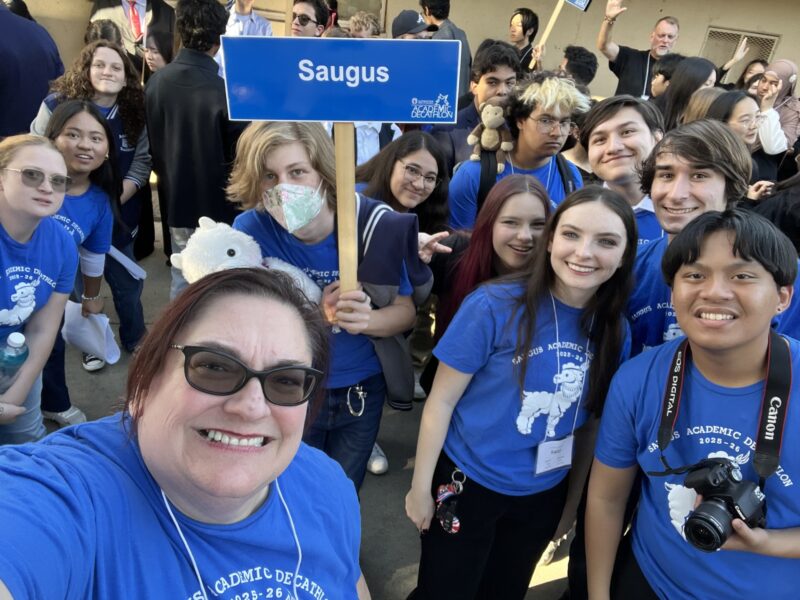
If there’s an easy way of explaining Academic Decathlon – that is, what it does and who it’s for – it’d be that it exists because some people love learning for its own sake.
That doesn’t necessarily mean students who chose to compete in AcDec competitions, “scrimmages” and club or elective activities have exceptional GPAs. On the contrary, assembling a team eligible to compete for full points in a regional competition requires at least three members with a sub-3.2 GPA.
The students who gravitate to AcDec – whether it be an elective, such as at Saugus High School, or a club, like at its rival and collaborator West Ranch – are drawn by an abiding love of at least one of the subjects AcDec competitions score on: art, economics, math, literature, music, science, social science, public speaking, essay writing, prepared speech-making and interviewing.
The AcDec competition that’s typically the most significant of the year, known as “regionals,” pits dozens of schools against each other by area before California’s uber-selective state competition in the spring.
The theme of this year’s regional was “The Roaring ’20s,” and students have spent the past year studying subjects and skills under the lens of 1920s American culture, from the economics leading up to the Great Depression to “The Great Gatsby.”
At the tail end of January, William S. Hart Union High School District schools Golden Valley, Saugus and West Ranch competed against dozens of other teams, with Saugus securing 11th place out of 72 teams, said district spokesperson Debbie Dunn.
While the Hart district missed out on qualifying for state, Owen Higgins, a senior at Saugus and the school’s top regionals scorer, said he was more than happy with his score: the science category has become so competitive that Higgins’ 960 points out of 1,000 earned him a bronze medal.
Higgins said the AcDec comrades he’s met over his four years in the program are a diverse bunch, but the things they share – certain hobbies, common interests, and above all, a shared love of the process of discovery inherent to learning – have always drawn them together as a team.
“(It’s) a group of people who are very diverse, where we have a lot of different interests, but we also have a lot of similar interests, and in the future I’ll be looking for similar people,” Higgins said. “As long as we have a shared interest or a shared … hobby, I know I’ll be able to work with those people.”
This year, 37 students participated in the AcDec elective at Saugus. AcDec coach Jodi Guerrero’s class functions as their “clubhouse,” she said, where she cultivates an environment in which students support each other, but can also compete to their full ability – to be their best selves.
Guerrero was a part of one of Hart High School’s first AcDec teams in the 1980s, and took over the coaching position at Saugus about 10 years ago.
The role AcDec serves for a diverse cross-section of students is important to her, she said. AcDec kids often go to Stanford, Berkeley and Ivy League schools, which includes students who don’t have a social scene they readily fit into in high school.
“It’s a great place for people who don’t really fit, and they have instant friends, and academic support,” Guerrero said. “We end up having problems because kids can’t find that, so AcDec functions as a place for kids who don’t really have that … I’m glad to offer that for them.”
West Ranch AcDec advisor and math teacher Miguel Tenorio said that, at his high school, AcDec has served the same purpose: a place for students who love learning for its own sake, divorced from the promise of reward or the threat of punishment.
“I’d say the biggest thing AcDec has done for my students is it’s given them the space to be comfortable learning, because there’s no grade,” Tenorio said. “The kids just learn for the sake of learning.”
After this year’s regionals functionally wrapped up a year of work – the last of his high school career – Higgens said the scores were basically incidental to the sense of accomplishment he felt reaching the finish line alongside a bright, generous cohort.
“If it wasn’t for them I probably wouldn’t have felt as … happy as I am with my progress this year, so I really do attribute my feeling of, ‘Man , we really did it’ (to them) … It’s a team effort, and I’m very proud to have the people I have around me,” Higgins said.