For those in the Santa Clarita Valley fighting its environmental battles – advocates for the unique fish that swim its streams, the forests to its north and east, the quality of its air and water – opportunities to find their audience can be precious.
Filmgoers at the Santa Clarita Valley Eco Alliance’s third annual Eco Film Festival were that audience Saturday.
Lessons from the festival’s lineup of seven environmental documentaries, ranging from an overview of the ocean’s subsystems to the story behind a regenerative farm in Ventura County, helped illustrate key concerns for environmental advocates at booths lined up outside College of the Canyons’ Boykin Hall.
Southern Steelhead Coalition head Elizabeth Burns said one of the movies in Saturday’s lineup had provoked a deep discussion with a viewer on the state of fisheries – and by extension, advocacy for one of California’s endangered species, the steelhead trout: “Ocean with Sir David Attenborough.”
The movie, in part, discusses the devastating effects of overfishing on the ocean’s fisheries, or sites of both farming and wild-catch fishing practices.

“She was wondering, ‘People don’t really talk about (steelhead trout), and is the reason that this is getting more … attention than it used to … because you’re seeing our ocean fisheries collapse, so it’s better to start taking care of something that’s also a freshwater (fish), and an oceanic (fish)?’” Burns said. “And I was saying ‘Yes and no.’”
Steelhead trout are born in freshwater streams and travel to the ocean before returning to the streams to spawn. Unlike salmon, some can make the stream-to-ocean journey multiple times over the course of their lives – including, however rarely now, in the Santa Clara River.
While its ocean habitat plays a major role in the steelhead’s life, the Southern California streams that allow it to reproduce are just as critical, and as Southern California has continued to grow, those streams have become drastically less habitable. Sometimes simple design decisions, like building bridges that allow fish passage, can make a huge difference, according to California Trout’s website.
“The fact that she thought about that … is really important, because it shows how she sees the importance of (the ocean and freshwater streams) linking up with each other,” Burns said.
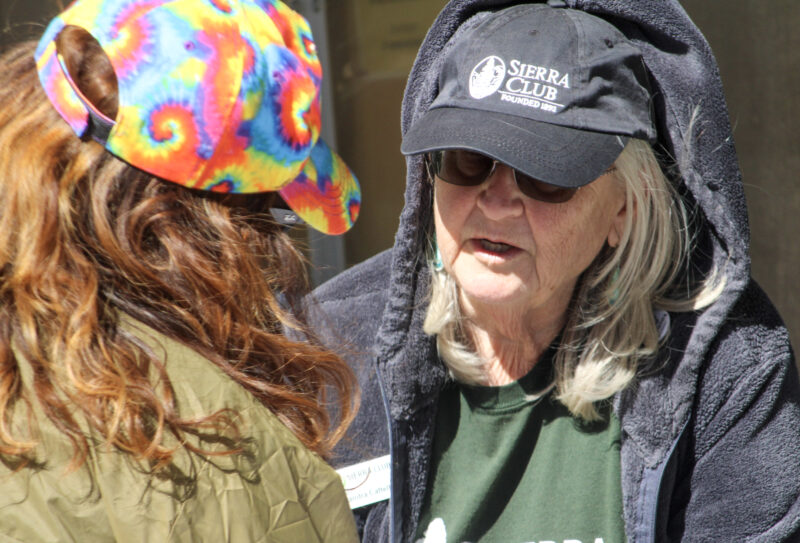
Representatives from the Sierra Club had their own booth Saturday, collecting signatures to support the designation of a Northern Angeles National Monument to protect the forests within a 240,000-acre area between Santa Clarita and the northern county line from mineral and oil extraction, as well as open up funding opportunities for camp sites and other amenities.
Sandra Cattell, chair of the Sierra Club’s Santa Clarita group, said one significant lesson from Saturday’s movie slate was the “30 by 30” rule.
“A lot of them talk about ‘30 by 30,’ which is, protect 30% of the land and the ocean by 2030 … you save the climate,” Cattell said.
At least one organization at Saturday’s film festival also had a hand in the research presented in one of the films. The documentary “Chasing Chimeras,” about the fossil fuel industry’s efforts to bill its energy services as environmentally friendly, included sources from Food and Water Watch, a nonprofit that advocates for addressing environmental concerns that impact communities’ quality of life.
Fossil fuel industry facilities impact the life expectancy of the people who live nearby, said Food and Water Watch organizer Noah Ropp, making them a focal point for the nonprofit.
“There is a lot of oil and gas drilling in the L.A. area, more than people realize. I’m sure I don’t need to tell Santa Clarita residents … that’s all over the L.A. County area,” Ropp said. “Down in Signal Hill near Long Beach, there you can find photos of community parks that have oil derricks on three different corners of one local community park.”
At the booth, Ropp and a fellow organizer were also collecting signatures to stop a large data center from being built in Monterey Park.
Overwhelming pressure from Monterey Park residents has already resulted in a nearly year-long moratorium on data center development, and could result in a permanent ban via a June ballot measure this year.
“We really look at the human impact of a lot of these issues,” Ropp said. “Yes, it’s important to fight for clean water, for clean food, for clean air, but how does that impact the communities that are really being disproportionately affected by it?”