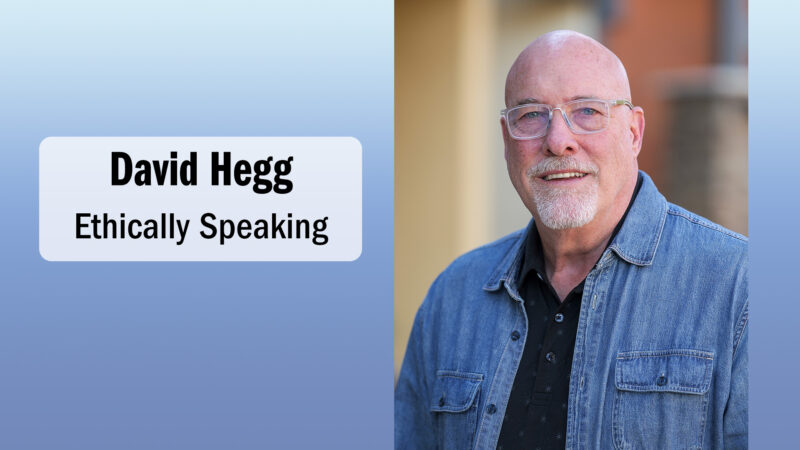
By David Hegg
Given that critique has become one of our most enjoyed national pastimes, I’m offering some thoughts on how to shape our criticisms in ways that can spur understanding, progress and acceptable change rather than incite anger, division and retaliation. Whether you express your opposition face-to-face or engage in a war of words in a column or letter to the editor, the following suggestions can help your comments and criticisms bring benefit rather than further acrimony.
Before going on, I must confess my own bias in this area. Every leader becomes the target of criticism, and I am no exception. So, drawing on my years of experience as an emotional punching bag, I offer these suggestions to those of you who find yourselves displeased with others’ actions, opinions, or criticisms, and feel the need to respond.
First, get your facts straight. Regardless of how you see things, you almost never have all the facts, especially if you’ve “heard” about the problem rather than been a principal in it. I can tell you from experience that the retelling of stories, even by good and trusted friends, often comes with bias and prejudice baked in. So, before you embarrass yourself with an ignorant foray into a harsh confrontation, make sure you have at least 90% of the truth.
Second, set your expectations. As you prepare to confront a leader, or someone you believe has acted or written wrongly, ask yourself what you hope to accomplish. Are you simply mad and just want to rant? Are you willing to critique your own position first? Are you expecting a complete change of mind and action on the part of the one you’re confronting? And most importantly, if you’ve spotted a problem, are you willing to be part of the solution?
Third, lose the emotion. If all you want is to hurt the other person, then just rush in and say things you’ll later regret. But if you want to understand, engage in dialogue, and see progress, realize that emotional outbursts, generalizations, hurtful statements, and, above all, threats will never add up to being heard, understood and valued.
Fourth, scan your own position carefully. Are your arguments sound? Will your past behavior, or the allowances you’ve made, paint you as a hypocrite? Have you distinguished yourself as someone who is always upset about something? Or have you shown you are a level-headed, reasonable person whose insights will be received as valuable?
Fifth, when you realize that a conversation with someone is needed rather than a hastily written letter, start with these three words: “Help me understand …” Almost certainly, despite your efforts to know everything, there are things you don’t know. When you seek first to understand, and only then to inform, you start with a much higher chance of achieving mutual understanding and agreement.
Lastly, civility is everything if, in person or in writing, you are actually attempting to bring about a change of perspective. Be clear, be correct, but also be kind. Making your opponent mad will never make them respect your opinion. Demand the best of yourself and treat the other person the way you want them to treat you.
In our world, conflict is inevitable. Even worse, since the advent of social media, the likelihood that errors will be taken as fact has grown exponentially. And to top it off, we’ve become a society that no longer holds to basic rules of interpersonal civility.
What is most astounding is this great paradox: It is evident that the world we now inhabit considers we have the right to offend, but also the right to never be offended. These contradictory maxims have both become “unalienable rights” in a society that considers it proper to be greatly offensive to those they deem offensive.
In the end, all I’m campaigning for is a return to mature adulthood on the part of those purporting to be mature adults. Sadly, we have enough models of childish behavior. If we’re ever to regain a level of real civility, it will have to start with us, the common folk, who still remember when polite conversation, even in times of conflict, left us all feeling better for having engaged in conversations that pointed the way to mutual respect.
Local resident David Hegg is senior pastor of Grace Baptist Church. “Ethically Speaking” appears Sundays.