When Sunkist moved its headquarters from Sherman Oaks to Santa Clarita in 2014, it signaled a vibrant new chapter for both the iconic citrus cooperative and the local community. Valencia has now become the latest link in Southern California’s long, juicy legacy of citrus growing, packing and marketing — a legacy told through historic packing houses, utopian groves,and the enduring art of the fruit crate label.
After more than a century lifting up California’s family citrus growers, Sunkist Growers headquarters pulses with the activity of sales, marketing and executive teams, supporting more than 1,500 grower members in the oldest continually operating agricultural cooperative in the United States. “Everything we do is for our growers,” says the company’s mission, a testament to over 130 years advancing California citrus through collaboration and innovation.
The Valencia headquarters symbolizes Sunkist’s commitment to both tradition and forward-thinking growth, ensuring Santa Clarita’s spot on the map as a key player in the global citrus industry. For many local residents, citrus is more than a business — it’s the scent of blossoms in spring, the hum of bees and a bright slice of history.
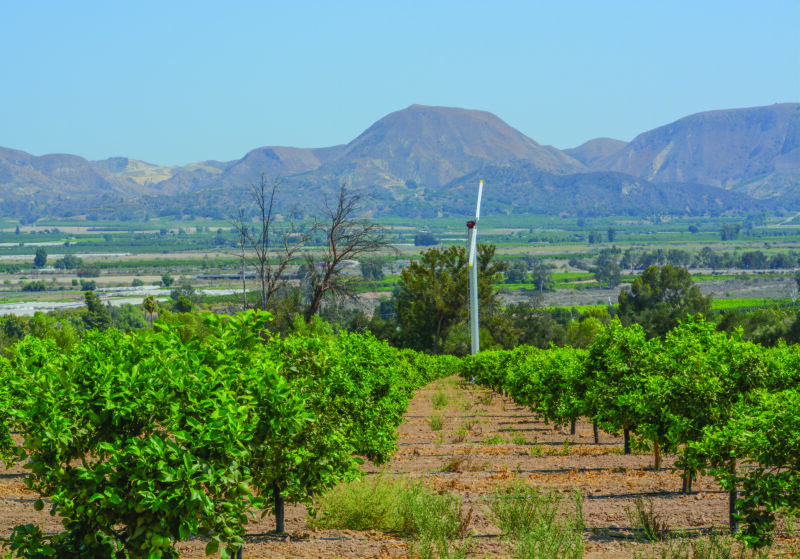
The stretch of California Highway 126, known as Heritage Valley, is a key Southern California citrus region. And, it is often called the Citrus Capital of the World.
The Legacy of Packing Houses
Santa Clarita’s citrus story is part of a broader Southern California tapestry woven through railways and packing lines. The region boasts a remarkable collection of historic citrus packing houses—once gleaming hubs of seasonal labor, now icons of architectural and agricultural history.
Elephant Packing House, Fullerton: Built in 1924 by the Union Pacific Railroad, this 23,500-square-foot marvel blends Mission Revival and Spanish Colonial Revival styles and was among Fullerton’s last citrus packing houses. It earned a spot on the National Register of Historic Places in 1983.
Anaheim Packing House: Originally a 1919 Sunkist lemon packing house, it’s one of the few surviving examples in Orange County. Today, it’s the centerpiece of the trendy Anaheim Packing District food hall, connecting culinary innovation to a storied citrus heritage.
Santiago Orange Growers Association Packing House, Orange: The largest in its city, this 1918 structure is now the Sandi Simon Center for Dance at Chapman University and an anchor in the Old Towne Orange Historic District.
Other cities like Claremont and Riverside echo these stories, where entire communities once orbited the packing plants and railroad sidings, and trolleys ferried workers by the hundreds.
The Art and Business of Crate Labels
From the late 19th century into the 20th, citrus crate labels were as important to California’s fortunes as the fruit itself. For family farms, a vivid label was a badge of pride and a marketing pitch in one — the face the region showed to the world as its oranges crossed the continent by train.
Early labels often featured sweeping orchard vistas, regional icons or the shimmering faces of growers’ children. Large orders (sometimes 10,000 labels at once) would last for several years; changes in partnership, such as a son joining the family business, were hastily overprinted, resulting in collectible oddities with blackout marks.
With the rise of grower collectives like Sunkist and the California Fruit Exchange, labels either adopted the exchange’s imprint or mixed co-op branding with farm design. Sometimes, collectors find both a lone-ranch label and the Sunkist-adorned version for the same harvest — a testament to shifting allegiances and marketing might.
By the 1960s, government rules required zip codes on labels, making them time capsules for historians and collectors. Soon, cardboard replaced most wooden crates, but a few holdouts remain—usually for export or long-term storage, where wood’s durability still reigns.
Why So Many Labels Survive
Despite the passage of generations, hundreds of thousands of original fruit crate labels endure today, largely thanks to warehouse finds and the archivist instincts of packinghouse managers. Boxes upon boxes, sometimes loaded with bundles of 1,000 labels, gathered dust as unsold inventory—then emerged onto the collector’s market decades later. “Packing houses had purchased the labels as inventory, labels took up very little room, and some packing houses or farmers were poor housekeepers,” explains one seasoned collector.
Other labels surfaced from printer archives, worker souvenirs and even patent office samples. As gallery-worthy relics, these labels are now prized for their stunning design and historical connections—many originals selling for less than modern reproductions thanks to the sheer volume of unearthed stock.
The Santa Clarita Angle: Past, Present, and Future
Today, Sunkist’s presence in Santa Clarita ties the city directly to California’s citrus epic. The headquarters hosts not just business operations, but also a legacy — a living bridge from orange-grove days to high-tech, global produce trade.
Nearby, companies like Limoneira in Santa Paula continue packing traditions as multi-generational growers and exporters of lemons, oranges and avocados. Their own packinghouses and land represent century-old business models reshaped for the modern market.
Meanwhile, local history buffs and new arrivals alike can explore the beauty of crate label collecting, hunting for themes as diverse as “children,” “Sunkist,” or even “airplane.” For the curious, “just about every label tells a story,” says one collector. “It’s a slice of California history you can hold in your hand.”
Santa Clarita’s bright role as the heart of Sunkist keeps the city rooted in this ongoing story — where every shipment, every label, reconnects us to a legacy of sunshine, community and enduring agricultural dreams.