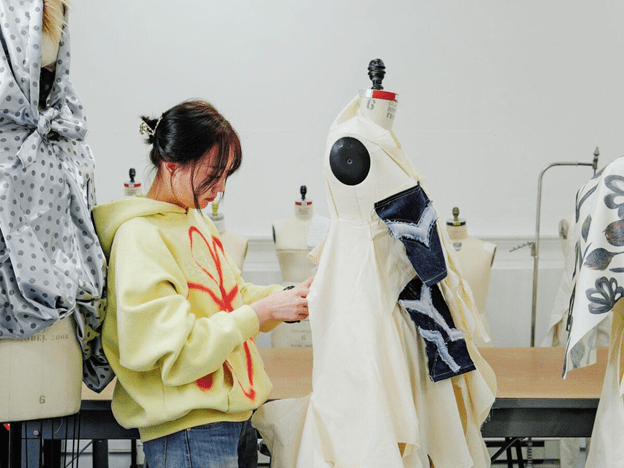
As the city’s Union Square bursts into color for its annual floral showcase, Academy of Art University is adding its own kind of bloom. This week, the institution’s School of Fashion presents “US NOW” and the “Bloom Fashion Show” — two events that put 19 graduating designers and their yearlong thesis collections in front of live audiences, industry professionals, and a global streaming audience.
“US NOW” opens on May 7 with twin runway presentations at 2:30 p.m. and 7 p.m. at the Academy’s San Francisco campus, with the evening show streamed worldwide. The following day, “Bloom Fashion Show” takes the work outdoors to Union Square, positioning student designs within the city’s everyday fabric as part of the Union Square in Bloom floral event. A panel of judges will select a standout designer from the Bloom presentation.
Nineteen Designers, Nineteen Distinct Voices
The thesis collections on display reflect the breadth of perspective that Academy of Art University’s fashion program cultivates. Rather than directing students toward a unified aesthetic, the School of Fashion encourages each designer to develop their own conceptual grounding — and the results span a wide creative spectrum.
“Our students form opinions, create concepts, and showcase them through fashion and clothing,” says Academy of Art University’s Executive Director of Fashion Neil Gilks. “It’s open to their interpretation.”
The collections range from the conceptually rigorous to the boldly personal. Ella Romano, Justin Federico, and Katelyn Knapp collaborate on “Substrata,” a collection of uneven, layered forms that evoke erosion and accumulated time rather than deliberate construction. Katherine Van Kraut pushes materiality further still, incorporating wood and bark into rigid silhouettes that blur the line between garment and sculptural object.
Other designers explore movement and identity through different lenses. Eva Kam creates pieces that respond to the body in motion, while Fiza Riyas draws from the Theyyam tradition of South India to build ceremonial layered forms. Patric Yikun Wang uses dramatic shifts in scale and theatrical costume to examine transformation and queer identity. Michal Rezoni reconstructs discarded garments, preserving traces of their original use. Brittany Patterson, a U.S. Air Force veteran, reinterprets the visual language of uniform, introducing softness and color into structures defined by rigidity.
“I hope people will leave the shows with a few question marks,” says Gilks. “It’s about provoking thoughts and emotion.”
A Halston-Inspired Turn in Union Square
While “US NOW” gives each thesis designer full creative latitude, the “Bloom Fashion Show” on May 8 works within a more defined framework — and deliberately so. Developed in partnership with the With Love Halston Foundation, the presentation asks students to engage with Halston’s principles of ease, fluidity, and the relationship between garment and wearer, and then push those principles forward.
“The last thing we wanted to do was make this feel like it’s a period piece at all,” Gilks says. “It’s the attitude that makes it now.”
The Union Square setting reinforces that contemporary stance. Rather than confining the work to a traditional runway or gallery environment, the Bloom show places Academy of Art University student designs in a public, open-air context — one where fashion exists alongside city life rather than apart from it. For Gilks, that integration reflects something true about San Francisco itself.
“I think there’s such a cross-section of people and fashion in this city, which I find really wonderful,” he says. “The greatest thing I find about San Francisco is that there’s a lot less judgment. Everyone is much happier to let people identify, dress, and do as they wish.”
Fashion Education Rooted in Industry Connection
The public showcases are the most visible expression of a fashion program that emphasizes real-world preparation alongside creative development. Gilks, whose background includes work with the Council of Fashion Designers of America (CFDA), brings direct industry perspective to how the program is structured.
Students at Academy of Art University frequently gain hands-on experience with major industry partners — including internships and studio placements with companies such as Gap Inc. and Levi Strauss — while still completing their degrees. In some cases, those placements lead directly to post-graduation roles. San Francisco’s fashion ecosystem, while operating outside the centralized infrastructure of New York or Los Angeles, offers its own form of access: a network of independent designers, art schools, and cross-disciplinary practices that Gilks describes as less unified but more flexible.
The spring showcases serve as a bridge between that educational environment and the broader industry. They give graduating designers a high-visibility platform to present work developed over the course of a year — work that reflects both personal vision and professional readiness.
“We have students who are big and passionate about making political statements, but we also have people who just want to create things of beauty,” Gilks says. “There’s a pulse to this place that’s reflected in the shows.”