Staring at a blank page still hurts.
Good news—you no longer have to face it alone. Modern AI chatbots brainstorm twists, track sprawling lore, and polish dialogue while you sip coffee.
The AI-writing-assistant market hit $589 million in 2023 and is growing 26.6 percent each year toward multi-billion status by 2030. Yet most bots weren’t built for fiction: some forget eye colour by chapter three; others fade to black when scenes turn gritty.
We tested the leaders against six metrics—writing quality, memory, creative freedom, usability, price, and community—to find the ones worth your attention.
How we selected the stand-out chatbots
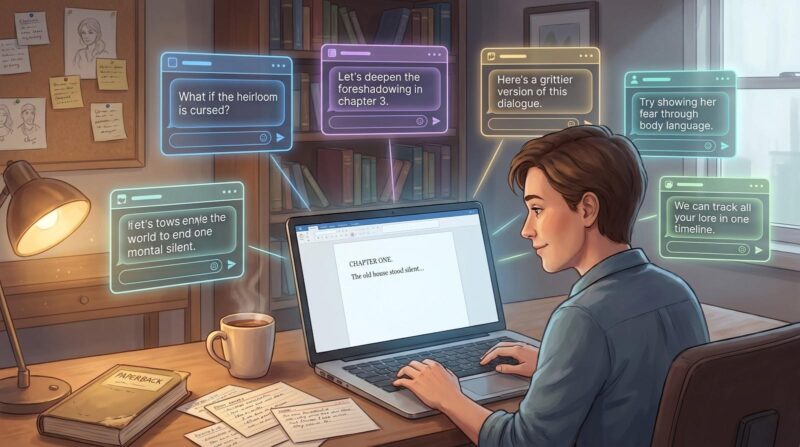
You deserve to know why each tool earned its spot. We didn’t grab names at random or recycle last year’s list. Instead, we spent weeks hands-on with every major AI built for fiction or widely adopted by novelists. Then we scored them against six factors that matter when you’re drafting stories, not ad copy.
First came writing quality. If the prose felt wooden, we cut the tool.
Next, we stress-tested memory by feeding each bot multi-chapter excerpts and looking for plot slips. Claude’s one-million-token context window set the gold standard here.
We also pushed boundaries to gauge creative freedom. ChatGPT’s corporate filters removed the grit from our noir scene, confirming authors’ complaints about “sanitized” fiction.
DreamGen’s terms of service explicitly allow adult, violent, or explicit themes as long as the content is legal, giving authors freedom to explore the full emotional spectrum without filter-triggered fade-outs.
Ease of use, price-to-value, and the vibrancy of each tool’s writer community rounded out the checklist. The weight for every factor sits below, so you can see exactly how the rankings break down.
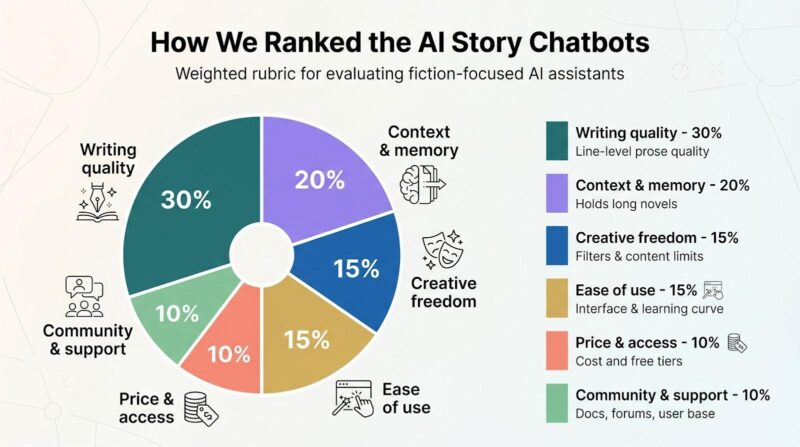
- Writing quality: 30 percent
- Context & memory: 20 percent
- Creative freedom: 15 percent
- Ease of use: 15 percent
- Price and access: 10 percent
- Community & support: 10 percent
Why share the rubric? Once you know our lens, you can tweak it for your own needs. Crave full control over mature themes? Raise “creative freedom” to the top and test an AI role-playing platform built for uncensored storytelling. Prefer polished prose? Push “writing quality” to 50 percent and watch Claude or Sudowrite leap ahead.
Now that the ground rules are clear, we can explore the tools themselves, starting with the one that rewrites the rules on interactive fiction.
DreamGen: your interactive sandbox for uncensored storytelling
Picture a writing studio where characters talk back in real time. Launch immersive AI role playing scenarios through DreamGen’s step-by-step wizard, then drop several characters into a scene, steer the action, and watch fresh prose unfold as naturally as an RPG session.
Freedom is the headline here. DreamGen skips corporate safety rails that muzzle dark or steamy material. Want a villain’s monologue dripping with menace or a romance chapter that refuses to fade to black? Type away; the bot responds without a lecture. For horror, thriller, and spicy romance authors, that openness boosts productivity.
The interface feels more like a chat game than a blank document. Spin up a “world,” define the cast, and set initial stakes. A sidebar lets you whisper director notes—“Have the sidekick betray the hero now”—and the AI rewrites the scene on cue. Because conversations can include images, you can drop a concept sketch of a gothic mansion and ask the AI to describe it through candlelight and creaking floorboards.
On the technical side, paid tiers unlock a 30 000-token context window, enough to hold a novella’s lore without losing track of who owes whom a blood debt. The free tier still offers generous daily credits, so you can test a few chapters before paying. Upgrades stay author-friendly: about the cost of two fancy lattes a month for the Starter plan, rising only if you need marathon sessions or faster image renders.
Total freedom does require discipline. DreamGen produces raw drafts if prompts are vague, and it lacks Sudowrite-style polish tools. Treat it as the improv stage of your process: let characters riff, harvest the best lines, then refine in your primary editor.
Use DreamGen when you want the story to breathe—dialogue crackling, plot twists landing in real time—and when conventional chatbots choke on mature themes. If collaboration by conversation sparks your creativity, DreamGen belongs at the top of your toolkit.
Claude 4.6: the marathon partner with a novelist’s memory
Claude feels less like a chatbot and more like a patient developmental editor. Drop an entire act of your novel (chapters, notes, stray world-building fragments) into its enormous context window, and the model keeps every thread straight. We tested it with a 60-page manuscript chunk, asked for a continuity check, and Claude flagged a missing heirloom while suggesting a subtle way to foreshadow its return. Its one-million-token buffer earns its keep.
The prose has bite. Claude’s training favors nuanced, sensory description, so dialogue lands with subtext and inner monologues carry emotional weight. Reviewers rank it above ChatGPT for long-form depth and reasoning clarity. When you request a rewrite (“raise the stakes, keep my voice”), Claude edits like a respectful co-author, not a bulldozer.
Filters exist but feel lighter than OpenAI’s. Dark fantasy battles stay bloody, villain taunts remain sharp, and only explicit erotica trips a guardrail—a middle ground many authors prefer to ChatGPT’s stricter approach.
Access is simple. A free tier lets you experiment, and Claude Pro costs twenty dollars a month, matching ChatGPT Plus while acting as cheap insurance against plot holes. You can use Claude on Anthropic’s site, Poe, or even within Slack, so it fits wherever you already write.
Turn to Claude when your project sprawls. It remembers foreshadowing from page one, respects your tone on page three hundred, and offers line-level edits that read like you, only sharper.
ChatGPT (GPT-4o / GPT-5): the Swiss-Army pen for brainstorming and first drafts
ChatGPT remains the entry point for many writers, and for solid reasons. Open a new chat, toss in a prompt, and seconds later you have plot ideas, scene scaffolds, or snappy dialogue ready to paste into your manuscript.
Quality improves when you pay for Plus. Sentences flow, metaphors land, and the bot juggles several voices without breaking a sweat. We lean on it for rapid brainstorming: need five meet-cute scenarios or a villain’s tragic backstory? ChatGPT lists them while you refill your mug.
Versatility comes with guardrails. OpenAI’s safety layer removes explicit sex and tones down graphic violence. Ask for a gritty interrogation scene and the bot fades to black just as fists fly. If your genre lives in R-rated territory, expect refusals and plan to shift sensitive passages to another tool.
Memory is the other caveat. A ChatGPT Plus chat remembers up to 128 000 tokens, sufficient for a novella but not a sprawling epic. Feed it chapter twenty without restating threads from chapter one and you risk a continuity glitch. Although memory has improved, long-form writers still paste summaries for massive manuscripts.
Even with limits, ChatGPT earns its place as your fastest idea generator and on-call line editor. Ask it to tighten slack prose, replace weak verbs, or convert a paragraph from third person to first person. The changes arrive in clean Markdown, ready for Scrivener or Docs.
Use ChatGPT when speed and flexibility matter more than absolute freedom or marathon memory. Keep it on hand for outlines, scene sketches, and rapid rewrites, then pass the baton to a long-context or filter-light assistant when the story grows darker or wider.
Sudowrite: the fiction coach that turns ideas into chapters
Sudowrite treats storytelling like a structured workshop. Open a project and the Story Engine asks for genre, theme, and a quick outline. Feed it a one-sentence premise, and it produces scene beats, character arcs, and tonal checkpoints. You never face a blank page; the software guides you from big-picture plot to paragraph-level prose in logical steps.

Its secret weapon is Describe. Highlight a flat sentence such as “The alley was dark” and click. Sudowrite returns a sensory burst of damp brick, distant sirens, and the metallic taste of fear. In seconds, you trade exposition for vivid imagery that passes the “show, don’t tell” test.
A Story Bible keeps continuity tight. Drop character bios or magic-system rules into dedicated fields; every time you generate text, the model refers to those notes so eye colours stay consistent and magic costs remain lethal. Over the course of a novel, this saves hours of manual cross-checking.
Worried about AI clichés? Sudowrite’s proprietary Muse model is trained on fiction, not marketing copy. It favours fresh metaphors and emotional subtext. In side-by-side tests we found its raw paragraphs needed fewer edits than ChatGPT when removing generic phrasing.
Cost is the one drawback. Plans start at nineteen dollars a month for about thirty-thousand generated words. Heavy writers can burn that in a week and need to upgrade or buy extra credits. Think of Sudowrite as a premium writing coach—valuable when you are actively drafting, pricey if you dabble.
Use Sudowrite when you want a guided process that turns outlines into full chapters, enriches bland passages, and polices continuity, all while leaving creative control in your hands.
NovelAI: the unfiltered playground for genre and fan-fic writers
If Sudowrite is a writing workshop, NovelAI feels like the after-hours speakeasy. No filters, no judgment, only a sandbox where anything goes, from wholesome fairy tales to Lovecraftian body horror. The platform’s ethos is simple: let authors explore without a hall monitor.
Open a new document and you meet a minimalist editor and two power features: Lorebook and Modules. The Lorebook works like a living encyclopedia. Define magic rules, character quirks, or planetary physics once, and every future paragraph respects those facts. No more re-explaining mid-draft.

Modules push customization further. Want prose that whispers like classic gothic horror or snaps like shōnen manga? Load a community module tuned to that style and the AI’s voice shifts instantly. Fan-fic writers appreciate the variety, as modules exist for nearly every major fandom, letting you slip into established universes without sounding off-brand.
With zero content filters, you decide how far to lean into violence, language, or intimacy. That freedom means you also act as the quality gate. NovelAI’s core model is smaller than OpenAI’s flagship, so long outputs may drift or repeat if left unchecked. Adjust temperature and repetition penalties, regenerate, and refine until the scene clicks.
Pricing stays reasonable: ten to twenty-five dollars a month buys unlimited text generation and, on higher tiers, built-in image prompts useful for character portraits or cover mock-ups. There is no word cap, making the tool ideal for marathon drafting sessions.
Choose NovelAI when you need unbridled creativity, niche style mimicry, or an AI partner that never says “content disallowed.” Bring your editorial rigor to keep the wild prose on track.
Character.AI: a dialogue gym to flex your characters’ voices
Think of Character.AI as improv class for your cast. Instead of delivering paragraphs of exposition, it presents thousands of premade personas you can chat with or lets you script your own. You ask a question, the character answers in voice, and a swipe gesture reveals alternate takes so you can pick the sharpest line.
That conversation-first design is priceless when dialogue feels wooden. Spend ten minutes interviewing your protagonist about their worst fear and you will surface quirks you never planned. Need banter between rival detectives? Load two bots in one chat and watch them spar while you capture the zingers.
The trade-off is brevity. Each reply caps at a few hundred characters, so you will not get full scenes. Moderation is strict, and the moment a chat veers into explicit sex or graphic violence, the bot refuses or pivots to a PG-13 tone. For dark genres you will draft sensitive passages elsewhere and import them manually.
Memory also runs short. After a dozen exchanges, secondary details slip unless you restate them. That makes Character.AI a brainstorming stop, not a long-form drafting engine.
Still, it is free, mobile friendly, and unrivaled for voice experimentation. Use it to break writer’s block, fine-tune speech rhythms, or let your villain rant until their motive crystallizes, then carry that fresh energy back to your main manuscript.
Google Gemini: the no-cost gateway to AI-aided fiction
Gemini’s strongest selling point sits right on the price tag. It is free. Sign in with your Google account and you gain a competent, always-on writing buddy ready to riff on scenes, translate dialogue, or fact-check an obscure Victorian street name without installing anything.
Gemini leans practical over poetic. Ask it to expand a synopsis and you get clear, structurally sound paragraphs that stay on topic. For beginners, that restraint is comforting. You will not drown in purple prose or tangled plot threads; instead, you receive a clean draft that invites your personal flair.
Because Gemini taps live web data, it excels at weaving accurate details into historical or near-future settings. Planning a techno-thriller set in Nairobi? Ask Gemini for current commuter slang or the latest mobile-money figures, and it cites sources you can verify.
The flip side: stylistic sparkle is lighter than ChatGPT or Sudowrite. Descriptions land safely in “competent” territory unless you push the bot with detailed stylistic prompts. Content filters place it between ChatGPT’s strictness and Claude’s leniency—mild violence passes, explicit romance stalls.
Use Gemini as an accessible first step. It is perfect for students, hobbyists, or anyone testing AI before investing in a paid tool. Draft chapters here, polish them elsewhere, and you have spent zero dollars to discover whether AI co-writing fits your process.
Jasper Chat: a marketer’s multi-tool, but a lukewarm fiction companion
Jasper built its reputation on ad copy and SEO blog posts, and that DNA shows. The chat interface runs on advanced GPT models, so sentence mechanics are solid. Yet when we asked Jasper to draft a fantasy tavern brawl, it wrapped with a tidy brand-safe moral about “co-operation and unity.” Great for LinkedIn, less so for immersive fiction.
Templates focus on business first: product descriptions, listicle intros, YouTube hooks. There is a “creative story” mode, but it keeps the marketing tone, adding lessons or calls to action that feel off-key in novels.
Pricing is the main barrier. Forty-nine dollars a month buys copywriting power you may never use if you only craft prose. Sudowrite or Claude cost less and focus on storytelling rather than keyword density.
Jasper shines in the author-as-entrepreneur workflow. Need an Amazon blurb, Facebook ad set, and press-release quote after finishing your book? Jasper’s brand-voice feature keeps tone consistent across every channel, saving hours.
For pure drafting, treat Jasper as a marketing sidecar, not the primary writing engine. Use it after the manuscript is done to polish the sales funnel, not the story.
Quick-scan comparison table
We just covered a lot of ground. To help you eyeball the differences quickly, here’s a one-page snapshot of every tool we tested and the traits writers care about most.
| Tool | Best for | Max context | NSFW policy | Guided features | Free tier? | Monthly cost | Stand-out extra |
| DreamGen | Interactive role-play, uncensored scenes | 30 K tokens | Allowed | Multi-character chat, image prompts | Yes | $8–$48 | “Your world, your rules” freedom |
| Claude 4.6 | Long novels, line-level edits | 1 M tokens | Moderate | Instruction-driven rewrites | Limited | $20 | Development-editor style feedback |
| ChatGPT (GPT-4o / GPT-5) | Rapid brainstorming | 128 K–256 K | Strict | Plugins, voice mode | Yes | $20 | Swiss-army versatility |
| Sudowrite | Structured drafting & prose polish | ~8 K* | Lenient | Story Engine, Describe, Story Bible | Trial | $19–$59 | Fiction-tuned “Muse” model |
| NovelAI | Unlimited, filter-free fiction & fan-fic | Up to 128 K** | None | Lorebook, style modules | No | $10–$25 | Community style packs |
| Character.AI | Dialogue rehearsal | ~4 K | Strict | Swipe-to-swap replies | Yes | $0–$10 | Thousands of public personas |
| Google Gemini | No-cost AI starter kit | 1 M+ tokens | Moderate | Live web data, Docs integration | Yes | Free | Real-time fact weaving |
| Jasper Chat | Post-launch marketing copy | 8 K | Business safe | Brand-voice templates | Trial | $49+ | Ad and SEO toolkit |
*Sudowrite extends practical memory through its Story Bible, even though the raw token count is smaller.
**NovelAI relies on Lorebook entries to simulate a larger working memory.
Scan down the columns for the factor you value most—context size, price, or content freedom—and your shortlist appears in moments.
Tips for choosing your ideal AI co-author
Start with the pain point. If continuity errors keep you up at night, Claude’s huge memory earns its fee. Fighting “show, don’t tell”? Sudowrite’s Describe button acts as an on-demand tutor. Craving full-tilt grimdark without a content filter? NovelAI or DreamGen serve you better than ChatGPT’s polite prose.
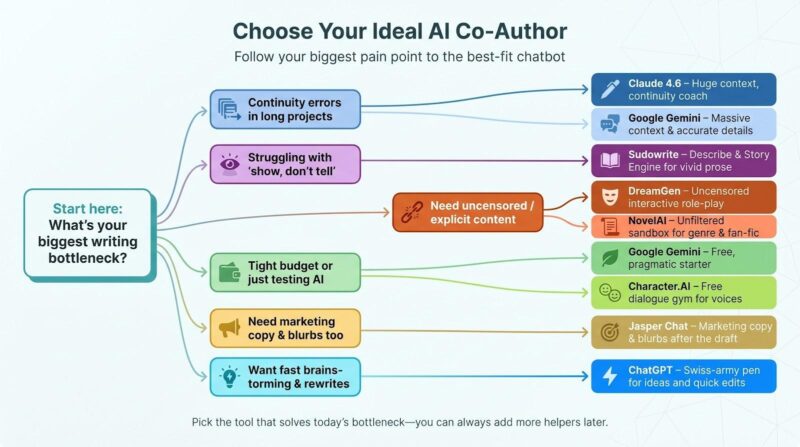
Next, weigh the budget. Gemini is free and covers the basics. ChatGPT Plus and Claude Pro hover around twenty dollars a month, a sweet spot for serious hobbyists. Publishing monthly serials and need unlimited words? NovelAI’s flat-rate text plan beats Sudowrite’s credit meter.
Match the tool to your workflow. Outline first, draft later? Sudowrite’s Story Engine mirrors that sequence. Discover plot through character banter? DreamGen or Character.AI thrive on spontaneous exchanges. Running a Kickstarter and need marketing copy alongside chapters? Jasper handles the promo tasks in the same dashboard.
Always test drive. Nearly every platform offers a free tier or trial. Paste a page of your writing, set a clear instruction such as “continue in this voice, add tension,” and judge the response. You will know within a day whether the chemistry clicks.
Choose the bot that fixes today’s bottleneck, not the one with the flashiest interface. You can always add another assistant when the next hurdle appears.
Frequently asked questions
Can I publish a novel written mostly by AI?
Yes. You own the copyright to text you generate with these tools, as long as you shape and edit the material into an original work. Treat the AI as a tireless collaborator, then add your voice.
Will readers spot an “AI voice”?
Only when the draft goes straight from the bot to print. Combine the AI’s speed with your revision skills, and every line will sound like you.
Which AI handles explicit romance best?
NovelAI and DreamGen allow adult content without refusals. Sudowrite is comfortable with steamy scenes but stops short of pornography. ChatGPT, Gemini, and Character.AI fade to black.
Do these tools run offline?
No. All seven services process your text in the cloud. If privacy is critical, consider open-source models you can host locally, but they require technical setup.
How much text can I paste at once?
Claude and Gemini accept the most—up to 1 000 000 tokens, or multiple novels at once. ChatGPT Plus tops out at 256 000 tokens. The rest range from 8 000 to 128 000, depending on tier and model.
Is using AI cheating?
Think of it like hiring a developmental editor who never sleeps. You still decide the plot, theme, and final wording. Readers care about impact, not your tool set.