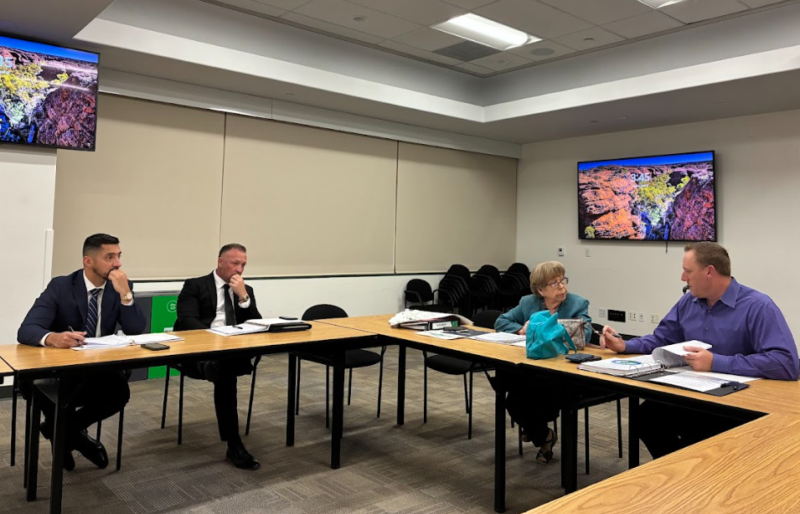
The Santa Clarita City Council’s Legislative Committee made a few recommendations for the council on rules and regulations that could impact Santa Clarita.
Masis Hagobian, the city’s intergovernmental relations officer, presented recommendations on three items to the council’s standing committee, which includes Councilwoman Marsha McLean and Councilman Jason Gibbs. Those included a countywide sales tax to pay for service gaps anticipated due to the One Big Beautiful Bill Act; and a pair of bills meant to speed up the construction of more homes.
Also known as HR 1, the OBBB Act “cuts billions in federal Medicaid funding to California and imposes new eligibility requirements and copays, resulting in reduced care for patients,” according to a resolution from the L.A. County Board of Supervisors in February, supporting the county tax increase.
In response, the county passed a spending plan “which allocates these general tax revenues to help fund health care, public health, food benefits and other human services in Los Angeles County,” according to a county website about the measure.
The county response asks voters on the June 2 ballot whether they support a countywide half-cent sales tax increase, which is expected to raise a half-billion dollars over the next five years.
The money would “keep the county’s health care system positioned to meet the demand it currently faces and prevent the potential closure of our public hospitals,” according to the county CEO’s office. The measure also calls for a nine-person advisory committee to recommend and review expenditures and provide annual reporting to the public.
It passed with a 4-1 vote, according to Hagobian, with L.A. County 5th District Supervisor Kathryn Barger opposed, he added.
The city staff recommendation to the committee, which the committee supported, was opposition to what’s being called the Essential Services Restoration Act, or Measure ER.
“From the county’s perspective, and departments specifically related to Department of Public Health and other departments that receive federal funding for support of health care programs throughout L.A. County have estimated a significant hit to their funding, as a result of this federal legislation,” Hagobian said, “and so because of that, there was a concern and a need identified by the Board of Supervisors to place this on the ballot.”
Sales tax within Santa Clarita is currently 9.75%, and the county measure would bring the sales tax back to 10.25%.
The measure is being supported by health care providers’ unions, as well as a number of health care providers.
Gibbs asked about the deficits being forecast by HR 1, with one estimate putting the funding difference at $2.4 billion over three years.
McLean said she was “a hard no,” on the tax increase, because there’s never acceptable accountability for the measures, mentioning the recent audit with the county’s homeless services.
“You read every single day where nonprofits have spent tons of money, they have not accounted for that money, and nobody is making them account for that money,” she said. “Right now, the county with LAHSA, there’s supposed to be an audit to find out where all that money went. There still is not a response to that audit.” She also said she was suspicious of the five-year sunset included in the act.
Housing bills
Assembly Bill 748 is a bill that the council has previously opposed, according to Hagobian.
Assemblyman John Harebedian, D-Pasadena, introduced the measure, which would require cities and counties to develop a program with preapproved housing projects, which could be approved and built through a streamlined ministerial process.
The bill also would deem such an application complete if a local agency fails to make a final determination of the application in 30 days.
Hagobian described it as a sort of point, click and build process for single-family homes, once a home is conceptually approved, meaning it abides by the city’s objective design standards.
“But then what happens with … those pre-approved plans is that the city would then have to then create a website, list out all of the different pre-approved plans based off of this new legislation, that website would need to basically come online July 1, 2027,” he said. “And then after that, moving forward, anytime someone is interested in building a project, they could go on the website, look at all the pre-approved plans out there, if they like one that’s on the website, they would select it, come over the counter and through a ministerial process.”
In explaining the recommendation for opposition, which the committee also supported, Hagobian described it as “that same thing that we’ve been seeing for seven years now, the state really trying to find any pathway to preempt local discretion, local authority, local review of any type of residential projects, whether it’s multifamily or single-family.”
The bill passed the Assembly unanimously, 75-0, according to online records. Assemblywoman Pilar Schiavo, D-Chatsworth, voted in support. It was given a first reading in the Senate on Tuesday for committee assignments.
Hagobian again began to talk about how it limited local control over the approval of housing plans.
“So first off, what this does is it requires, it creates a limit on the number of plan checks to really only two rounds,” he said. “So local building officials will only now be given the ability to conduct two plan checks per application that’s coming through the door.”
Hagobian said the intent might be positive, but the blanket mandate would increase the cost for the city’s planning division, by cutting the time frame it has to conduct reviews.
He said he the intent might be “to really ensure that if there are bad actors out there where you have local governments that are, quote, unquote, maybe dragging their feet on applications and plan checks, that this now limits the time frame that they have in place to really, you know, in good faith review and approve, plan checks,” he said. “The only problem with that is that this would apply regardless if you’re a bad actor or if you really are, you know, just going through a very due diligence process to ensure that the plan checks have everything that they need.”