By Aldgra Fredly
Contributing Writer
The Department of Justice asked a court on Sunday to lift the block on the White House ballroom project, citing a recent shooting it said was the second attempted assassination of President Donald Trump in one month.
In its court filing, the DOJ referenced the Saturday incident that occurred near 17th Street and Pennsylvania Avenue, where a gunman pulled a weapon from his bag and opened fire at a White House security checkpoint, prompting Secret Service agents to return fire.
The suspect, identified as Nasire Best, 21, was struck and pronounced dead at the hospital. No agents were injured, but one bystander was hit during the exchange of gunfire, according to the Secret Service. The bystander was “seriously wounded,” the DOJ stated in its filing.
The DOJ said the incident underscored the “critical need for top-level, state-of-the-art security at the White House, including the ballroom,” which it said is vital for national security and to ensure the president can perform constitutional duties in a “heavily secured facility.”
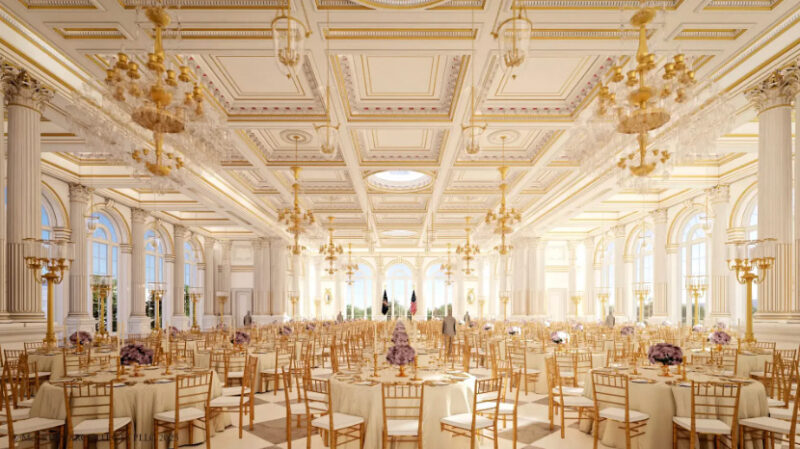
According to the filing, the under-construction East Wing ballroom will include “a heavy steel, drone-proof roof, missile-resistant and drone-proof columns, bullet, ballistic, and blast-proof glass, military-grade venting for air conditioning and heating, and much more.”
“This is a terrible, tremendously harmful case to the United States of America, and all it stands for,” the DOJ said of the lawsuit that led to the injunction.
The National Trust for Historic Preservation filed the lawsuit in December 2025, alleging that construction of the ballroom was unlawful. On April 16, U.S. District Judge Richard Leon issued a preliminary injunction halting the project but allowed “below-ground” construction of national security facilities to continue.
The appeals court later temporarily blocked the order and scheduled a June 5 hearing to decide whether to halt the project.
The DOJ previously requested, in an April 27 filing, that Leon dissolve his injunction and dismiss the lawsuit following an April 25 incident during the White House Correspondents’ Dinner at the Washington Hilton.
In that incident, a gunman breached a security checkpoint near the ballroom and shot a Secret Service agent. Authorities arrested the suspect, identified as Cole Allen, at the scene. He was charged with four federal charges, including attempted assassination of the president.
The judge has not yet acted on that motion. The DOJ had also urged the National Trust for Historic Preservation to voluntarily drop its lawsuit, saying it “puts the lives of the president, his family, and his staff at grave risk.”
Carol Quillen, president of the National Trust for Historic Preservation, issued a statement on April 27 saying the group does not intend to dismiss its lawsuit.
“Building it lawfully requires the approval of Congress, which the administration could seek at any time,” Quillen said.
The project is estimated to cost about $400 million, which Trump said will be funded by private donors. Senate Republicans have sought $1 billion in taxpayer funding for the Secret Service for White House security upgrades, including the ballroom.
The Senate’s parliamentarian, Elizabeth MacDonough, on May 16 rejected the proposed security funding provision, ruling that it breaks the rules of the reconciliation process.
Joseph Lord contributed to this report.