By Tom Ozimek
Contributing Writer
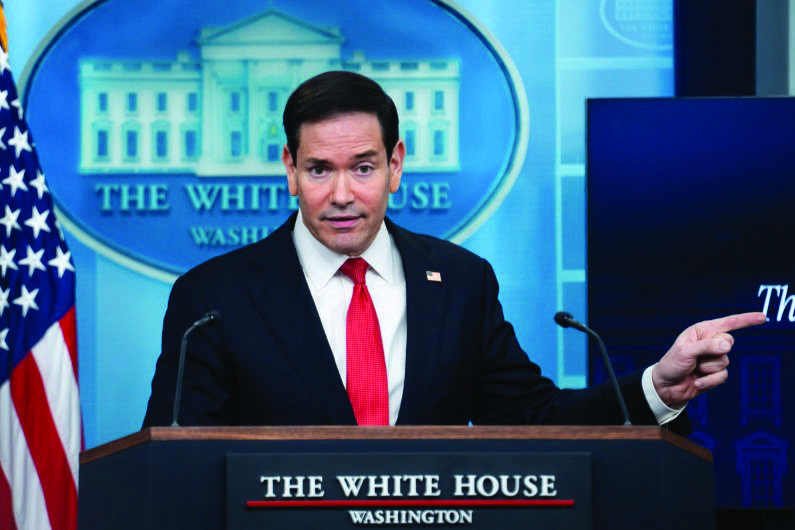
U.S. Secretary of State Marco Rubio said on Tuesday that the Strait of Hormuz must remain open “one way or the other,” after U.S. forces carried out what Washington described as defensive strikes in southern Iran, with Rubio also expressing guarded confidence that negotiations with Tehran would ultimately produce an agreement.
“The straits have to be open, they’re going to be open one way or the other, so they need to be open,” Rubio told reporters aboard his plane in Jaipur, India, when asked about the strategic waterway following Monday’s U.S. strikes on Iranian boats and missile launch sites.
Rubio said negotiations over a draft agreement with Iran were advancing but cautioned that finalizing the language could still take several days.
“Look, I think our position is well stated,” Rubio said. “The president had a very important, I think, historic call just a couple days ago, with a number of leaders from the region. I think there’s strong alignment and agreement on what a draft should look like.”
He added that disagreements remained over specific wording and details.
“Like anything with something like this, it’s going to take a couple days to settle on, even down to the disagreements over a word, sentence,” Rubio said. “There’s going to be a deal, we’re going to have to work through that, but this is either going to be a good deal or there isn’t going to be one.”
Rubio’s comments came amid heightened tensions in the Gulf following renewed U.S. military action against Iran and continued disruptions to maritime traffic through the Strait of Hormuz, one of the world’s most important energy chokepoints.
The U.S. military said on Monday it conducted “self-defense strikes” against Iranian missile launch sites and boats attempting to lay mines near southern Iran. U.S. Central Command spokesman Navy Capt. Tim Hawkins previously said that the strikes were intended “to protect our troops from threats posed by Iranian forces” while maintaining restraint during the ongoing ceasefire.
Iranian media reported explosions near Bandar Abbas, Sirik and Jask late Monday, though Tehran has not formally commented on the incidents.
Without commenting on the specific incidents, a spokesperson for Iran’s military warned that any new attack by the United States or Israel would trigger a response that is “very devastating.”
Brig. Gen. Abolfazl Shekarchi was cited by Iranian state-run media outlet IRNA that Tehran was fully prepared for war and would respond forcefully to “any attack and new adventurism” targeting Iran, adding that retaliation would involve surprise tactics and be far harsher than in previous clashes.
Shekarchi also said that Iran would continue to defend its national interests by maintaining control of the Strait of Hormuz “with authority.”
About 20% of global oil supplies normally pass through the narrow waterway, which Iran has been restricting in retaliation for the joint U.S.-Israeli military campaign, launched on Feb. 28 with a series of devastating strikes that left much of Iran’s leadership and military decimated.
Iran’s blockade has disrupted global shipping and sent oil prices and transportation costs surging, putting pressure on the Trump administration, as soaring gas prices have driven consumer sentiment to near-record lows.
Iran Rejects ‘Toll’ Characterization
Iranian foreign ministry spokesperson Esmail Baghaei on Monday denied reports that Tehran intended to impose tolls on ships using the strait, saying instead that Iran and Oman were working on a legal framework to ensure maritime security and environmental protection.
Baghaei said any fees under discussion would relate to navigation and environmental services and “should not be referred to as a ‘toll’ or ‘duty.’”
He also said Iran and Oman believed the strait should remain usable for the entire world and that no other countries were currently operating in the waterway.
The United Kingdom and France have both signaled support for a future multinational defensive maritime mission in the region. Britain has pledged mine-clearing support and specialist personnel once conditions allow, while British sailors stationed in Gibraltar are preparing for possible deployment.
European Union leaders recently voted to broaden the bloc’s sanctions framework against Iran to include threats to freedom of navigation.
“Iran’s actions against vessels transiting through the Strait of Hormuz are contrary to international law,” the Council of the European Union said on Friday, citing Tehran’s violations of established rights of transit and innocent passage through international waterways.
The new sanctions include travel curbs that bar listed individuals and entities from entering or transiting through European Union territories, as well as asset freezes.
Iran’s blockade has also accelerated efforts to bypass the Strait of Hormuz. Officials in the United Arab Emirates recently said that a major new oil pipeline designed to provide an alternative crude shipping route was nearly 50% complete, a project that, when finished, would undercut Iran’s ability to use control of the maritime chokepoint as leverage.
Evgenia Filimianova and Guy Birchall contributed to this report.