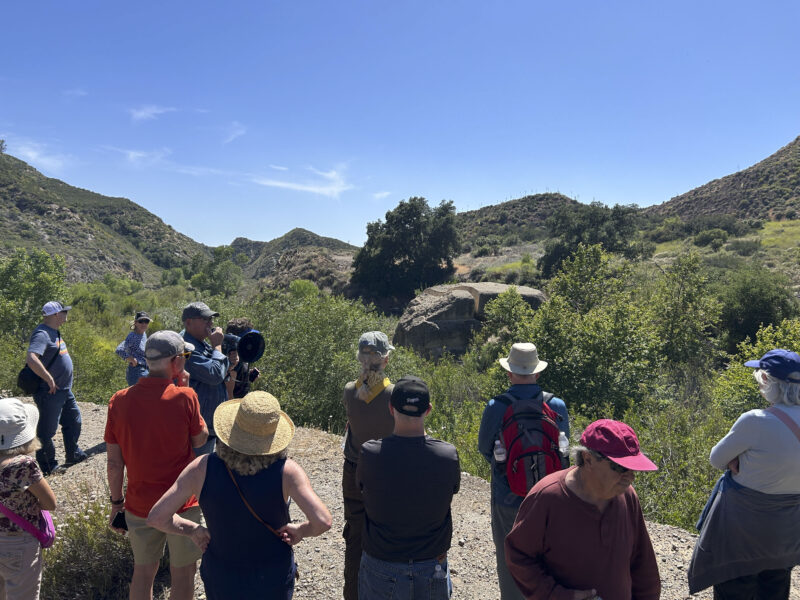
Two buses filled with nearly 100 people visited the St. Francis Dam site on Saturday for the Santa Clarita History Center’s annual dam tour.
The dam breached just before midnight on March 12, 1928, killing over 400 people, and is considered one of the worst disasters in the history of California.
“We all met at the Newhall Family Theatre, and there we had a lecture and a slideshow on the history of the construction of the dam and what caused it to go down. I recited the story itself from William Mulholland building the aqueduct, which brought water to Los Angeles in 1913, and he was also the man who was in charge of the St. Francis Dam construction,” said Frank Rock, who has been giving the tour since 1993.
Rock — nicknamed “The Dam Man” — gets a new crowd of people every year who are interested in learning more about the history of the dam.
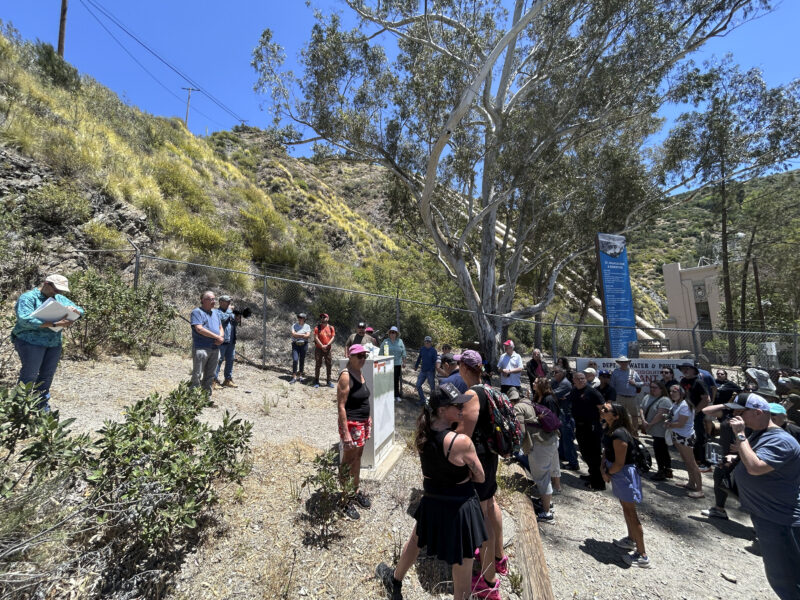
“We mainly get a crowd of new people every year, which is good. An influx of people come, and they read about the history of the valley in one way or another. This disaster is the second-worst in the history of California — second only to the 1906 San Francisco earthquake and fire,” Rock said. “We get all ages — small children, teens, people near 100, and sometimes we get those who are relatives of people who were victims of the flood.”
Despite its solemn history, the dam tour is the History Center’s most successful event each year.
“People are intrigued by the fact that there’s a ruin still associated with the flood. When the dam broke, it left a pretty remarkable fragment standing — a 200-foot-tall tombstone. It looks like a tombstone. They dynamited it the following year after a boy was killed playing on the rocks there,” Rock said. “What makes this site memorable is that it’s ‘tangible history’ — it’s something that you can walk and stand, and say that this is where the actual site is and where people lived and died.”
Rock has been researching the dam for over 40 years, and always finds something new, despite the dam being built a century ago — with construction ending in 1926.
“There’s quite a bit of pieces out there still — there’s one called Block 19, and that’s an 18-foot chunk of the dam, which still has five of the stair-step face of it. When they went and found pieces of the dam originally, they had nine different state, civil, county investigations on the disaster, and they were able to look at the different fragments and be able to tell where from the dam they came from,” Rock said.