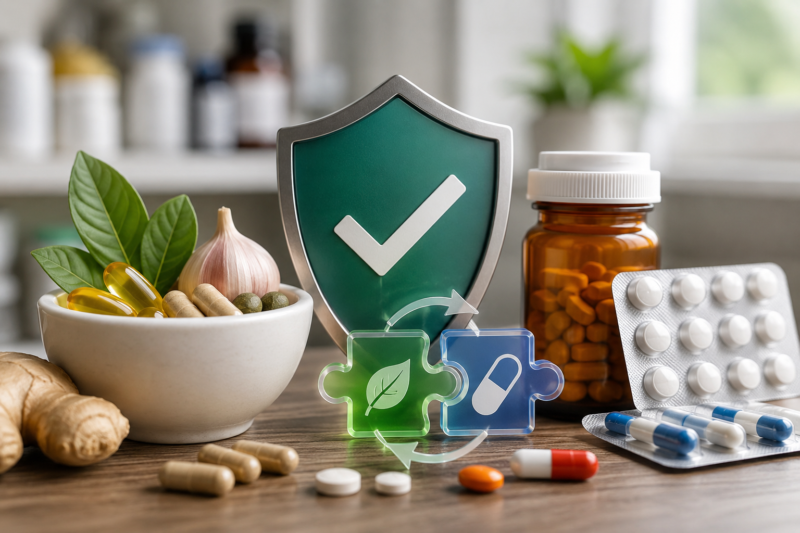
Millions of individuals consume dietary supplements daily without informing their physicians. One pill today, one bottle tomorrow; all appear to be innocuous in themselves. But when taken together with prescribed drugs, their interaction may either result in decreased effectiveness of the medications or even dangerous side effects.
Drug-supplement interactions are among the most underreported safety issues in modern healthcare. Patients don’t mention supplements because they don’t consider them ‘real medicine.’ Doctors don’t ask because the appointment time is short and the training on supplement pharmacology is often limited. The result is a gap in care that leaves patients exposed to risks they never knew existed. For clinicians and patients wanting to learn more about how this gap is being addressed, the ClarityTx blog covers emerging approaches to supplement safety in clinical practice.
This article elaborates on the mechanism by which such drug-supplement interactions occur, highlights the interactions that are most frequently overlooked, shows ways for patients to avoid potential harm, and describes how healthcare professionals are making use of innovative technology to bridge the gap.
How Drug-Supplement Interactions Actually Happen
Knowing how interactions occur allows for better understanding of the significance of interactions. Many supplements influence one or more of these processes. St. John’s Wort is a good example that has been extensively researched to have strong effects on CYP3A4 enzymes. Most drugs that are commonly used are metabolized by these enzymes, which include anti-depressants, HIV drugs, immune system suppressants, and oral contraceptives.
With the increase in the enzyme activity, the rate at which the medication is metabolized becomes very high; its concentration levels in the bloodstream become low, and consequently the effectiveness is reduced, especially in organ transplantation recipients who fail to respond to anti-rejection drugs due to St. John’s wort ingestion.
Pharmacodynamics interactions involve where the supplement and the medication target the same system and result in an interaction between them through addition, synergy, or antagonism. Large quantities of fish oil, which is a very mild blood thinner, used together with blood-thinning medications, such as warfarin, causes excessive bleeding. In contrast, using antioxidants in combination with anticancer medications is bound to reduce the ability of the drugs to destroy the cancer cells.
The Supplements Most Likely to Cause Problems
Not all supplements carry equal interaction risk. Several have particularly well-documented interaction profiles that patients taking prescription medications should know about.
Although Ginkgo biloba is commonly used to enhance mental performance, its antiplatelet action may result in increased bleeding tendencies when taken with blood thinners and NSAIDs. Similarly, garlic extracts at high dosages have shown anti-coagulant activity. Kava that is taken for treating anxiety can cause an interaction with sedatives; moreover, kava can cause a bad effect on liver functioning.
The use of calcium that people take in large quantities to ensure strong bones will slow down the absorption of other drugs like thyroids, some antibiotics, and even bisphosphonates when used together. The intake of iron will affect the absorption of levodopa (used for Parkinson’s disease), tetracyclines, and fluoroquinolones (both antibiotics).
The challenge is not that these supplements are dangerous for everyone – most are safe when used appropriately, in the right context, for the right patient. The challenge is identifying when ‘the right context’ does not include a patient’s current medication regimen.
Why This Problem Is So Widely Missed
Several factors converge to make drug-supplement interactions a chronic blind spot in healthcare.
Supplements are first considered different from medicine, in that when a patient fills in their intake form regarding current medication use, they generally do not write in their vitamin D, omega-3s, or ashwagandha. The mental category of ‘things I take’ versus ‘medications’ creates a documentation gap that persists through the entire care relationship.
Second, many physicians receive limited training in nutritional and botanical pharmacology. Medical school curricula have historically underemphasized these topics, leaving many conventional physicians without the background to assess supplement safety even when they do ask.
Thirdly, unlike pharmaceutical medications, there is no requirement for interaction warnings to be printed clearly on supplement labels. The label of a bottle of St. John’s Wort might have a caution about taking the product with particular medications; however, this information may be included in fine print using vague wording.
Fourth, the sources that can help clinicians cross-check the information in order to identify any interactions between the substances is fragmented. There is no continuous repository of interactions between the medications and natural supplements which is continuously being updated and which would be easily accessible for clinicians during a consultation. Platforms such as ClarityTx have taken steps in this direction by integrating interaction checking into the clinical protocol process.
What Patients Can Do Right Now
Patient action is the first line of defense. There are several ways to help lower the risk of such interactions.
Keep an exhaustive record of your supplements which must contain brand names, names of supplements, dosage, and frequency of their intake. It is essential for you to carry this list whenever you visit a doctor. It would be best to keep this list either in your pocket or your cell phone.
Always reveal all supplements to all doctors regardless of their significance. It’s possible that the gastroenterologist who just prescribed you a new medicine is unaware that you take high-dose iron. The dermatologist recommending a topical retinoid may not know you are taking blood thinners that affect wound healing.
Be particularly cautious during any change in your medication regimen. When a new prescription is added, this is the moment to explicitly ask your prescriber whether it interacts with anything you are currently taking – and to include your supplements in that list.
Consult a pharmacist. Pharmacists are among the most underutilized resources in healthcare. They have extensive training in drug interactions and can review your complete medication and supplement list for potential concerns in a way that many physicians, pressed for time, cannot.
The Role of Functional Medicine in Closing the Safety Gap
Functional and integrative medicine practitioners are uniquely positioned to address the supplement safety gap because the evaluation of the patient’s complete supplement and medication regimen is a core part of their practice model. Where a conventional 15-minute appointment may not allow time for a thorough supplement review, a functional medicine consultation typically begins with a comprehensive intake that includes everything the patient is taking.
The best functional medicine clinicians use this intake to build a safety profile before making new recommendations – checking what the patient is already doing against their medication list and identifying any concerns before layering on additional interventions.
What Healthcare Should Look Like Going Forward
The supplement safety gap is fixable, but fixing it requires changes at multiple levels. Clinician education on supplement pharmacology needs to be incorporated more consistently into medical and pharmacy training. Supplement labels need to carry clearer interaction warnings. Patients need to be systematically asked about supplement use at every clinical encounter, not just by integrative providers.
Technology also has a role to play. Clinical platforms that automatically screen a patient’s supplement and medication list for interactions – presenting the results in a format the clinician can review and act on during the appointment – make it structurally easier to catch problems that have historically slipped through.
FAQ
Q: Do I need to stop my supplement intake before starting on any drug therapy?
No, but it is not necessarily so as one should discuss it with one’s prescriber or pharmacist.
Q: Are natural supplements less harmful than prescription medicines?
Not necessarily. “Natural” does not mean “chemically inactive.” Certain substances from nature have a strong biological effect and can greatly affect the way one takes their medications.
Q: How do I find a doctor who will take my supplement use seriously?
Practitioners of functional medicine and integrative medicine are knowledgeable about supplement screening as part of their professional training. Your primary doctor or pharmacist will be able to screen your supplements for any possible interactions.
Q: Supplements can affect test results.
Yes. Biotin (Vitamin B7) is an example where it may affect laboratory tests using immunoassays, resulting in either falsely elevated or falsely low values. If you are taking large amounts of biotin, notify your laboratory and your physician who ordered the test before you undergo the test.
Q: Is there a safe amount of fish oil for those taking blood thinners?
There is no universal safe dose. The interaction risk is dose-dependent, and the clinical context – the specific anticoagulant, the patient’s INR levels, other risk factors – determines whether fish oil can be used and at what amount. This requires individualized clinical guidance.
Q: How often are drug-supplement interactions reported to health authorities?
Very rarely, relative to the actual frequency of interactions. Adverse effects caused by supplements are routinely not reported as patients do not associate their symptoms with the use of supplements, and the information about them is not routinely recorded by healthcare professionals.
Supplement safety is not a niche concern for the health-conscious – it is a mainstream patient safety issue affecting anyone who takes prescription medications and dietary supplements simultaneously. The first step toward safety is awareness, and the second step is a conversation with a clinician who has the training and the tools to give you a real answer rather than a guess. To see how modern clinical platforms are supporting that standard of care, visit ClarityTx, a functional medicine protocol platform built on evidence, accuracy, and clinician expertise.