From shared harvests to hands-in-the-soil connection, community gardens are quietly flourishing across Santa Clarita — offering residents a place to grow more than just food.
At both the longstanding Community Gardens of Santa Clarita and the newer garden at FivePoint Valencia, the act of tending crops has become a vehicle for building relationships, promoting sustainability, and reconnecting with nature in an increasingly fast-paced world.
Rooted in Community
For Mark Hershey, president of the Community Gardens of Santa Clarita, the appeal begins with something simple yet powerful: the opportunity to grow.
“Community gardens provide an opportunity for gardeners to grow vegetables all year since our climate has two growing seasons, summer and winter,” Hershey said. “Our garden members lovingly tend their plots and the gardens as a whole, growing a variety of vegetables, herbs, fruits and flowers using organic methods.”
But beyond the harvest, Hershey emphasizes the emotional and social benefits.
“Working with the soil and growing crops offers a sense of peace and calm and instills a feeling of community,” he said.
Founded on May 9, 2011, the Community Gardens of Santa Clarita have steadily expanded over the years. Today, the site spans 1.29 acres and includes 131 garden plots, along with an orchard of approximately 50 fruit trees, owl boxes, birdhouses and a flower garden.
“Our mission is to create a community facility where individuals can come together to promote the benefits of locally grown, organic food that is environmentally friendly, sustainable and cost effective,” Hershey said.
That mission has drawn more than 200 residents over the past 15 years, with 88 active gardeners currently cultivating plots ranging from 10-by-10 to 10-by-20 feet.
Growing Together
The gardens are not only a place to plant, but also a hub for year-round community engagement.
“We have four quarterly events every year to involve gardeners,” Hershey said, noting activities such as a pancake breakfast, harvest festival with chili and pie competitions, and a holiday celebration.
Participation does require commitment. Gardeners pay an annual fee — $50 for a 10-by-10 plot or $100 for a larger plot — and are expected to contribute 12 volunteer hours each year. Plots are assigned on a first-come, first-served basis, and there is currently a short waitlist.
While the rewards are plentiful, Hershey is quick to point out that gardening is not without effort.
“Many people underestimate the time and physical work of preparing, planting, maintaining and harvesting their crops,” he said.
Still, for those willing to invest the time, the payoff extends far beyond the garden bed.
“Gardening and harvesting your crops is a very fulfilling endeavor,” Hershey said. “The flavor of your own grown vegetables is far more delicious than store-bought. The relationships formed are wonderful and last a lifetime.”
A Newer Model in FivePoint
Across town, a different — but equally community-driven — approach is taking root at the Community Garden in FivePoint Valencia.
Located at Confluence Park Garden Home at the corner of Riparian Avenue and Ramblewood Street, the garden operates as a shared space rather than individual plots.
“The Community Garden is much more than a place to grow vegetables and flowers — it’s a vibrant gathering space that reflects FivePoint’s commitment to sustainability, connection and community spirit,” said Gaynor Butler, one of three volunteer committee members alongside Samantha Santana and Sara Voznyak.
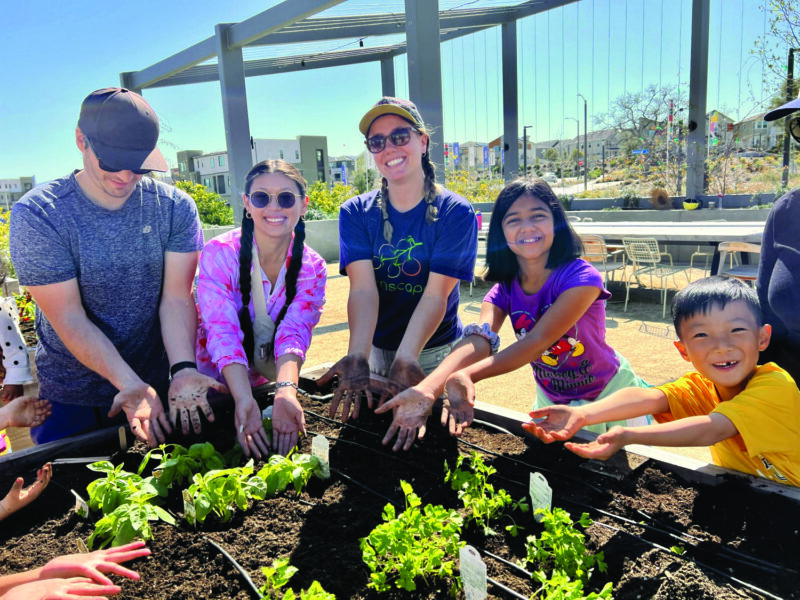
Unlike traditional garden models, FivePoint’s garden emphasizes collaboration. Residents collectively plan seasonal plantings, and all crops are grown and maintained together in five raised beds measuring 4-by-9 feet.
“What makes the garden unique is its welcoming atmosphere,” Butler said. “Whether you’re an experienced gardener or simply curious to learn, everyone is encouraged to participate.”
No Experience Required
Accessibility is a defining feature of the FivePoint garden. There are no fees to participate, thanks to funding from the homeowners association, and no prior gardening experience is required.
“Residents simply need to bring their enthusiasm and willingness to learn,” Butler said. “The garden is a supportive, hands-on environment where members can gain confidence while working alongside neighbors.”
Monthly workdays paired with healthy potlucks have become a cornerstone of the program, blending light gardening tasks with social connection.
“These gatherings help strengthen neighborhood bonds while nurturing a space that benefits everyone,” Butler said.
The garden also hosts a weekly community harvest every Tuesday evening, inviting residents to sample fresh produce while learning proper harvesting techniques from members.
“Signage throughout the garden encourages visitors to harvest during these designated times, helping maximize yields and maintain plant health,” Butler said.
Cultivating Connection
While the two garden models differ — one offering individual plots and the other operating as a shared space — both reflect a growing interest in local, sustainable living and community engagement.
At FivePoint, Butler sees the garden as an extension of neighborhood life.
“At its heart, the Community Garden is about more than gardening — it’s about cultivating community, fostering lifelong learning and experiencing the simple joy of growing something together,” she said.
Children and families are especially encouraged to participate, turning the garden into a living classroom for healthy habits and environmental awareness.
Similarly, at the Community Gardens of Santa Clarita, education and mentorship play a key role. Beginner gardeners are welcomed with orientation sessions and access to instructional videos, ensuring that even those new to gardening can succeed.
For Hershey, that inclusivity is essential.
“Beginner gardeners are welcomed,” he said. “We provide guidance and resources so they can learn and grow.”
Planting Seeds for the Future
As interest in sustainability and local food sources continues to rise, community gardens like these are becoming increasingly relevant.
They offer not only fresh, organic produce, but also a chance to slow down, connect with others and engage in something tangible.
For those considering getting involved, both Hershey and Butler emphasize that the first step is simply showing up.
“Gardening is a very fulfilling endeavor,” Hershey said. “It brings people together in a meaningful way.”
And at FivePoint, the invitation is just as open.
“New members are always welcome, whether they are experienced gardeners or simply interested in getting involved and meeting neighbors,” said Butler, adding that interested residents can stay informed through community publications such as Valencia Lifestyle and the Clubs Weekly Roundup.
In a region known for its sunshine and long growing seasons, these shared spaces are proving that community can take root just as easily as any seed — when given the right conditions to grow.