By Signal Staff
The Los Angeles Homeless Services Authority on Friday released the results of the 2026 Greater Los Angeles Homeless Count, and while the results show an uptick in homelessness countywide, the tally reflected a slight reduction in homelessness reported in Santa Clarita.
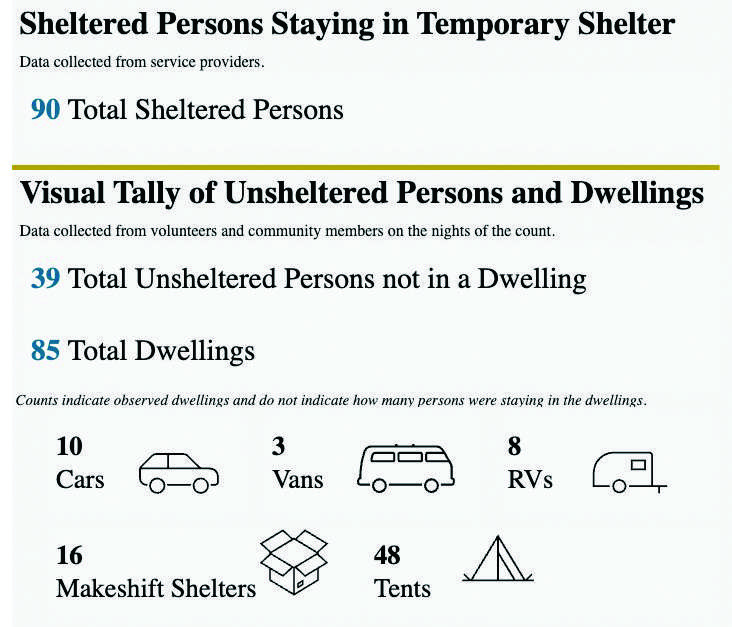
Locally, LAHSA reported 90 individuals were sheltered in Santa Clarita shelters, based on data provided by service providers. The visual count conducted by volunteers in January reported 39 unsheltered individuals in Santa Clarita and a total of 85 “dwellings” sheltering homeless individuals.
Such dwellings include cars, vans, RVs, makeshift shelters and tents. Of those 85 “dwellings,” 48 of them were tents.
The Santa Clarita tally reflected an overall decrease in the number of dwellings and homeless individuals compared to the two prior years.
Within that overall number, the number of individuals housed in shelters has gone up, from 58 in 2024, to 61 in 2025 and 90 in 2026.
Countywide: Progress Stalls
Regionally, following two consecutive years of steady drops in homelessness, progress stalled, showing a slight 1.2% increase to an estimated 73,040 people in Los Angeles County and a 3.4% increase to 45,194 people in the city of Los Angeles, according to a news release from LAHSA.
Neither change is considered statistically significant by LAHSA.
LAHSA said the data indicates that the increase does not come from the failure of any particular program.
“Rather, the data shows that the primary driver of the increase is a pause in new enrollments and permanent housing placements using Time Limited Subsidies,” the release said. “Funding reductions forced the pause on TLS enrollments; as a result, the number of people newly housed using TLS dropped from 10,308 in 2024 to 6,590 in 2025. This substantially contributed to the number of people the rehousing system permanently housed in 2025, which dropped to 23,532.”
That is an approximately 5,100-person decrease from the record high of 28,625 people permanently housed in 2024, the LAHSA release said, adding that the reduction in available rental assistance slowed down the rehousing system’s efficiency.
The lack of movement in the system left fewer available beds for people experiencing unsheltered homelessness to fill, according to LAHSA. “This bottleneck contributed to the 3.3% rise in unsheltered homelessness in L.A. County to an estimated 49,002 people and the 7.9% rise in unsheltered homelessness in the city of Los Angeles to an estimated 29,115 people,” the release said.
“This year’s count confirms a fundamental truth: access to permanent housing ends homelessness,” Gita O’Neill, interim CEO of LAHSA, said in the release. “When our unhoused neighbors lost access to rental subsidies, the system slowed, there was less upward movement in interim housing, and progress stalled. Our community needs to come together to reinvest in permanent housing resources and advocate for resources from our state and federal partners to clear this bottleneck and get our region back on track.”
The rehousing system slowdown was further compounded by the severe economic pressures that persist in this region, the LAHSA release said. In Los Angeles County, a household must earn an annual income of $110,000 per year to afford the average rent of $2,745/month, the release said, adding that the region also lacks more than 473,000 affordable homes it needs to meet current needs.
In this year’s PIT Count demographic surveys, 59% of newly unhoused residents cited economic hardship as the primary cause of their homelessness. The number of people who accessed the rehousing system for the first time or for the first time in the past two years increased to 55,691 people. That means 2.37 newly unhoused people enter the system for every person the system placed in permanent housing, the release said.
L.A. County Supervisor Kathryn Barger, whose northern L.A. County district includes the Santa Clarita and Antelope valleys, issued a statement in response to the LAHSA data release.
“The annual homeless count provides valuable information, but it is only one measure of our work and does not reflect the full picture of the challenges that remain,” Barger’s statement said. “I was encouraged to see a 37% reduction in unsheltered homelessness in the Antelope Valley, demonstrating that focused strategies can make a meaningful difference. That said, I also understand how the public measures success. Residents look to our streets as the most visible indicator of whether we’re making progress, and too many still see people living in crisis. We have to acknowledge that reality.”
“If we want fundamentally different outcomes, we must be willing to address the biggest barriers standing in our way. Los Angeles County cannot solve this crisis through housing alone,” the statement said. “We also need the ability to provide timely, intensive treatment for individuals experiencing severe mental illness and substance use disorders. For years, I have advocated for greater local flexibility to expand access to those services because outdated federal restrictions continue to limit our ability to treat people at the scale this crisis demands.”
Barger added: “We owe taxpayers accountability. We owe our communities safer and healthier neighborhoods. And, most importantly, we owe people experiencing homelessness every opportunity to recover and rebuild their lives. That remains my focus.”
To view the LAHSA data dashboard, go to www.lahsa.org/data-refresh.