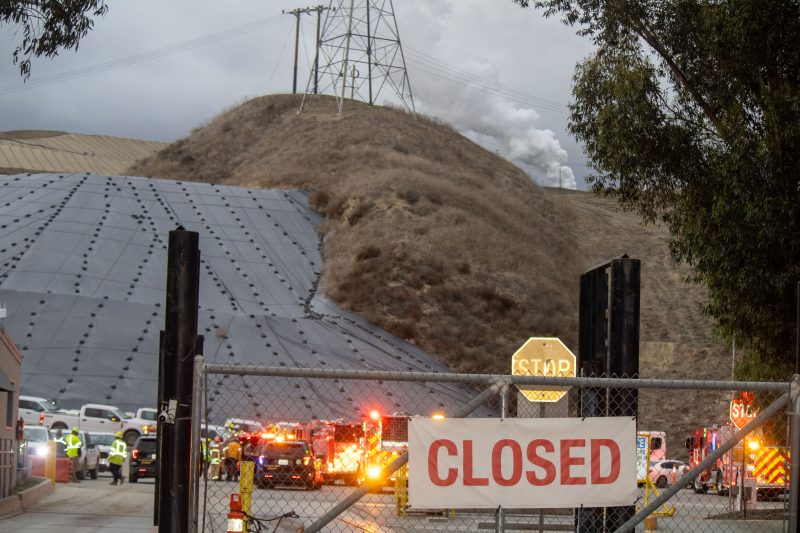
The Castaic Area Town Council cleared its regular agenda Wednesday for two items: the preparation for a storm that dropped 1.5 inches of rain in Castaic on Thursday morning and Monday’s geyser-style eruption at the Chiquita Canyon Landfill, which drew national media attention.
The storm landed in the early morning hours Thursday in the burn scar of an August brush fire near the landfill, but there was much more concern about the trash eruption Monday.
Around 4 p.m. that day, a black geyser of degraded trash, leachate and unknown gases erupted there, during what landfill officials described as “a routine drilling operation to install a new gas well.”
Further upsetting some at Wednesday’s virtual town council meeting, the incident comes about six weeks after L.A. County Public Health’s response to the yearslong crisis at the landfill was given a scathing review by a Sept. 29 Joint Legislative Audit Committee report from the state.
Residents and officials reiterated concerns mentioned in the audit about communication, as a three-day evacuation paid for by the landfill was expected to end Friday, while basic questions about residents’ safety remained.
Toward the end of the five-hour virtual discussion with emergency responders, Assemblywoman Pilar Schiavo, D-Chatsworth, showed her frustration in an exchange with L.A. County Public Health Officer Dr. Muntu Davis, after asking him if there was a risk for the children who attend Live Oak Elementary, which is a little over a mile from the landfill as the crow flies.
“Do your job and protect people,” she said, adding these failures and others with the Chiquita Canyon response are why she’s called for the removal of county Public Health Director Barbara Ferrer and Davis from their current roles.
Following their exchange, Castaic Area Town Council President Bob Lewis said he wanted to end the meeting with two questions that he still hadn’t received an answer to: “Is it safe now, and when is it? When can people go home?”
Davis launched into a 40-second reply.
“An incident happened, and there, as we said, there are constant things that are happening between multiple agencies looking at what’s the scenario right now. Right now, in terms of what additional steps we will do, that we will continue to talk about and go through. And talking about it doesn’t mean that nothing gets done. It doesn’t mean that it takes a week for a (Board of Supervisors) meeting to have something happen. But you’re asking in a moment as we’re still learning and seeing what’s coming up, and so I just, and I’m not going to talk about the audit. I cannot talk about the audit,” Davis said.
“I’m not asking about that,” Lewis said.
Davis said he wanted to state his position on the audit, then he pivoted back to the questions.
“So, we are continuing, as was said, all of our agencies are continuing to look at what is left here, what is there to worry about, what risk is in place. And what was your second question?” Davis said.
“So my question is: Is it safe now? And if you’re still evaluating it, then the answer is, ‘to be determined,’” Lewis said. “And people that are moved out of the area so they wouldn’t be exposed, is it safe for them to go home? And if the answers are not determined yet, then that would be the answer. We have not made that determination.”
Davis said health officials are still checking and double-checking the air monitors.
“Does it look like there’s anything at the moment that is high risk? Not at the moment. However, I do think that if there people are finding stuff in terms of the dark ash, which is why I talked about it, I mean the dark material or powder, then let’s be cautious with that,” Davis said, referring to dark residue that people complained about being left on their property from the eruption, “and go through and use those same practices as we talked about with soot and ash.”
On Thursday, Rep. George Whitesides, D-Agua Dulce, Schiavo and L.A. County 5th District Supervisor Kathryn Barger co-signed a letter to the Environmental Protection Agency saying what Chiquita was doing wasn’t enough, with respect to its evacuation assistance.
“Upon writing this letter, we have learned that the landfill has 80 hotel rooms secured for
residents who live within the designated boundaries, which includes approximately 1,200
households. Based on these figures alone, the need for relocation is far greater than what
(Chiquita Canyon) has provided so far,” the letter stated. “We respectfully request the EPA to expand its Unilateral Administrative Order to include specific community mitigation measures that require CCL (the landfill) to comply with — but not limited to — increased length of hotel stays, increased availability of hotel rooms and higher-quality air purifiers available to all residents. The air purifiers should be certified by the California Air Resources Board and capture sulfide and sulfur-based compounds.”
The landfill responded Thursday by adding three days to the hotel offer, through Monday, and updated its statement to include that the Regional Water Quality Control Board has issued an investigative order, requesting sampling of the precipitation the landfill’s neighborhood received between 1 and 7 a.m. Thursday.
“Recognizing concerns expressed by the local communities, and in coordination with requests from our regulatory partners, Chiquita Canyon is offering hotel rooms to residents in Val Verde and Hasley Hills. Chiquita is extending stays through the weekend with checkout now scheduled for Monday,” according to the statement.
In a news broadcast Wednesday, Barger said she was frustrated with Public Health’s response, indicating her office was aware of the geyser situation by 4:30 p.m. Monday, and by 8 p.m., her office was pushing Public Health into action, which was not acceptable. Her statement following the incident said she was asking for a “full accounting” of what happened.
Fernando Florez of the Los Angeles County Fire Department Health Hazardous Materials Division said the samples of the “dark material” were sent to the Department of Toxic Substances Control office in Pasadena that same day.
It was later indicated that the results of those tests were still not available, but a DTSC official indicated there was a request to get the results as fast as possible.
The eruption of gas was capped at 11:30 p.m. Monday and welded over by 1:15 a.m. Tuesday, according to Mario Tresierras, division chief of the county Fire Department’s Health and Hazardous Materials Division. Tresierras said the team’s primary responsibility was to identify any threats that were an “immediate danger to life or health,” which is what would prompt an evacuation.
In response to questions about why the Fire Department was doing that initial survey, Air Quality Management District officials indicated that the Health and Hazardous Materials teams were using the same tools that AQMD would use in that scenario.
Florez added that his staff had people there throughout the night and the following morning, and no harmful readings were detected based on the established acute exposure guideline levels, which are part of the Environmental Protection Agency’s emergency threshold. He did note that those levels were significantly higher than Reference Exposure Levels, which the agency does not use in emergency scenarios like Monday’s.
Town Council member Cher Arabalo questioned how the landfill could say, “no liquids were released,” in the explosion Monday, when she said she could see the liquid when she was there, minutes after the explosion.
“It was mostly trash, but there was liquids, so obviously, some liquids did pool,” Florez said. “So (on Tuesday morning), when we sent our investigations teams, there was liquid that did pool on that liner,” he said, referring to the geosynthetic membrane the landfill has been ordered to put over the reaction area. Florez called it a “mist” that was gummy, black and wet, and pooled as a liquid would, on top of the membrane.
John Musella, spokesman for Chiquita Canyon Landfill, released an updated statement Wednesday that referred to the geyser as “degraded municipal solid waste and other particulate matter.” On Thursday, the landfill’s statement referred to it as an “above-ground release of gases and particulate material.”
James Stephens, a Castaic Area Town Council member, shared his frustration that imminent danger and death was the only threshold L.A. County Fire was using to determine a community risk, as the landfill had been causing air-quality concerns for years, and he himself still had a sore throat the following evening.
“Some people stayed home, sheltered in place, as the order told us to … but the point is, we sheltered in place and we were, maybe, getting some harmful level — not instant death,” he said, adding he felt that was not an acceptable barrier for a community health response.
Stephens, whose Zoom background was a photo of the giant black geyser, said Fire Department officials using that threshold, and then declaring there was no risk based on that level, was an incredible disservice to those who’ve been protesting and calling for a state of emergency for over four years due to their health impacts, and misleading to those unfamiliar with the gravity of what Castaic residents have been dealing with.
“This was our big chance to get it really noticed,” he said, saying he was a big supporter of the Fire Department but very upset about how the situation was portrayed in the media, without full context.
Stephens also said there was no follow-up messaging from the county regarding an “all clear,” if that was possible, or if the school campus closest to the landfill, Live Oak Elementary, was safe to attend.
“You were misleading us in the beginning, you led us to believe it would be safe to be home, and then you never followed through to make the commitment that it was safe to stay, because you know what, it wasn’t,” Stephens said. “I don’t think anyone felt comfortable sending out a message saying, ‘Hey, you know what, everything’s cleaned up — no problem.’”
L.A. County Public Health issued a new order Thursday evening, which stated, for the benefit of parents and guardians, that “based on responding agencies’ review and analysis of available ambient air monitoring data collected during and following the incident, the available information does not indicate a need for broader community-wide emergency protective actions at this time.”
The agency also announced that this weekend, “Public Health will conduct door-to-door outreach and a voluntary household survey in communities surrounding Chiquita Canyon Landfill. The survey will capture information on residents’ experiences with odors and debris, document reported health concerns, assess community needs, and connect residents with available resources and services.”