By Jack Phillips
Contributing Writer
The U.S. military announced Wednesday that it seized two oil tankers in the Atlantic Ocean, including one linked to Venezuelan oil shipments, coming just days after an operation that led to the arrest of Venezuelan leader Nicolás Maduro.
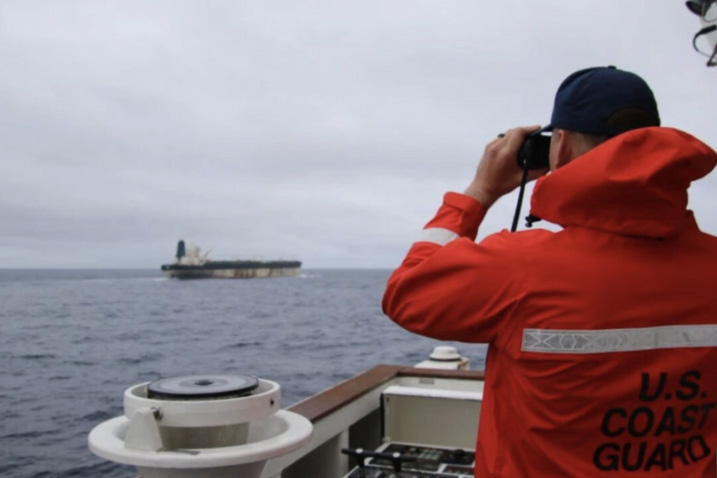
In a statement confirming the development, U.S. European Command wrote that the Department of Justice, Department of Homeland Security, and the Pentagon were involved in the operation to seize the M/V Bella 1, a Russian-flagged crude oil tanker.
The reason for the seizure was “for violations of U.S. sanctions,” the statement said.
“The vessel was seized in the North Atlantic pursuant to a warrant issued by a U.S. federal court after being tracked by USCGC Munro,” it added, referring to a type of U.S. Coast Guard cutter vessel.
In another statement, the U.S. Southern Command said it seized a second oil tanker in the Caribbean Sea. The vessel was described as a “stateless, sanctioned dark fleet motor tanker” that was captured in an early morning operation.
“The interdicted vessel, M/T Sophia, was operating in international waters and conducting illicit activities in the Caribbean Sea,” the military said. “The U.S. Coast Guard is escorting M/T Sophia to the U.S. for final disposition.”
Southern Command did not say whether the Sophia was connected to the shipment of oil from Venezuela.
Russian state-run media RT on Wednesday published images of U.S. forces boarding Bella 1 vessel, showing a helicopter flying near the ship. The outlet said that U.S. forces were attempting to board the oil tanker.
In a statement published by the outlet, Russia’s foreign ministry said that “for reasons unknown to us, the Russian vessel is getting excessive attention from the U.S. and NATO militaries, clearly disproportionate to its peaceful status.”
State-run media also said that the vessel was renamed to Marinera from the Bella 1.
Commenting on the Bella 1 seizure, U.S. War Secretary Pete Hegseth wrote: “The blockade of sanctioned and illicit Venezuelan oil remains in FULL EFFECT — anywhere in the world.”
Secretary of Homeland Security Kristi Noem wrote on X that U.S. forces seized both the Bella 1 and Sophia ships because they were “either last docked in Venezuela or en route to it.”
The announcements on Wednesday came after the capture of Maduro and his wife, Cilia Flores, in an operation over the weekend.
Maduro made his first appearance in a U.S. federal court on Monday, entering a not guilty plea. He faces drug trafficking and a range of other federal charges.
On Tuesday evening, President Donald Trump wrote on his Truth Social platform that current Venezuelan officials “will be turning over” around 30 million to 50 million barrels of sanctioned oil to the United States, which he said would be sold at its market value.
“That money will be controlled by me, as president of the United States of America, to ensure it is used to benefit the people of Venezuela and the United States,” Trump also wrote.
“I have asked Energy Secretary Chris Wright to execute this plan, immediately. It will be taken by storage ships, and brought directly to unloading docks in the United States.”
It’s not clear if the oil tanker that was seized Wednesday is connected to Trump’s statement a day earlier.
Since the U.S. government imposed energy sanctions on Venezuela in 2019, traders and refiners buying Venezuelan oil have resorted to using oil tankers that disguise their location, or to vessels already sanctioned for the transportation of Iranian or Russian oil.
This week, Trump has suggested the United States would help rebuild the country’s oil infrastructure to benefit oil companies that were affected by a Venezuelan oil nationalization by former President Hugo Chávez.
Last month, Trump said in a social media post that he had ordered what he called a “TOTAL AND COMPLETE BLOCKADE OF ALL SANCTIONED OIL TANKERS going into, and out of, Venezuela.” The reason why, he asserted, is because of the Maduro regime’s alleged use of the country’s vast oil reserves to finance terrorist groups, drug traffickers and human traffickers.
At the time, deputy chief of staff Stephen Miller echoed the president’s comment in a post on X that the Maduro regime’s alleged “tyrannical expropriation was the largest recorded theft of American wealth and property.”
Reuters contributed to this report.