The modern automotive market is no longer defined by a single buyer type. Instead, it reflects a wide spectrum of needs—from individuals seeking efficient daily transport to families requiring spacious, multi-purpose vehicles. The contrast between the Hyundai Exter and the Kia Carens Clavis captures this divide clearly. While one is designed for personal, city-focused mobility, the other is built around shared experiences and family-oriented travel.
This distinction highlights how vehicles today are shaped not just by engineering, but by lifestyle requirements.
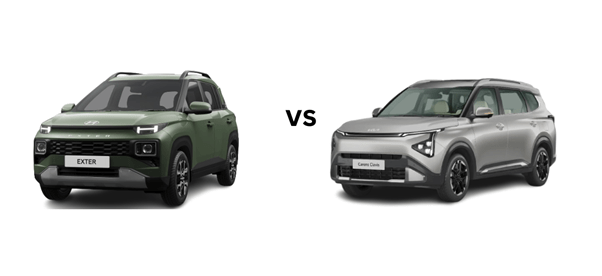
Individual Mobility: Compact and Urban-Focused
The Hyundai Exter represents the idea of individual mobility. It is designed for users who prioritise ease of driving, compact size, and everyday convenience.
Its sub-4-metre footprint (3,830 mm length), combined with a tall stance and longest wheelbase in its segment, makes it well-suited for urban environments. The elevated seating position and compact dimensions make it easier to manoeuvre in traffic and tight parking spaces.
Additionally, features such as:
- 391-litre boot space for daily practicality
- Wireless Android Auto and Apple CarPlay connectivity
- Efficient 1.2L petrol engine producing 83 PS
reinforce its suitability for everyday commuting and short-distance travel.
For individual users or small households, this combination offers a balanced and manageable driving experience.
Family Mobility: Space and Versatility
In contrast, the Kia Carens Clavis is built around family mobility. It is designed to accommodate multiple passengers while maintaining comfort and flexibility.
With a length of approximately 4,550 mm and a wheelbase of 2,780 mm, the Carens Clavis offers significantly more interior space than the Exter. Its 6- and 7-seater configurations further emphasise its role as a family vehicle.
The interior layout is focused on usability and comfort:
- Three-row seating with split and reclining options
- Roof-mounted air vents for rear passengers
- Flexible seat configurations for luggage and passengers
These features make it suitable for long journeys, group travel, and varied usage scenarios.
Design Philosophy: Expression vs Purpose
The design language of both vehicles reflects their intended use.
The Exter adopts a micro-SUV styling approach, featuring roof rails, wheel arch cladding, and a bold front fascia. These features create a sense of individuality and modern appeal.
The Carens Clavis, on the other hand, balances SUV-inspired styling with MPV practicality. Its Kia Digital Tiger Face, connected LED lighting, and longer silhouette emphasise its presence while maintaining functionality.
This difference highlights how design serves different purposes—self-expression for individuals and practicality for families.
Technology: Essential vs Comprehensive
Technology integration also varies significantly between the two vehicles.
The Exter focuses on essential connectivity and convenience. Features such as:
- 8-inch infotainment system
- Connected car technology (in higher variants)
- Dashcam integration
They are designed to enhance everyday usability.
The Carens Clavis offers a more comprehensive technology package. It includes:
- Dual panoramic display panels
- Level 2 ADAS with multiple driver assistance features
- BOSE premium sound system and ambient lighting
These features create a more immersive, premium experience, particularly on longer journeys.
Performance and Usage Context
Performance expectations differ based on usage.
The Exter’s 1.2L petrol engine is optimised for city driving, offering predictable performance and efficiency.
The Carens Clavis, however, offers multiple engine options, including turbocharged petrol and diesel variants, delivering higher power and torque for highway driving and heavier loads.
This difference reflects their intended roles—urban commuting versus long-distance family travel.
Safety Considerations
Both vehicles incorporate strong safety features, but their scope differs.
The Exter comes standard with 6 airbags and over 30 safety features, ensuring essential protection for daily use.
The Carens Clavis expands on this with a comprehensive safety package that includes ADAS Level 2, multiple collision-avoidance systems, and all-wheel disc brakes.
For families, these additional features provide enhanced confidence during longer journeys.
Buyer Mindset: Personal vs Shared Needs
The choice between these two vehicles ultimately reflects the buyer’s priorities:
- Buyers choosing the Exter are typically focused on individual mobility—compact size, ease of use, and affordability.
- Buyers choosing the Carens Clavis prioritise shared mobility—space, comfort, and versatility for multiple passengers.
This distinction highlights how vehicles are increasingly tailored to specific lifestyles.
The Role of Digital Platforms
Online car-buying platforms such as ACKO Drive allow buyers to evaluate vehicles based on real-world usage rather than just specifications. By comparing features, dimensions, and seating capacity, users can determine whether they need a compact personal vehicle or a larger family-oriented one.
This transparency makes it easier to align choices with actual needs.
Conclusion
The Hyundai Exter and Kia Carens Clavis represent two fundamentally different approaches to mobility. One is designed for individual convenience and urban efficiency, while the other focuses on family comfort and long-distance versatility.
Rather than competing directly, they cater to different market segments. This reflects a broader trend in the automotive industry, where vehicles are increasingly defined by how they fit into people’s lives.