Part 1 of 2
The tentative “memorandum of understanding” with Iran has caused glee on the Left and furor among many on the Right. The Left might welcome “peace,” but surely not as much as it enjoys infighting on the Right over the details.
If last week Democrats were calling Trump a fascist warmonger, now they deride his peace efforts as those of a Neville Chamberlain patsy. Within 24 hours, the Left’s talking points shifted from a mad bomber-style Curtis LeMay in the White House to an impotent appeaser.
A week ago, some Republicans were arguing that not one of the prior seven presidents had dared to use force to stop Iran’s nuclear program. Now some of them are deriding him as an Iranian enabler.
What We Are Missing
There are legitimate concerns about the tentative memorandum, including the idea of third-party cash infusions to the regime and claims that violence in Lebanon is somehow Israel’s fault. In truth, history shows that Hezbollah, with Iranian financial support, consistently instigates the killing and then whines when Israel — or the U.S. in past conflicts — responds disproportionately.
That said, much of the current hysteria assumes a radical change in Trump’s strategy rather than a continuity that has brought us to the current denouement. It also does not consider the wider strategic context of the memorandum, the critical role of domestic public opinion in shaping how wars are conducted, or the broader strategy of isolating and weakening the regime.
A closer look at the current position of the U.S. suggests it has done an enormous amount of fiscal, economic, and military damage to Iran — the full extent of which will not be known until foreigners are allowed into the country.
So why did Trump agree to a memorandum that does not treat Iran as a strategically defeated opponent without options?
Do We Really Want to Micro-Manage Iran?
Iran has been militarily devastated, but it does not yet consider itself strategically inert. The regime has little concern for the welfare of its own people and assumes Trump will not retaliate against dual-use targets in the manner of most past presidents who ordered bombing campaigns.
Remember, Trump could have gotten a much better deal had we dealt with the Iranians as we did with the once-defeated Iraqis and Taliban, whose governments were forcibly replaced by ones more agreeable to U.S. demands.
But, with a population of 93 million, Iran is neither Iraq nor Afghanistan, which together required decades of U.S. ground troops, $2 trillion in treasure, 7,000 American deaths, and 53,000 wounded. In the end, those efforts still did not result in lasting Western-style governments aligned with U.S. interests.
Neither Afghanistan nor Iraq was as large or as formidable as Iran. To fully dictate terms to Iran as if it were an inert protectorate, the U.S. would either have to bomb it to smithereens or send in thousands of ground troops, both politically unpalatable to the American people. Trump must deal with the realities that Americans have been sick of dealing with the Middle East for years. By now, they believe that any costly, enforced regime change on the ground — or any years-long no-fly zone — is not worth the life of a single American soldier.
The War that Is and Is Not Over
Yet Iran remains militarily defeated if not devastated. Its ability to cause havoc should not be confused with the U.S. ability to inflict even greater damage on Iran’s economy without significant concern about suffering losses in a “forever” war.
If Iran chooses to hit Kuwait with another dozen missiles this week, Trump can adopt the 1999 Bill Clinton-style approach to Serbia — something he has again so far avoided.
When that bombing stalemated in its fifth week, and Slobodan Milosevic remained defiant, Clinton ordered the bridges on the Danube taken out. And when there were still no concessions, NATO planes began dropping graphite bombs to disable 70% of the Belgrade grid, which, along with other dual-use targeting, finally forced Serbia to leave Kosovo.
So far Trump has avoided the Clinton-Obama-style bombing of such targets in Serbia and Libya (e.g., Libyan TV/radio stations, industrial works, docks, ports, private homes and compounds, etc.). But should Iran begin to ignore its promises and renege on its agreements (and it will), the regime would have no ability to keep its utilities, roads and transportation viable if the U.S. were even to spend 48 hours to knock them all out.
The U.S., by disproportionally hitting an array of dual-use targets, can force Iran to adhere to its agreements any time.
Trump’s Political Viability?
Why, then, did Trump agree to the memorandum instead of a few days of dual-use targeting?
He likely did so thinking he could manage the next four months until the midterms without an energy- and media-driven recession in the U.S. or abroad, which would likely ensure that the Republicans lose the House and perhaps also the Senate. And a democratic socialist-driven Congress would paralyze the MAGA agenda, guarantee two years of frenzied House subpoenas, and prompt a nonstop impeachment circus.
However, while 38 of the last 41 midterm elections have seen the in-party lose congressional seats, a Republican loss is not preordained this November. Republicans will likely win the redistricting wars, both in red state legislatures and through the Supreme Court outlawing racial gerrymandering. They might then pick up between five and 10 new seats.
The Democrat Party has gone full socialist. And it has de facto embraced a number of unpopular 30/70 issues including property confiscations, open borders, transgender chauvinism, restoration of DEI, the New Green Deal, and 10,000 illegal border entries a day. Opening the strait will soon crash the price of oil to prewar levels. And the U.S. economy, despite all the hysterical doom and gloom, ploughs ahead with record stock prices, strong employment figures, record foreign investment, more fossil fuel development, and massive deregulation and tax cuts in progress.
By November, we might even see inflation cooling with far lower gasoline prices and the memory of an active war abroad dissipating.
Part 2 is scheduled to appear in Friday’s edition of The Signal.
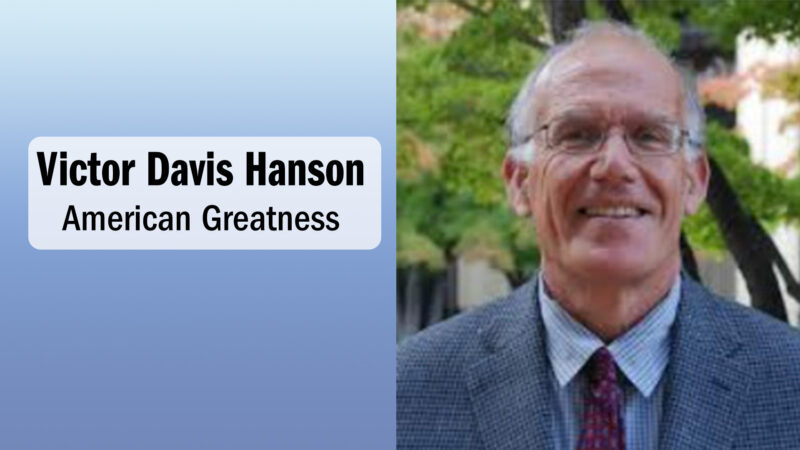
Victor Davis Hanson is the Martin and Illie Anderson Senior Fellow in Residence in Classics and Military History at the Hoover Institution, Stanford University, a professor of Classics Emeritus at California State University, Fresno, and a nationally syndicated columnist for Tribune Media Services.