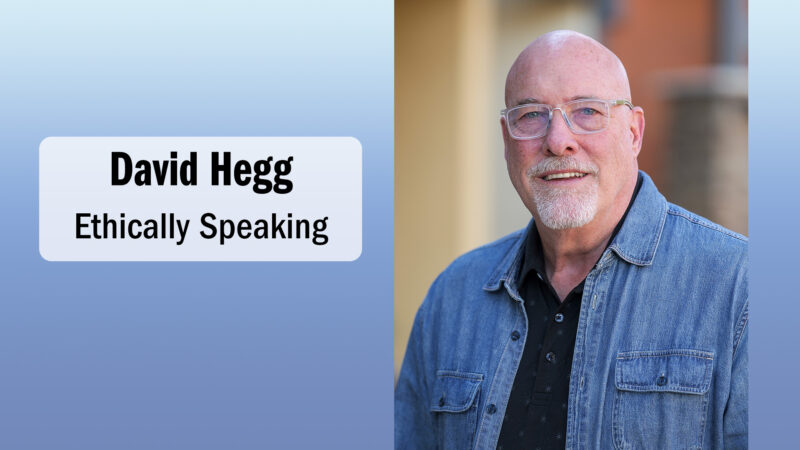
By David Hegg
If you’ve been reading this column for the past few weeks, you may have noticed my thoughts have been in one lane. I’ve been captured by the reality of just how divided we are as a nation, as families, as neighbors. And this division has made itself known through a dangerous rise of incivility, violent actions carried out in the guise of helpful, necessary change, and even publicly declared desires for opponents to be murdered.
So, perhaps it is time to ask: Why are we so divided? I’m sure you can come up with some reasons we’re becoming more and more divided, but here are my suggestions.
1. The wealth we enjoy has severely eroded the fabric of our interdependence. Historically, when societies were agrarian, it took a community to eke out a living on the farm. Married couples relied on their children and neighbors to clear land, plow fields, plant crops, bring in the harvest, and build barns, fences, and other necessary structures to make a living.
Farming and ranching communities were dependent on the community to make things work. Their lives were dependent on one another. The same was true for the smaller settlements, as farming technology allowed some to become shopkeepers and tradesmen. Yet the interdependence of these communities was evident, as farmers would barter their grain for supplies from merchants. People needed people.
Today, wealth has made independent living commonplace by enabling us to provide for almost everything we need. And if we are in need, we can usually meet that need without assistance from our community. After all, Google can point us to a solution. Consequently, we’ve created communities that actually lack community relationships.
2. Conflicting ethical beliefs and systems due to severe erosion of natural law and belief in a transcendent God have created deep societal divisions. There is no argument that the recent divergence from medical and scientific evidence concerning biological realities has been extremely divisive. Considering a fetus to be less than human, those with male chromosomes to be female if they so choose, and marriage reduced from God’s design to a union incapable of procreation are all examples of conflicting ethical and ideological beliefs. But the true danger is not only that some have decided to live out a scientifically mangled ideology. The true danger is that they not only demand acceptance but also applause. And, in addition, when natural law is thrown out as no longer valid, any concept of the God who created all things from nothing is also consigned to the trash heap along with the historical foundation of Judeo-Christian ethics and virtue.
3. Freedom has been redefined as the absence of restraint. As hinted at above, freedom has been redefined as living without any societal restraints. We have gone from supporting freedom from tyranny as a nation to being forced to support freedom from scientific and biological reality as individuals. Today, we are seeing essential restraints replaced by emotionally driven woke demands. Merit is no longer meritorious, capitalism is no longer respected, and crime is no longer consistently punished. Standards that have for centuries been the guardrails of civility are now giving way to “feelings-based personal freedoms” that allow every individual to live out their “authentic” self.
4. Principles and procedures are too often the result of emotional feelings rather than provable facts. As a society, we are watching emotion overtake logic. The situation can be summed up this way: Reasoned logic built on objective facts is authentic and, thus, profitable and beneficial. Emotional logic arising from subjective feelings is spurious and, thus, destructive. Just look around. So much of what our society is creating and demanding is now driven by emotion rather than logical, provable reasoning. Every time I’m in a discussion, and someone says “Well, I feel that …” I want to scream.
5. The societal preference to champion rather than defeat the rise of acceptable decadence.
The by-product of the four reasons given above is an abandonment of honor in favor of decadence. We are watching the borders of decency explode. As an example, the world of fashion is promoting the “naked dress,” and public nudity has become commonplace in certain protests and celebrations, and consistently in our entertainment portals. Public discourse now finds obscene and even violent language acceptable. Sexual activity outside of marriage is not only no longer frowned upon but is championed as sexual freedom, resulting in a total redefinition of what constitutes a marriage and family. Simply put, decadence has been relabeled as decent, and anyone who protests is out of touch and poses a danger to individual freedom and expression.
So, yes, we’re a nation divided into many groups whose appreciation for one another is severely eroded. But it is not too late. And while we can’t fix the country, we can concentrate on our neighborhood, our district, our valley, and become people who hold to and live out basic virtue and civility. We can disagree, but do so agreeably. We can challenge, but also listen. And most of all, we can raise our children to honor what is honorable, do what is useful, and recognize what is degrading and capable of undermining civil society.
Local resident David Hegg is senior pastor of Grace Baptist Church. “Ethically Speaking” appears Sundays.