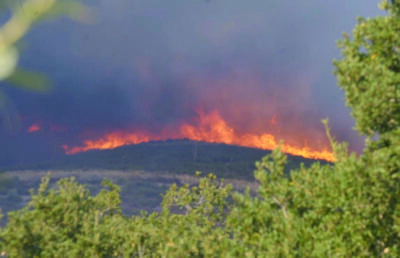
Downtown Newhall’s fire early Monday was many things, all incongruous. How can a raging fire destroy our heritage in this SciFi-sounding year of 2026? Shouldn’t this be an issue of a distant past? Shouldn’t it be Mrs. Leary’s cow kicking over a kerosene lantern in a Chicago barn? And yet, with all the modern technology, state-of-the-art firefighting equipment and instant communication, stubborn flames roared well into mid-morning along Main Street. Familiar buildings, a century-plus, seemed they’d stand a thousand years. They didn’t. The loss tugs at heart, soul and identity.
We’re courageous creatures. We won’t rebuild. We’ll build something new. I pray a true artist’s heart will inspire that fresh design, sculpt it into something unique, filled with the right dash of mirth, the perfect splash welcome and coziness with more than enough of what zen calls, in appropriate lower case, “…suchness.” I hope the lesser PR gods of Bureaucracy and Suits won’t bedevil the process and con us into accepting that an imagination-less beige cube with Christmas tree lights belongs on the cover of Architectural Digest Magazine. This is Santa Clarita. We shouldn’t (but — curse our fatal indifference — we so often do) settle. We settle for paint-by-numbers mediocrity, then call it the Mona Lisa.
I know a little of local history. It’s eerie how fire has visited that one particular tiny corner. Henry Mayo Newhall once owned most of Santa Clarita. His vision was to build this valley into the Paris of the West Coast. Hank never lived to see his dream. He died in 1882. But, his hotel was built in — ahem — 1878 (the “ahem” is because there’s much scholarly disagreement whether it was built in 1878 or 1879). In 45 minutes, the resort burned to the ground on Oct. 23, 1888. The Southern was considered a five-star hotel and the finest south of San Francisco. It rested at the southwest corner of today’s Railroad Avenue and Market Street.
Just about where Monday’s fire burned most of a city block.
Today, kitty-corner to this week’s inferno, is the Jan Heidt Metrolink Station. It used to be the site of one of Newhall’s very first commercial buildings — The Newhall Train Depot.
It gets a smidge confusing here. Bear with me. The Newhall Train Depot and the town was officially dedicated in 1876 — in future-Saugus (across the street from the present-day Saugus Café). There’s a few theories, but, in 1878, they moved the entire Newhall Depot to the corner of present-day Railroad & Market. Moved the whole darn town of Newhall, too. Saugus would be built a decade later.
In Saugus.
The Newhall Depot was abandoned in 1933 and used as a potato packing shed. On a subfreezing night, Jan. 17, 1963, that rickety old building burned to the ground. Hoboes broke in and started a fire inside the dry, wooden building. Reports differ. Some say the mercury dipped to single digits — cold enough the fire hydrants froze. The fire started around 2:15 a.m., about the same as our Monday fire. Photos the next morning of the simmering wreckage were eerily identical to Monday’s coverage.
The Mighty Signal was no stranger to the capricious element of fire. Renting offices in the local (and wooden) Swall Hotel, we published our first issue on Feb. 7, 1919. The hotel burned to the ground a month after The Signal’s historic launch. The Swall rebuilt (this time, in brick). Where was The Swall located?
At the southwest corner of Market Street and Railroad Avenue …
The Signal burned again, in 1969. This time, just the production building was razed to the ground. We should relax. While the fire was in January, it wasn’t at the corner of Market and Railroad.
It was a block away — at the corner of Railroad and 6th …
The threads of dark serendipity weave through Monday’s blaze and fires of yesteryear. In May 2013, the bar and eatery, The Newhall Refinery, was one of the first new businesses to open in the fresh and revitalized Downtown Newhall. It anchored and inspired a rush of fine pubs and restaurants along Main Street. What few realize is this wasn’t the first Newhall Refinery fire. Past Eternal Valley cemetery, off Sierra Highway, was the ORIGINAL Newhall Refinery. During World War II, it produced not designer beer and Happy Hour appetizers. It made airplane and battleship fuel. They even named a U.S. destroyer after the plant.
In August 1944, either the heat from a Bunsen burner or a welder’s torch ignited a series of explosions where not just the smoke, but — the flames — shot an entire mile, some 5,000 feet, into the air. Approximately 2.5 million gallons of various fuels and lubricants exploded.
Downtown Newhall has seen so many fires. Newhall Elementary burned down three times its first half-century. Before fabled silent screen superstar William S. Hart built his New-hall castle, the hill housed a huge, fire tower lookout. Even the American Theatre’s opening in 1941 was delayed for months. Hoboes broke in and used wall molding to start a campfire.
Strangest thing. We had a volunteer fire department in the early 1920s. A fire swept through Downtown Newhall and firemen rushed out the old horse-drawn pump wagon. They hooked up the hose, stretched it out and turned on the hydrant. A trickle of water dripped from the nozzle. But, from the many holes in the canvas hose, moths flew out. Community leaders made a note to buy a new hose and maybe check it from time to time.
We must mourn that wonderful corner of historic Downtown Newhall, each, in our own way. We need to financially support Downtown Newhall while it’s being fixed and dolled up.
To remind again?
We can’t rebuild. We can, however, create something splendiferous. Some of us? We’ve never seen something splendiferous. No need to worry. In fact, be of light heart. You’ll know splendiferous when you see it …
Pick up “Naked Came the Novelist,” John Boston’s sequel to the international bestseller, “Naked Came the Sasquatch,” at JohnBoston-Books.com. A lifelong SCV resident with 119 major writing awards and nearly 12,000 columns, Boston is Earth history’s most prolific humorist and satirist.