Across church lawns, synagogue grounds, university campuses and school properties, rows of miniature Israeli flags will form temporary fields of blue and white around the anniversary of October 7. Each participating institution in the International Fellowship of Christians and Jews’ third annual Flags of Fellowship campaign will receive approximately 1,200 flags, creating a visible memorial connected to the lives lost in the October 7, 2023 Hamas attacks on Israel. The displays also honor hostages, heroes and families affected by the attacks while expressing solidarity with Israel and Jewish communities.
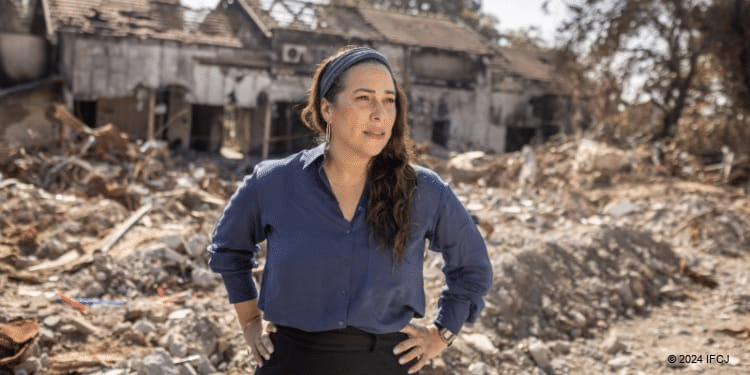
For Yael Eckstein, President and Global CEO of the International Fellowship of Christians and Jews, the campaign has developed well beyond its first observance. What began around the first anniversary of October 7 has expanded into an international initiative involving Christian and Jewish communities and other institutions. As the third annual Flags of Fellowship campaign approaches, IFCJ says more than 4,300 churches worldwide are participating in 2026, planting more than 5.2 million Israeli flags throughout the month of October.
Remembering October 7 Through a Visible Memorial
The defining image of Flags of Fellowship is intentionally simple. Participating organizations receive approximately 1,200 miniature Israeli flags for display, with each flag representing a life lost on October 7, according to IFCJ’s campaign materials. Together, the fields are intended to remember those killed while honoring hostages, heroes and families whose lives were affected forever by the attacks, and to show Israel and the Jewish people they are not alone.
The physical nature of the display gives communities a way to mark the anniversary in a shared public space. An online acknowledgment can disappear quickly from view. A field of flags remains present on a lawn or campus, making remembrance part of the local environment for congregants, students, visitors and neighbors.
IFCJ’s Flags of Fellowship resources and digital toolkit provide participating organizations with planning materials, talking points, graphics and videos. The organization’s host materials also suggest that communities may incorporate prayer, reflection or a moment of silence into their observances.
From Memorial Initiative to International Campaign
The scale of Flags of Fellowship has changed substantially since its launch in 2024. The inaugural campaign, organized around the first anniversary of the attacks, brought together nearly 250 churches, universities, schools and synagogues, according to IFCJ’s reporting the following year.
Participation expanded sharply in 2025. Current IFCJ campaign materials report that more than 1,350 organizations participated in the second annual campaign, resulting in more than 1.5 million flags being planted globally at local events, worship services and community gatherings.
Participation continued to grow in 2026. IFCJ now reports that more than 4,300 churches are participating in this year’s campaign and planting more than 5.2 million Israeli flags, surpassing the campaign’s original goal of at least 2,500 participants and more than three million flags. The updated figures show the continued expansion of the campaign since its launch in 2024, with participation growing substantially each year.
Flags of Fellowship Becomes a Global Movement
The campaign has also become increasingly international. IFCJ identifies participating communities beyond the United States and Canada to Australia, Africa, the United Kingdom, India and countries throughout Latin America and South America. The organization reported that the 2025 campaign included organizations across North America and 10 countries worldwide.
That reach broadens the setting for October 7 remembrance. The anniversary is being marked not only in Israel and within Jewish institutions, but also by participating Christian congregations, schools, universities and community organizations in other parts of the world.
The format gives those organizations a common visual language without requiring every participating community to approach the anniversary in precisely the same way. A congregation may incorporate the flags into a religious service, while a school or university may use the display as the focal point of a campus observance. The shared element is remembrance made visible.
Yael Eckstein on Unity, Resilience and Standing Against Antisemitism
“What began as a memorial initiative has become a global movement of light, unity, and resilience,” Eckstein said in announcing the third annual campaign. She also described Flags of Fellowship as a way for people to stand with Israel and speak out against antisemitism.
That framing reflects Eckstein’s broader role at IFCJ. As President and Global CEO, she oversees the organization’s ministry programs and serves as its international spokesperson. Before assuming her current responsibilities, she held several leadership positions within the organization, including Global Executive Vice President, Senior Vice President and Director of Program Development and Ministry Outreach.
IFCJ describes its mission as providing humanitarian assistance to people in need in Israel and Jewish communities around the world while building greater understanding and cooperation between Christians and Jews. Flags of Fellowship places that bridge-building mission within the specific context of October 7 remembrance.
Christian-Jewish Cooperation Made Visible
Christian-Jewish cooperation has been central to IFCJ since Rabbi Yechiel Eckstein founded the organization in 1983. Its work has combined humanitarian assistance with efforts to strengthen relationships between the two faith communities, a mission that continues under Yael Eckstein’s leadership.
Flags of Fellowship translates that institutional mission into a public act that can be repeated locally. Participating Christian and Jewish communities may differ in theology, politics and their reasons for becoming involved. The campaign does not require those differences to disappear. Instead, it creates a shared format centered on remembering October 7 and demonstrating solidarity with Israel and Jewish people.
The result is interfaith cooperation expressed in physical space. Flags planted outside a church, synagogue or university make an institution’s participation immediately visible in a way that a statement or social media post may not.
Remembering While Confronting Antisemitism
IFCJ has explicitly connected the 2026 campaign to its concern about antisemitism. Its announcement describes Flags of Fellowship as both a memorial initiative and an opportunity for communities to speak publicly against antisemitism while supporting Israel and the Jewish people.
The campaign’s approach is centered on remembrance rather than partisan political messaging. Participants plant flags, gather for observances and, depending on the institution, may incorporate prayer, educational materials or reflection. The Fellowship’s Flags of Fellowship host resources describe the initiative as bringing churches, synagogues and universities together to remember victims and hostages, pray for Israel and publicly oppose antisemitism.
That focus also gives communities outside Israel a tangible way to mark an event whose consequences can otherwise seem geographically distant. For IFCJ, visibility itself is part of the response: remembrance is something participants are encouraged to express publicly.
Remembrance Beyond a Single Day
Although Flags of Fellowship is organized around October 7, the initiative sits within IFCJ’s year-round humanitarian mission. The Fellowship provides assistance in Israel and to Jewish communities internationally, including support involving food, basic needs, security and immigration and resettlement programs.
Since October 7, 2023, The Fellowship has committed $432 million in aid to Israel to support the ongoing emergency needs in Israel and to continue to provide assistance in its core program areas — everything from prepacked emergency food, water, equipment for first responders and security personnel, to aliyah support of olim and other needy populations impacted by the war and ongoing conflict. The organization’s 2026 campaign announcement identifies emergency food and water, equipment for first responders and security personnel, aliyah assistance and support for people affected by the continuing conflict among the areas receiving aid.
The memorial campaign therefore occupies one part of a broader organizational response. It gives participating communities a symbolic act tied to an anniversary while IFCJ’s humanitarian programs continue throughout the year.
A Simple Symbol Repeated Millions of Times
One miniature flag occupies little space. Approximately 1,200 of them together create a field that changes the appearance of a church lawn, synagogue property or university campus. Replicated across thousands of participating communities, that visual becomes an international form of collective remembrance.
That multiplication has defined the development of Flags of Fellowship. More than 1.5 million flags were planted through participating organizations in 2025. In 2026, if IFCJ reaches its stated goal of at least 2,500 organizations, the Fellowship says more than three million flags could be displayed.
Eckstein’s description of the initiative as having grown from a memorial into an expression of “unity and resilience” captures what IFCJ is seeking to preserve as the third anniversary approaches. The campaign offers participating communities a meaningful way to remember victims, hostages, heroes, and affected families while expressing solidarity with Israel and Jewish communities.