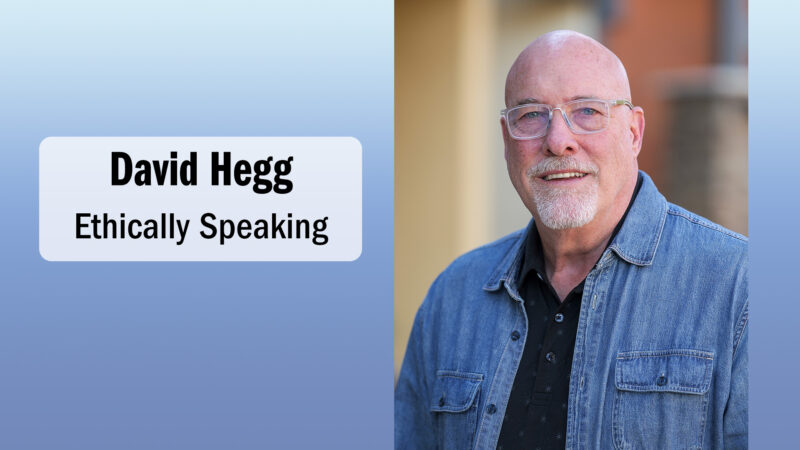
By David Hegg
“How did that happen?” I find myself asking that question far too often these days. How did a good guy get involved in illegal activity? How did a great company forget its moorings and slide into unethical behavior? How did an honored university get carried away from its foundations by the current of culture? And how did incivility, vile insults and threats, and outright lies become such a staple in our national discourse?
To find an answer, I started thinking about the times in my own life when I ended up being and doing things I never intended, making assertions and behaving in ways I knew, down deep, weren’t best or even right. Here’s what I found.
Our moral convictions and ethical standards act as guardrails to keep our thoughts and actions from bringing about a reputational smash-up, or worse, a fiery descent into the valley of disqualification. The stronger the guardrails, the more authentic the accountability, the more ethically ordered the life.
But what about when the ethical guardrails are allowed to decay, to shift, to drift, or become soft and easily pushed aside? What happens when convenience or pragmatism or greed or pride or lust – or whatever! – starts to erode the ethical barriers, leaving them easily rationalized and malleable?
I think we all know the answer because we’ve all experienced it. When the guardrails are softened, moved and eventually removed, ethical stability degenerates into chaos.
We all have a front-row seat to the devastating results happening in our society right now. When ethics erode, chaos and corruption explode. Just ask Richard Nixon, Bobby Bonds, Harvey Weinstein, Bill Cosby, Kevin Spacey, R. Kelly, or Lance Armstrong. And these are just a handful of the myriad who have abandoned their guardrails to satisfy their unethical and immoral desires.
So, that takes us back to the original question: How did that happen? While I can’t give a complete answer to every instance of ethical erosion, one key element is something we all know and can agree on.
The erosion of ethics starts with complacency. We become lazy in life, especially in those disciplines that thwart the temptations to evil in our world. We start thinking we’re strong enough, good enough and certainly better than most. Then we overestimate our moral strength and ethical resolve, and complacency begins to produce other poisonous fruit.
One of these deadly fruits is compromise. We start giving ourselves an ethical hall pass. We consider that shaving the edges off our ethical standards poses no threat. After all, we’re outstanding, strong, and moral people, and little indiscretions here and there won’t matter. They don’t constitute a central fault line. We’ll be OK.
On too many occasions, I’ve sat with married men and women who, through tears of deep anguish, told me they never intended to have the affair. Somehow, little incremental lapses made leaving their ethical lane easier and easier as rationalization replaced conviction and pushed them over the edge into corruption.
I’ve also sat with business owners, church leaders, and members of now dysfunctional families whose lives and dreams have been shattered due to their own ethical lapses or those of their associates and relatives.
And the formula was always the same. Complacency empowers compromise, which makes us easy prey for corruption. And what’s worse, by the time we espouse ethical failure, we’ve often become professionals at spinning evil as good, lies as truth, and self-gratification as an inalienable right.
As we look at our own lives and those on the national scene, it is evident that America needs an ethical revolution. We must demand better of ourselves and our leaders. We need to fight a two-front war on ethical erosion with the weapons of truth, civility, and love of neighbor. We must oppose the notion that truth is relative, and everyone gets to decide what is true for themselves. We must reject incivility in all its forms, and remind ourselves that listening is a virtue, tolerance is essential, and robust discourse, including civil disagreement, is required if a pluralistic society is to remain both free and united.
Where do we start? We’re told all politics are local. In the same vein, all ethics are personal. Ethical people create ethical families, neighborhoods, cities, states and countries. The good of America begins with us. We can’t do everything, but we can do something. And what we can do, we should do. And what we should do, by the grace of God … let’s do it!
Local resident David Hegg is senior pastor of Grace Baptist Church. “Ethically Speaking” appears Sundays.