By Allan Stein
Contributing Writer
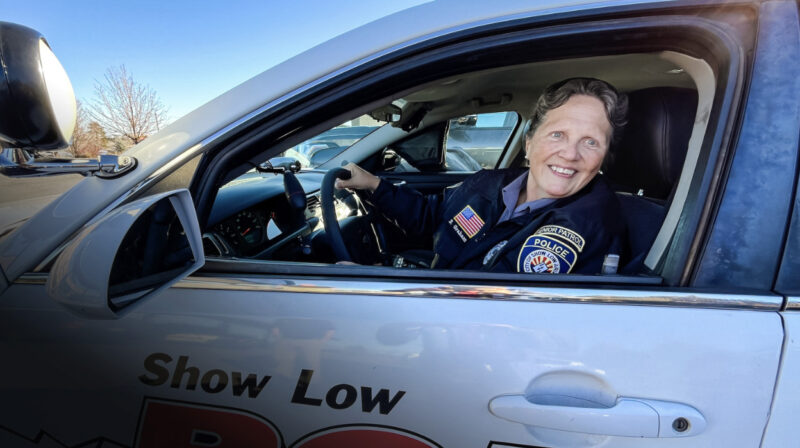
SHOW LOW, Ariz. — Beverly Graham spent years analyzing data in California’s prison system, and at 67 and retired, she isn’t yet done with law enforcement.
These days, as a volunteer in the Senior Patrol program in Show Low, Arizona, her main challenges are keeping homes safe, watching for porch pirates and burglars, and handing out an occasional disabled parking violation ticket.
“I’m one of the younger ones,” Graham said as she drove through one of the city’s many gated communities in a new patrol SUV provided by the program.
Her first stop was a grand suburban house nestled beneath tall pines. The absent owners had requested a watchful drive-by, hoping for peace of mind while they traveled.
Graham stepped out of the Ford Bronco, her crisp blue uniform neatly pressed and badge gleaming.
She climbed the front steps, tested the lock, then circled to the back deck to check the rear door.
Everything was safe and sound.
There were still dozens of homes to visit, parking lots to check, and long stretches of road ahead before the end of her shift.
“I have relatives that are in law enforcement. It’s just kind of in my blood,” said Graham, one of the program’s three sergeants.
In 1988, Show Low Police Chief John Corder and volunteer Bob Edwards came up with the idea to form a police auxiliary unit made up of retired seniors.
Residents and homeowner groups backed the idea, and the program started on July 7, 1989, with two volunteers.
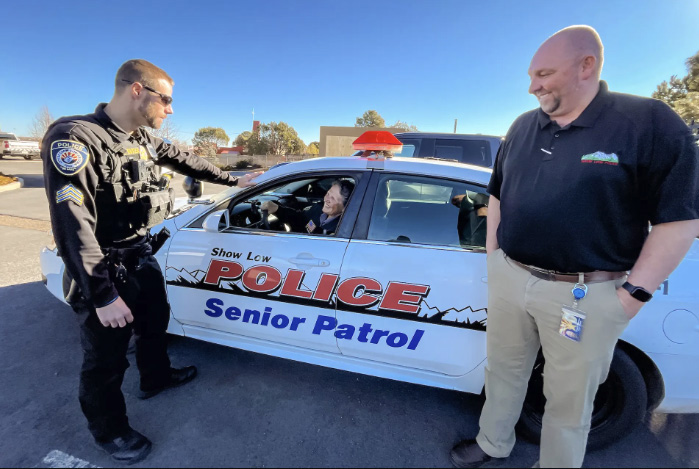
Today, 17 senior volunteers — soon to be 18 — patrol the city’s neighborhoods and parking lots in pairs, serving as the department’s eyes, ears, and goodwill ambassadors.
In 2025, they gave more than 8,000 hours of their time without pay. Their efforts allowed police officers to focus on other important work and saved thousands of dollars.
“It’s an awesome program. It’s been a great resource for us,” said Show Low Police Sgt. Justin Butler.
“Any time we need supplemental work done, whether it’s notifying people, checking houses, or traffic control, they’re always willing and able to help.”
Applicants must be at least 55 years old and in good physical health. Some current volunteers are in their 70s and 80s. Participants must also be willing to work four or five days each month and pass a background check.
Graham said she chose to become a senior patrol volunteer after she happened to meet a member while making rounds.
“They were driving through my neighborhood, so I waved them down. ‘What do you do?’ I said. They told me, and I turned in an application,” she said.
For Graham, volunteering was a way to get out of the house and stay active and engaged in the community.
When it comes to her career in law enforcement, she said, “I’m not done yet.”
Working with other volunteers makes her job even more interesting.
“We’re all from different backgrounds. Universally, we all have a heart of gold. We’re the neighbor you didn’t know you had. We’ll even pull in your trash can,” Graham said.
In their younger years, the Show Low senior police volunteers were logging truck drivers, mechanics and even flight attendants. Some had worked in law enforcement and missed the challenge.
Community Relations Officer Cameron Peterson, a retired Show Low police officer and detective, heads the program.
“Their primary role is house watch,” Peterson said. “We always have them work in pairs. And then they head out, and they have all of their neighborhoods organized. They’ll go and hit all of their house watches, [more than 300 in total].”
The program now uses three vehicles, usually older police “hand-me-down” cars, and will soon add two new Ford Broncos to the fleet.
The city provides uniforms for volunteers, and community donations help support the program.
Peterson said residents can request a vacation watch. Often, they’re concerned about burglars, as well as squatters moving into their properties while they’re away.
“I get phone calls fairly often from people with that concern. The first thing I tell them is sign up for a house watch with our senior patrol,” he said.
Mail and package theft from private homes is a widespread concern, Peterson said.
More than 104 million packages were stolen nationwide in 2024, according to a report by home security expert Safewise.
“If there’s something where it looks like there may have been a burglary or there could be a burglary in progress, [senior patrol volunteers] use the radio to call the police. We don’t want them doing any police action,” Peterson said.
“When people see flashing red and blue lights, they slow down.”
Show Low senior patrol officers not only secure property but also help with fingerprinting, transport chain-of-custody records, watch over school zones, and issue warnings or tickets for illegal handicapped parking.
Other Cities
The Show Low program is just one of many across the country where seniors step up to volunteer and make a real difference in their communities and police departments.
As property crimes climb, law enforcement credits these volunteers with making a meaningful impact.
In Chula Vista, California, senior volunteers help the police department by handling routine tasks, which allows sworn officers to conduct the “more critical aspects of public safety.”
“While these duties are generally not critical or hazardous, they are desired and appreciated by our citizens,” Chula Vista’s website reads.
These roles focus on support, not confrontation. Each volunteer receives training, a uniform, and a vehicle, ready to step in where needed.
From watching homes when people are away to helping with traffic, looking after schools, setting up speed monitors, and noting where graffiti is found, organizers say volunteers serve the community in many ways.
Volunteers must be at least 50 years old, complete a 40-hour training academy, commit to one year, and serve at least six hours each week.
Volunteers are unarmed, and they do not arrest people, make traffic stops, or issue tickets for moving violations.
A San Diego County grand jury survey found that senior police volunteers play an important role during times of “economic stress.”
Assigning routine tasks that do not require a police officer to be experienced volunteer patrol members allows officers to focus on critical safety responsibilities, according to the survey.
When senior volunteer patrol members conduct neighborhood patrols in marked police vehicles, they increase police visibility and reinforce the importance of safety within the community.
From 2013 to 2014, the survey reported that eight separate jurisdictions had 1,573 senior police volunteers. They contributed 453,384 hours of service, and the program cost $2,291,221.
According to the data from these areas, the work of senior police volunteers saved local governments more than $11 million.
“While the volunteer programs come at some cost to the sponsoring agencies, they save the community much more than they cost,” the survey reads.
“Program costs vary from agency to agency, but typically include items such as the cost of administering the program, uniforms, training, vehicles, and related costs such as fuel.”
The El Cajon Retired Senior Volunteer Patrol in California is a community program that draws on the skills and experience of retired seniors.
The program’s mission is to find, train, and keep skilled senior volunteers who use their abilities to help others and take part in community service projects.
RSVP members help law enforcement and prevent crime in El Cajon by checking handicapped parking, making sure vacation homes are safe, directing traffic, and teaching people about safety.