

Beyond the headline bonus, what will this account cost you? To price a checking account, start with the deposits and spending in your records, not the balance you hope for or an advertisement’s deposit schedule.
When you’re going through transactions for the first time, include quiet months. An account with a “no monthly fee” label can still charge you for cash deposits or for using an unfamiliar ATM. Get the money coming in and going out between paydays onto paper before you browse offers. What’s left after rent is the balance to use, not payday’s peak.
Online checking account fees need a yearly calculation
Turn ordinary banking behavior into a cost profile

From the last two or three months of transactions, list your direct deposits, then jot down the average and lowest balances beside them. Count ATM withdrawals and cash deposits separately. After listing transfers and overdrafts, add the transactions you’ve made internationally.
Total the recurring charges for a year of your usual banking before comparing online checking account bonuses. Do your records show you meet each fee-waiver condition? The promotion’s end date belongs in your notes, too.
Separate monthly charges from transaction charges

Keep a separate tally for maintenance fees. Wire and transfer fees go on your tally after you check overdraft costs and charges for items returned unpaid. Don’t overlook paper-statement charges. Stop-payment fees belong in that tally alongside out-of-network ATM and cash-deposit charges.
The year’s bill is any monthly fee you can’t avoid multiplied by 12, plus the other charges you’d pay for your usual banking. Before comparing that yearly bill with a bonus, check eligibility and any repayment or early-closing terms.
Test checking account minimum balance requirements
Don’t confuse the minimum deposit for opening your account with the balance you must keep in it. A minimum daily balance applies every day. Each day’s balance during the period counts toward the average daily balance; the fee-waiver balance is the balance needed to avoid a charge under the stated measurement method. One low day can violate a daily rule despite an adequate monthly average.
Before looking up the required direct-deposit amount, find out which deposits the account’s rules will count. Record the measurement period and deadline, too. Don’t count on transfers from another personal account qualifying the way payroll or government benefits do.
Access and digital service must work in real conditions
Map ATM and cash-deposit access
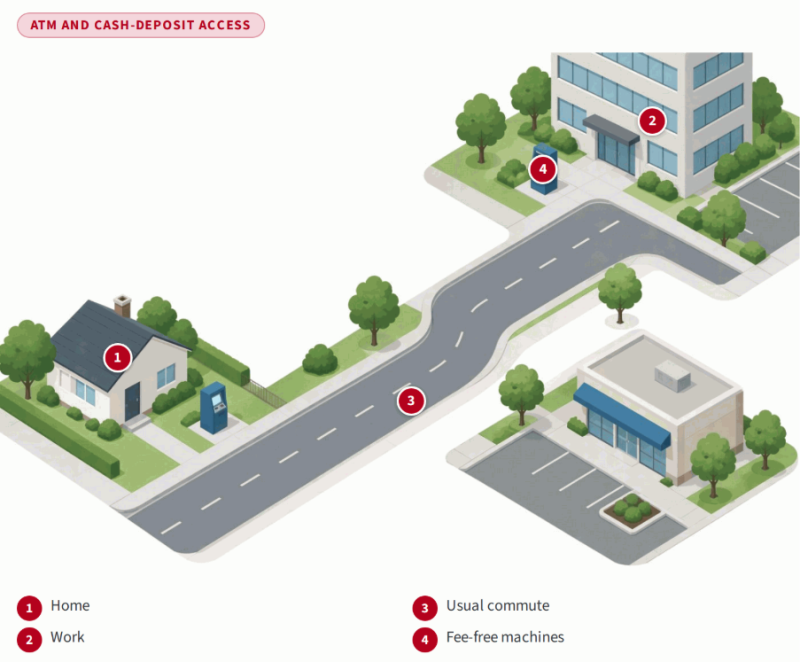
An online checking account’s ATM map needs to match the places you actually go. Check whether the fee-free machines mapped near home and work are along your usual commute. Give the ATM owner’s surcharge a separate line from the provider’s out-of-network fee; they’re different charges.
Check reimbursement limits and statement-cycle caps, plus international withdrawal rules. Check how you’d make cash deposits and what a participating location would charge. Being convenient for withdrawals doesn’t mean a spot also takes cash deposits.
Test mobile banking features for checking accounts
The FDIC’s 2023 household survey found that 48.3% of banked U.S. households primarily accessed their accounts through mobile banking. Overall, 70.5% primarily accessed their accounts through off-site channels, which include mobile banking along with online or telephone access.
Try the mobile banking features you actually need for your checking account. Check mobile-deposit limits and when deposited money is available before you turn to transaction alerts and card controls. In any available demonstrations, check how external accounts link and bills get paid. Check the app documentation for authentication instructions and note any mobile-deposit cutoff time beside the funds-availability policy.
Evaluate customer support before an emergency
J.D. Power’s 2025 U.S. Direct Banking Satisfaction Study put checking satisfaction at 692 on a 1,000-point scale. Regional banks trailed that score by 24 points, with national banks 35 points behind. Checking satisfaction was four points higher than in 2024.
Treat that score as a benchmark rather than an account recommendation. Once you’ve noted support hours and ways to make contact, ask about identity checks and escalating issues that aren’t resolved. Ask for specifics on when deposits become available or how a disputed transaction is handled before you apply. Ask whether they tell you to look in the account agreement.
Their answer needs to be written.
Confirm deposit insurance under the institution’s legal name
Don’t assume the banking app’s name matches the legal institution that holds your deposit. After identifying the institution, use the FDIC’s deposit insurance resources to check its status. Ask if money held at a credit union is covered by federal or state insurance. Put the account agreement’s legal institution name in your notes before applying.
A disciplined way to compare checking accounts
Compare the same fields for every account
You should first record the fees, access needs, and account features that matter to you. With that list, compare checking accounts, then verify current rates, fees, eligibility requirements, and disclosures with each financial institution.
The nonpromotional terms come first when you compare accounts. On a separate line, note when any bonus or promotional annual percentage yield expires and what you need to qualify. For linked savings, check the regular rate and transfer timing, including restrictions on access to funds.
One commenter discussing bonuses in r/personalfinance called bonus chasing low-effort but still warned, “You do have to keep track of who charges fees and make sure to avoid them for low balance or whatever.” Having several accounts to keep track of bothered another commenter in that thread.
Judge fit by behavior rather than advertising
The FDIC reported that 81.6% of U.S. households, about 109.1 million, were fully banked in 2023; those households had an account and hadn’t used the surveyed nonbank financial services during the prior 12 months. Another 14.2%, about 19 million households, were underbanked: they had an account but also used a surveyed nonbank financial service. The remaining 4.2%, about 5.6 million households, were unbanked, with no checking or savings account at a bank or credit union.
Having an account doesn’t mean it covers every financial service you need. Count outside check-cashing charges or money-order purchases when you add up banking costs.
Does your lowest balance meet the fee-waiver requirements?
Verify the full terms before applying
Complete a written account check
Fill every row for each account on your list. Before applying, verify any term you’ve left blank in the table against the institution’s current disclosures.
| Comparison field | Your expected use | Term to verify | Dealbreaker |
| Monthly and transaction fees | Estimated uses per month | Fee amount and waiver conditions | Expected annual cost |
| Balance rules | Lowest likely balance | Daily or average-balance method | Unrealistic threshold |
| ATM and cash access | Usual locations and frequency | Network and surcharges; reimbursement limits | No practical deposit method |
| Customer support | Preferred contact method | Hours and escalation process | No help when needed |
| Mobile banking | Required everyday tasks | Limits and alerts; authentication options | Missing required function |
| Deposit protection | Expected account balance | Institution name and insurance status | Unverified coverage |
| Direct deposit | Deposit source and amount | Qualifying type; deadline and measurement period | Cannot meet requirement |
| Linked savings | Planned transfer pattern | Rate conditions and transfer rules | Restricted access to funds |
Keep the fee schedule and deposit agreement, along with the promotional disclosure that’s current when you apply. Rates and terms can change, so choose using those disclosures, not an advertisement or comparison page.
Choose the account that survives the checklist
You’ll need to be comfortable using the account even when the promotion has ended. A tempting offer shouldn’t require you to change when you’re paid or maintain a balance your transaction history doesn’t support. Choose using the account details you’ve compared, rather than letting an advertised headline guide you. The account stays on your reject list until you have written answers about any unclear terms. Keep your account-opening confirmation with the completed comparison table and current disclosures after you’ve applied.