By Jack Phillips
Contributing Writer
More than a dozen states and municipalities have declared an emergency ahead of a powerful winter storm set to bring snow and ice across much of the eastern United States starting Friday and lasting until Monday.
As of Friday, 14 states had declared emergencies — Alabama, Arkansas, Georgia, Kansas, Kentucky, Louisiana, Mississippi, Missouri, New York, North Carolina, South Carolina, Tennessee, Texas and Virginia. Washington, D.C., also declared an emergency due to the storm.
“We’ve officially declared a Snow Emergency and a State of Emergency in Washington, D.C.,” said District of Columbia Mayor Muriel Bowser in a statement on X issued Friday. “A Snow Emergency, which goes into effect Saturday at noon, means residents must move vehicles off of Snow Emergency Routes.”
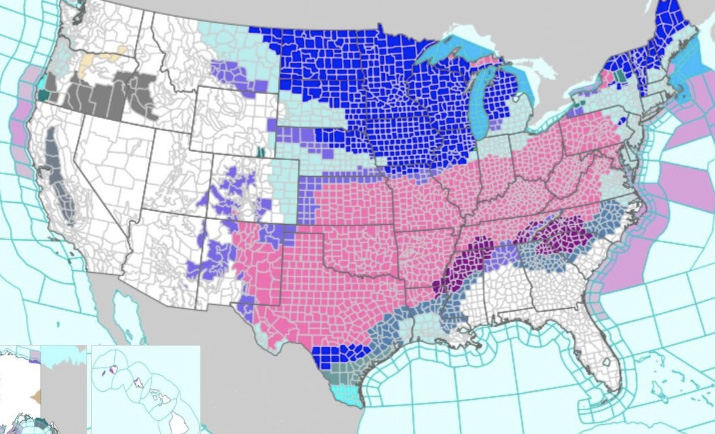
Ice, snow and sleet were expected to begin falling later Friday in Texas and Oklahoma. The storm was expected to move into the South with freezing rain and sleet, then move into the Northeast, dumping about a foot of snow from Washington, D.C., through New York and Boston through the weekend, the National Weather Service forecast on Friday.
New York Gov. Kathy Hochul, in declaring an emergency, advised residents on Friday to “follow all travel advisories and warnings from your local governments and stock up, and we don’t want to run on groceries.”
“So what I’m saying is go to the grocery store, stock up on food, water. Baby food, pet food,” she added. “Make sure you do not have any reason to go out into the extreme colds as it unfolds over Sunday and Monday.”
After the storm passes through the United States, frigid cold temperatures are expected to follow across much of the country, the agency also said. With wind chills factored in, temperatures are expected to plunge below zero degrees Fahrenheit in the Midwest and Plains states, it added.
“In the wake of the storm, communities from the Southern Plains to the Northeast will contend with bitterly cold temperatures and dangerously cold wind chills,” the weather service warned. “This will cause prolonged hazardous travel and infrastructure impacts.”
More than 1,000 flights nationwide were delayed or canceled Friday, with well over half of them in Dallas, according to flight tracking website FlightAware. The website listed more than 1,400 cancellations for Saturday, when the worst weather could start in busy Atlanta.
Utilities in the Southeast have also warned customers to prepare for possible outages. Duke Energy, which serves more than 4.6 million customers in North and South Carolina, urged residents to be ready for multiple days without power. The utility said more than 18,000 workers would be ready to respond once conditions are safe.
The Tennessee Valley Authority, which serves more than 10 million people across seven states, said it has invested hundreds of millions of dollars in weatherization since a 2022 winter storm in the state that was recognized as a federal disaster. Heavy rainfall that turned to freezing rain and ice accumulations caused widespread damage across seven counties. The Tennessee Valley Authority said it has implemented built-in redundancies to reroute power if a line goes down.
In Texas, CenterPoint Energy said it would send more than 3,300 workers to deal with the winter storm, and the Oklahoma Corporation Commission said it would be doing what it can “to protect consumers from a repeat of the effects of Winter Storm Uri,” using a Weather Channel name for the storm system.
Duke Energy said in a statement that millions of customers in the Carolinas should prepare for several days of outages.
“A quarter-inch of ice can bring down trees and branches onto power lines,” it warned. “A half-inch or more can weigh down the lines themselves.”
Similar problems can occur with 6 inches of heavy and wet snow, the utility said, adding that it has sent 18,000 workers to respond.
For customers in the two states, Duke advised them to prepare emergency measures, such as charging their phones, gathering flashlights together and getting extra batteries.
After any damage or outages, the utility again warned it would take some time for restoration to occur. It noted that the process could be delayed due to travel conditions.
“Our teams are tracking this storm closely, getting equipment and crews in place now so we can respond quickly once it’s safe. Because winter weather can change quickly, we want customers to have the information they need and be prepared before conditions deteriorate,” Duke Energy’s storm director Rick Canavan said in the statement.
The Associated Press contributed to this report.