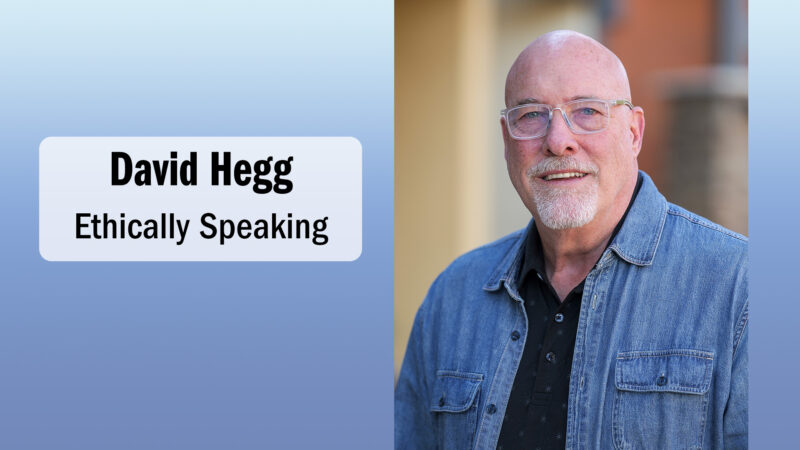
By David Hegg
Back in the 1960s, Joseph Fletcher, an Episcopal clergyman, proposed a new approach to ethics. Built on the assertion that love is the only absolute, Fletcher declared certain ethical norms can be violated if love dictates. This came to be known as “situational ethics.” While few could argue with the priority of love, this approach quickly deteriorated into pragmatism. The individual could decide how love factored into the situation and do as he pleased. Fletcher and his adherents were unable to quantify love, or better, they could not determine its rightful object. Love for what? Personal happiness or societal benefit? Love for truth or love for expediency?
Situational ethics has had an uncertain academic life since Fletcher’s sincere attempt to champion love. Today, it is seldom studied or discussed. But it is nevertheless prevalent in our daily lives. It is actively in play, and we can dispense with the fancy title and label it for what it is: an ethical compromise.
Today is Easter for many, Resurrection Sunday for some, and just another day to eat with family for still others. What started out as a Christian religious celebration of the resurrection of Jesus has dissipated into other things. My point is not to talk about the basis of this monumentally holy holiday. If you read this column, you know where I stand as a pastor and follower of Jesus Christ. This column intends to contrast the ethic of honest communication with the silliness of compromise.
An increasing number of agnostics, atheists and irreligious political liberals write books and protest against the existence of God. They proclaim the supposed arrogance and ignorance of religious folks who have the audacity to pour their faith into the bowl of political activity. Recently, we saw this as anti-religion activists stormed a Baptist church in Minneapolis with the intention of disrupting worship and goading the church family into behavior that would undermine their beliefs.
Additionally, we see those for whom religious pluralism – a constitutional rock in our country’s foundation – no longer applies to those who follow a biblical ideology. Recently, a famous politico’s wife said “Christianity is dangerous” and “evangelicals are dragging America backwards.” It seems the plan is to push historical Christianity to the margin of society, and preferably, off the page entirely. They rally supporters to unite against churches, schools, and other places where God and the trappings of religion are found. However, if they remain peaceful, this opposition is their right and privilege given that we live in a pluralistic country where every viewpoint has standing in the public square. Those who advocate for a Christianity-free society need to be consistent in their ethics. If there is no God, then when tragedy strikes, don’t try praying. Don’t ask others to pray with and for you. When cancer strikes your family, when terrorists strike, stand in front of the cameras and explain how this is to be expected given that the universe has no design, no controlling element. Explain how we should all take comfort in random chaos of the universe, that life has no purpose, no goal, and hence, no value in the long run. If you think Christianity and religion are just gobbledygook, be ethical enough to say so, and consistent enough to propose a reasonable alternative to faith, prayer, and the complex design of our world.
Today there are a number of Christian churches shaving the edges off their ethics, pulling a bait-and-switch as part of their celebrations of Jesus’ resurrection. They offer Easter egg hunts, appearances by the Easter Bunny, and – O yes – just a bit about Jesus. Come for the bunny, bonnets, and baskets … and stay for Jesus! I find this just as ethically reprehensible. Those who believe Jesus Christ rose from the dead, gloriously bringing eternal life to light, have no business thinking his story needs help from the Easter aisle at the supermarket. Since when can we have it both ways? Since when is it ethical to draw a crowd with the stuff of myth and secularism and then give them religion? The ethical compromise in such tactics is tragic.
Ultimately, ethical behavior is not situational. Above all else, we are to be true to our core values even when doing so is uncomfortable. It is only when we are consistent that there is room for meaningful dialogue with those with whom we differ. If the lines of our beliefs are blurred whenever pragmatism demands, how will anyone take us seriously? When it comes to this area of ethical behavior, I have much more respect for those who are consistent, even when wrong, than for those who believe their foundations can be abandoned at no cost.
And, for those of you who understand … He is risen! He is risen indeed!
Local resident David Hegg is senior pastor of Grace Baptist Church. “Ethically Speaking” appears Sundays.