By Zachary Stieber
Contributing Writer
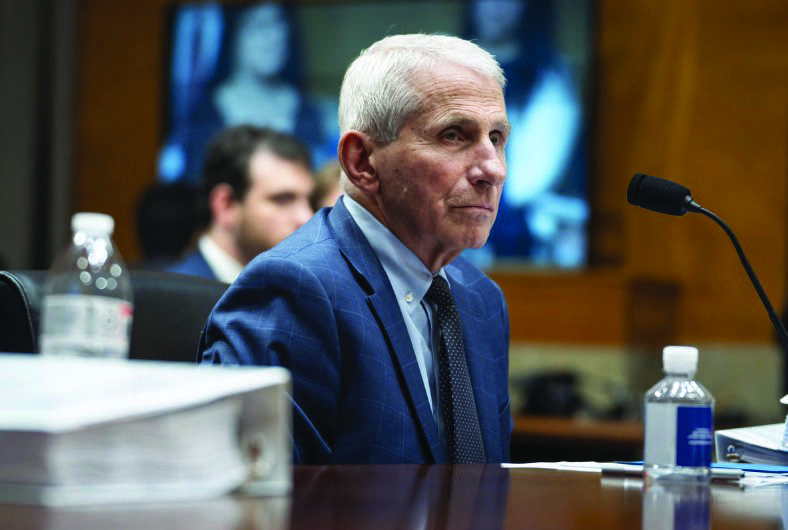
Dr. Anthony Fauci on Wednesday declined to answer questions from senators following the release of a diary he compiled while working in government.
“Although it pains me to do so, because of the respect I have for the legislative branch for government, and my decades-long record of cooperating with Congress, under the advice of my attorneys, I will invoke my right under the Fifth Amendment of the Constitution to refrain from answering your questions,” Fauci, 85, who led the National Institutes of Health’s National Institute of Allergy and Infectious Diseases from 1984 to 2022, said in his opening statement during a hearing in Washington.
The Fifth Amendment says no person “shall be compelled in any criminal case to be a witness against himself.” Fauci received a preemptive pardon in 2025.
“You don’t have any rights under the Fifth Amendment, because you’ve been pardoned,” said Sen. Josh Hawley, R-Mo.
Federal law makes it a crime for a person who is subpoenaed by Congress to “refuse to answer any question pertinent to the question under inquiry.” Fauci, who was appearing pursuant to a subpoena issued by the Senate Committee on Homeland Security and Governmental Affairs, could face misdemeanor charges under the law.
David Schertler, an attorney representing Fauci, was removed from the hearing for trying to speak to senators. Schertler did not immediately respond to a request for comment.
“The committee has issued a valid subpoena,” Sen. Rand Paul, R-Ky., the chairman of the committee, told Fauci. “They have requested your presence here. The questions are very pertinent to your decision-making as head of NIAID as well as a chief adviser to the president.”
He added later: “The committee will have to consider, after this hearing, what appropriate action should be taken against you for the failure to testify.”
The hearing unfolded following Paul’s release of a diary Fauci wrote while leading the government’s response to COVID-19. Diary entries undercut some of Fauci’s public comments, including his claim that he was never involved in the closure of schools.
In one entry in March 2020, Fauci recounted a conversation with then-New York City Mayor Bill de Blasio, writing that he “convinced him based on what I was saying publicly and my conversation tonight to close the NYC schools.”
Then he said he spoke with the chief of staff for California Gov. Gavin Newsom. The chief of staff “said that based on my TV appearances today and yesterday, the governor has decided to close the schools in California as well as the bars and restaurants,” he said.
Fauci also outlined a call he held with scientists shortly after COVID-19 was detected in Wuhan, China, writing that nine of 11 of the scientists said that it was possible humans inserted a feature of the virus called the furin cleavage site. A research proposal later made public went over experiments that would insert a furin cleavage site into a bat coronavirus, with work potentially taking place in China.
“This was either an extraordinary coincidence, or a smoking gun,” Paul said on Wednesday.
Fauci repeatedly said in public that COVID-19 likely came from nature, not from a lab, and said his agency never funded a class of risky experiments called gain-of-function.
President Donald Trump wrote on Truth Social on Wednesday that from the beginning, he said COVID-19 came from a lab in Wuhan.
“Fauci strongly disagreed, always trying to protect China,” he wrote.
The NIAID funded risky experiments in a laboratory in Wuhan, and adequate oversight was not carried out for the experiments, an inspector general determined.
“Your primary concern was hiding the fact that you approved funding for this dangerous research,” Paul said.
Sen. Gary Peters, D-Mich., the top Democrat on the panel, said that Paul’s investigation into the origins of COVID-19 was aimed at reaching a predetermined conclusion and was biased.
He also said that the government needs to work to improve efforts to prepare for future health crises and should conduct oversight on actions taken by the Trump administration on vaccines and other health issues.
“I could go on, on all the topics that we need to be looking at moving forward to protect this country,” Peters said. “We’re not doing that in this committee. That’s what this committee was designed to do; that’s what it has done throughout history. We should get back to that.”