By Travis Gillmore
Contributing Writer
More than 13,000 miles, 12 flights, five rental cars, and 23 hotels — that’s the math behind this effort to follow President Donald Trump on his recent midterm campaign tour.
As the president has participated in near-daily rallies to boost support for GOP candidates with less than a week left before the midterm elections, reporters covering the beat are scrambling to keep up with the grueling schedule.
The rally travel began when the president returned to the United States from Ireland last month, with a stop in Gastonia, North Carolina, on Sept. 16.
“In this election, I’m asking you to pretend I’m on the ballot just one more time,” Trump told the crowd, using a line he would repeat across the country. “Because, essentially, I am.”
A stop in Mobile, Alabama, on Oct. 2 marked a return to the area where his mega-rallies were born in 2015.
“It all sort of began here,” Trump said. “We packed the stadium, and the rest was history.”
Throughout the tour, he touted tightened border security, record stock market highs, and policy achievements, including lower taxes, reduced regulations, and investments, while endorsing local candidates.
He warned that Democrats would reverse the gains his administration made over the past 22 months.
“This is the most important midterm in the history of our country because we’ve gotten more things done, and they can undo them if we start losing an election, especially this one,” Trump said in Kentucky.
The congressional balance of power is at stake on Tuesday, with Republicans holding a 53-47 seat majority in the Senate and leading the House of Representatives with 218 seats to the Democrats’ 214.
Crisscrossing the Country
Many stops were in traditionally red states, with polling showing competitive races in Mississippi, Ohio, North Carolina and Texas, among others.
While sitting presidents have long campaigned for midterm elections, the 45th and 47th commander-in-chief chose an intense schedule this cycle, focused on concentrating support among his base supporters.
Trump gave lengthy speeches, often topping 90 minutes, using his personality-driven approach with comedic asides and off-the-cuff humor throughout his addresses.
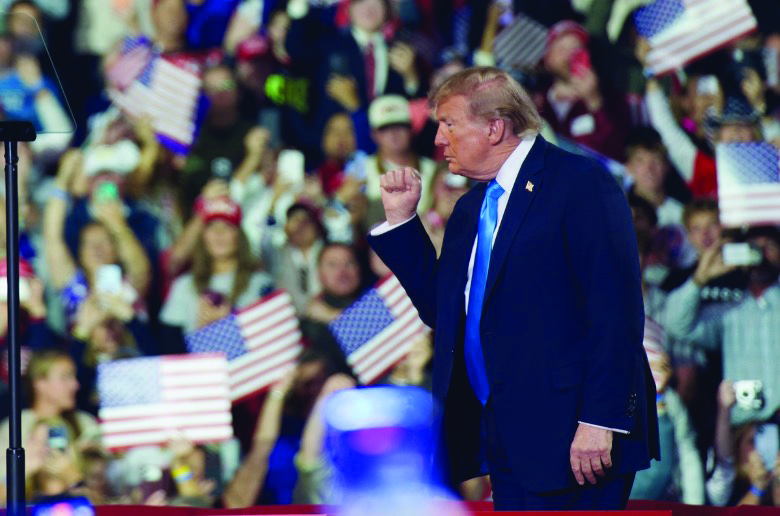
Thousands attended in every city, with crowd sizes ranging from a few thousand to tens of thousands. In many locations, organizers turned thousands away after venues filled to capacity.
More than 100,000 people showed up to the 12 rallies this reporter attended in recent weeks. Many wore Make America Great Again hats, and others caught one of many thrown out to the crowd by the president during his appearances.
Schedule updates were often provided just days in advance of appearances, giving the media and the public short notice.
Checking for new rally dates throughout the day, booking last-minute travel plans, and finding routes to the next site became routine elements of a reporter’s existence while covering the Trump tour.
The president often returned to the White House after midnight, while reporters scrambled to find hotels near the next stop. Then Trump prepared for another day to lead the nation from the Executive Mansion before jetting off on Air Force One to another event.
Rallygoers ranged in age from infants to more than 100 years old, and many were there to see Trump in person for the first time.
Christy Sills of Bonaire, Georgia, is new to politics and came to hear the president speak after learning of his border-security agenda.
“I would like to see more illegals taken out of the country,” she said during a rally in her home state. “I don’t like how people that are not born here are getting all the benefits that we should have.”
Others echoed her concerns, with immigration a hot topic among supporters congregating outside rally sites in the early morning hours.
Vendors selling Trump and MAGA merchandise lined the venues, and many parking lots had a tailgating party atmosphere, with some people lining up 10 hours before the doors opened to secure access.
Along more than 4,800 miles across 18 states from town to town and chatting with Americans, it was evident many were unaware the president was coming to their area, and some only found out when the roads were shut down to accommodate the motorcade.
“I had no idea he was in Corinth, or I would have gone,” Bill Rayburn of northern Mississippi said.
Messages nationwide echoed common themes: inflation, fuel prices and the Iran war.
Many said the cost of living was the most important issue in this election.
“It’s gas, housing and food,” said Jacob Walker of Memphis, Tennessee. “We’re struggling out here.”
Key Announcements
Rallies included speeches by local candidates, and Trump often delivered economic announcements and breaking news during the events.
Auto manufacturer Audi timed its $4.2 billion investment announcement to coincide with Trump’s rally in Perry, Georgia, on Oct. 24.
“This will be the single largest investment in U.S. auto industry history, modern history,” Trump said at the time.
At a rally at the Pinnacle Bank Expo Center in Grand Island, Nebraska, on Oct. 5, Trump signed an executive order expanding access to tax-exempt, red-dye diesel for all uses, including on-road vehicles.
The $8 billion Harvest Fuel Relief program was unveiled near Wichita in Park City, Kansas, on Oct. 19. The move will give farmers a formula to recoup some diesel costs.
“And when the Republicans win, we will pass even more funding for our farmers,” Trump told the crowd.
Other promises include $5,000 checks for every adult citizen if the GOP maintains control of Congress.
At a rally in Youngstown, Ohio, on Oct. 12, Trump announced a plan for federal agencies to support the local energy utility SOBE Thermal Energy Systems, which faces financial and maintenance challenges. The provider services buildings downtown, including city hall and the police department.
The Treasure State is the site for a new “super range” for weapons testing, Trump told a crowd in Kalispell on Oct. 14.
“Montana will help ensure the American military always reigns supreme,” he said during the rally.
The sitting president also teased Kentucky voters with a $100 million pharmaceutical investment, contingent on a Republican victory in the midterms.
“That’s a big revitalization project,” Trump said during a rally in the Truist Arena at Northern Kentucky University on Oct. 17. “But if the Democrats win … they wouldn’t be able to do it. They wouldn’t even know what you’re talking about.”
Mr. Wall
One fixture at the rallies is Blake Marnell, better known by the nickname Trump gave him: “Mr. Wall.”
“I wanted something to troll leftists, so I came up with the idea for a wall suit, and I looked it up, and that’s what it was,” Marnell, 62, of San Diego, said about his custom suit-and-tie outfit emblazoned with bricks, which he first started wearing to Trump events in May 2019.
The border security and First and Second Amendment advocate plans to donate the suit — which he wore in Butler, Pennsylvania, in 2024 during the assassination attempt on Trump’s life and also on the nominating floor during the Republican National Convention — to the Trump Presidential Library.
The president mentions “Mr. Wall” at most gatherings and usually says that he wants one of the suits to wear on stage.
Marnell said he’s working on a bespoke version of the ensemble for Trump, with an idea to send the fabric to the president’s tailor.
“I want him to open up the suit and look in and see the label of his tailor and know that it’s deluxe,” he said.
Marnell drove more than 12,000 miles to attend 17 rallies, as of the Rock Hill, South Carolina, event on Thursday, but hasn’t kept track of the exact number he’s made over the past seven years.
Protests
Individuals opposed to the president’s policies voiced their opinions in groups ranging from dozens to hundreds at each event. Several chose to bring their activism closer to the action by sneaking into the rallies, pretending to be supporters, then interrupting the events by screaming or unfurling signs.
As security protocols strengthened later in the tour to identify potential protesters before they entered the arenas, some would-be disrupters began dressing like Trump supporters and wearing MAGA gear to blend in with the crowd.
A protester wearing a MAGA hat, who goes by Robby Roadsteamer online, interrupted the Chillicothe, Ohio, rally on Wednesday by yelling about the Epstein files, a common theme of protests in recent weeks.
Nikki Reed, 62, of Virginia Beach, said she came to the Highland Heights, Kentucky, event to protest because “things need to change.” Security removed her shortly after she stood on chairs and displayed a painted jacket to get Trump’s attention.
While the president routinely dismissed protesters as paid agitators, saying the activists were receiving $250 for their actions, Reed rejected that notion.
“I came on my own volition, you know. I spent a lot of money to be here. A lot of gas money,” she said. “I think it’s really important to say I’m not paid to be here.”
To prove her point, Reed showed dozens of receipts from ActBlue, the Democratic Party’s donation platform.
“I pay them,” she said.
Most of the protesters were removed without incident, though a few were roughed up by attendees before security arrived.
One unidentified rallygoer landed a punch on Oct. 21 in South Carolina, disrupting a protester.
“That was incredible,” Trump said at the time, telling the supporter the combination reminded him of former boxing champion Evander Holyfield, who was in the crowd.
Boxing legend Mike Tyson appeared with Trump in Syracuse, New York, on Oct. 9 in the president’s first stop in the region since the 2016 campaign trail.
Other celebrity appearances included Dennis Rodman in Oklahoma, Nicki Minaj in Michigan, Darryl Worley in Mississippi, and Jon Gruden in Ohio.
More stops are planned for Florida, Iowa and Kansas. The latter two were briefly scrapped, but a last-minute scheduling change will see the president continue the tour before transitioning to tele-rallies over the final weekend before voters have their say on Nov. 3.