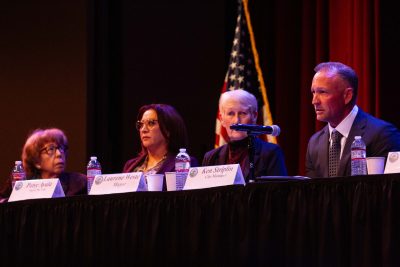
On Nov. 17, state officials came to Santa Clarita for a town hall on the proposed eight-story courthouse on McBean Parkway. It was a rare chance to stand in front of the people who decide how state money is spent in our valley and tell them, face to face, what we think.
Before that, I invited the young people who have been speaking out against Flock license-plate cameras and immigration enforcement to join me. They say they want less government. Here was a half-billion-dollar government building, and the officials responsible, in a room in our own town.
Hundreds showed up, filled the room, stood at the microphone, and made sure the state heard their voices. Not one of the young people I invited was among them.
Instead, that week, I learned they were holding a walkout during school hours, as they did last year. I understand the appeal. A walkout is visible, feels powerful, and shows how many people care. But it is fair to ask what last year’s walkout changed. Little, if anything. Students lost a day of class, and officials who make decisions were not there to see it.
Meanwhile, the conversation has too often turned to personal attacks. It hasn’t stayed online. For the six weeks before the town hall, public comment at City Hall, every two weeks, became a forum for personal attacks rather than arguments about issues. They proved they can show up and take the microphone. What’s missing is using that time to persuade. I am not writing to complain. I am writing because I believe these young people care about this community, and I want their advocacy to work.
It is fair to ask who benefits. A clip of a heated public comment or a walkout gets shared, liked, and clicked. It does not change a contract or move a building. I worry that some of these young people are being used as content for shares and clicks rather than supported as advocates. Some of that is coming from adult-run activist pages that promote them online. Those adults may believe in the cause, but they are misguiding these students and using them as pawns. So I will ask them directly: do you want to advocate, or do you want to be influencers? Only one of those changes anything.
I grew up in Santa Clarita. I remember being young and certain, frustrated that the adults in charge weren’t listening. That frustration is often justified. But energy alone doesn’t change a vote, a contract, or a building plan. Method does.
Start with the hardest truth: personal attacks don’t work. They hand decision-makers an easy reason to dismiss you, make potential allies hesitate to stand with you, and turn the story from your issue to your tone. The council member, the deputy, and the neighbor who disagrees with you all live here too. You can be fierce about ideas and still be decent to people. That combination is the most persuasive thing there is.
What does work?
Know who decides. No city council can direct ICE; immigration enforcement is federal. But state law already limits how local agencies cooperate with it and how license-plate data may be shared. Camera contracts, data-access rules, retention periods, and audits are decided locally, at public meetings. That is where a local ask can win.
Go where the decision-makers are. A walkout happens on a sidewalk. A public meeting happens in front of the people with the power to say yes or no, and your words go into the official record. In many processes, agencies are legally required to respond to written comments. A walkout can be ignored. A comment has to be answered.
Lead with facts and a specific ask. “This is wrong” is easy to dismiss. “Your own study ranked a different option higher; explain why you changed course” is not. In the courthouse fight, the most effective evidence has been the State’s own site study, which ranked a different location first. The strongest proof is often the other side’s own words.
Show up after school, not instead of it. Public meetings are held in the evening for a reason. Fifty students speaking to the issue at a council meeting, on the record, carry more weight than on a sidewalk at 12:30 pm.
Build coalitions. People who want less government come from every corner of this valley: taxpayers worried about a $519 million courthouse, neighbors worried about surveillance, families worried about enforcement. Find them, even if you disagree on everything else.
Stay with it. Change takes comment periods, follow-up letters, and showing up again. The Draft Environmental Impact Report for the courthouse is expected in January, with a 45-day comment window. That is a real opening, and anyone can use it.
None of this requires softening your convictions. It asks only that you put your passion where it produces results.
So here is my offer. I would like to sit down with any student or group who wants to make a difference on cameras, immigration, the courthouse, or any other local issue. No cost, no lecture. A library or a coffee shop, after school. I will walk you through how to find out who decides, how to write a public comment that gets answered, and how to speak effectively at a meeting. Bring your strongest disagreements with me. I would rather hear them across a table than read them in a comment thread.
Santa Clarita’s future belongs to its young people far more than it belongs to me. They deserve a real seat at the table, and they can earn one. The state officials came to town, and hundreds of their neighbors were heard. Next time, I hope the students are not only in the room, but ready to use it: learning how to advocate in ways that bring real change.
They are our future, and this valley needs them to lead it well.
Steffanie Stelnick is a Santa Clarita native and attorney with the Law Offices of Steffanie Stelnick in Valencia.